Showing posts with label Modern Greeks. Show all posts

Monday, September 22, 2014

Apostolos Mousouris

Apostolos Mousouris
Apostolos Mousouris participated in the battles of Grammos during the Greek civil war(1948,1949) as a photographer and took some photos of great historical value.Apostolos took many pictures and the majority of them is characterized as being human centered. He records moments from the daily lives of the fighters of the democratic army. The daily life of a Democratic army fighter consisted mainly of war training.
Mousouris was born in Syros in 1917. His father a teacher was a friend of Demetris Glenos who was a famous communist.Glenos hid in the family house in Syros as communits were considered criminals. It was there that Mousouris appreciated his personality and got inspired by his ideology.Mousouris bcame a member of the communist party when he was a law student in Athens. His degree was indifferent for him as his biggest passion was cinematography.
He started doing voluntary work at Finos film studios and there he learned the art of camera.In 1944 when the WW2 ended and Greece was liberated he opened a photography shop.During the battle of Athens(December 1944) he was a war correspondent. In 1948 he joined the Democratic army of Greece as a war correspondent. 
After the end of the civil war and the defeat of the communists, Mousouris went to Uzbekistan where he continued to work as a cinematographer. Later he moved into Moscow where he became a journalist.
Women fighters of DSE


Tuesday, August 6, 2013

The Greek captain of the early U.S navy.

 George Colcovoresses


George Colvocoreses (Γεώργιος Κολβοκορέσης) was a Greek-American officer of the US navy.He was born on 22 October 1816 in Chios, descended from a noble family.During the Chios massacre by the Ottomans he was caught by the Turks along with his 2 sisters and his mother.His remaining 6 simblings were all killed.His family's property was destroyed and confiscated.

His father,with the assistance of American missionaries,achieved to release him when he was 8 years old and sent him to Baltimore in U.S.A.There he was adopted by the lieutenant Alden Partridge who was the founder of the American scientific and military academy(nowadays university of Norwich) which was the first private military educational institute in U.S.A. In 1831 he graduated and was accepted in the ranks of the American navy.In 1832 he was appointed as a recruit and in 1836 he served in the frigate "United States" which was part of the U.S naval unit of the Meditteranean which would later become the 6th fleet.From 1838 until 1842 he served in the research team of the U.S.A in the Pacific Ocean.His impressions were illustrated in a book that he wrote bearing the title:Four years in a Government Exploring Expedition.
The outbeak of the American civil war found him fighting for the North.On January 29,1862. He was captain of the frigate USS Supply and achieved to capture a transport ship of the South which was carrying war supplies.In 1864 as captain of the warship Saratoga he was distinguished  in many naval missions.In 1867 he retired with the rank of the captain.
George Kolkovoresis was assassinated on June 3,1872  at Bridgeport of Connecticut while waiting for the ship for New York.Initially his death was attributed to suicide. The case is still unsolved today.He got married twice and had 4 children.
Three of his descendants followed a military career. His son George Colcovoresses reached the rank of admiral and his great grandson Alden  Colcovoresses became a colonel.
In his honor a sea strait in the Piugit canal of Washington state was named Kolvos passage and a gulf in Antarctica was named Colcovoresses bay

 George Colcovoresses' grave

Προς τιμή του, ένα θαλάσσιο στενό στον Πορθμό Πιούτζιτ της πολιτείας της Ουάσινγκτον ονομάστηκε «Πέρασμα Κόλβος» (Colvos Passage), καθώς κι ένας κόλπος στην Ανταρκτική (Colvocoresses Bay).

Sunday, April 7, 2013

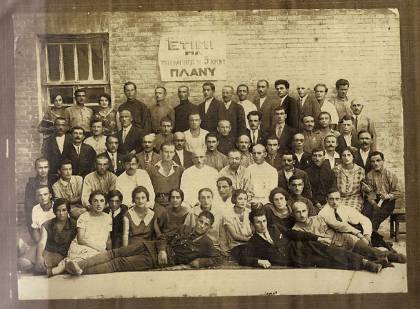
The Greeks in Soviet Russia and the Greek Soviet culture of the interwar period.

John Pasalidis with his wife and son in Sochumi.

An unknown subject of Greek historiography is the activity of Greek communist organisations in Soviet Union until 1937.


 Thousands of Greek refugees fled in USSR after the Asia minor disaster of the Greek army and the subsequent victory of Turkey.From the beginning, a Greek Bolshevik leadership organised to develop culturally and politically these Greek communities.
Thus a significant and populous Soviet hellenism was created, fully autonomous from the Greek state's influence(which was under Western influences). This Soviet Hellenism became a special Greek center with an unconventional social structure. It became a refuge for leftish Greeks from Greece . The Greek communities were governed by Greek communist party organisations which took bold decisions such as the implementation of a simplified Greek language and the reduction of the letters of the Greek alphabet in the education system.

Over than 300.000 Greeks

The Greeks  were one of the 160 ethnic groups that lived in the Soviet Union.The Greeks themselves belonged to distinct regional groups like the Pontian refugees , the Greek immigrants, the native Greeks of Mariupol , the refugees from the Asia Minor tragedy and self exiled Greek communists from mainland Greece.
Their exact numbers are difficult to be calculated. It is estimated that they numbered between 300.000 and 400.000 from which the 80% were farmers and one third had Greek citizenship .
This part of history remains unknown for the Greeks because later even though the Greeks embraced the principles and values of communism, they fell victims of the racist policies of Stalin and secondly Greek historiography was always introverted and state oriented(not nation oriented). Greek history never accepter the ecumenism and the cosmopolitan character of the Greeks beyond the Greek state's borders. The history of Greeks outside of Greece stops in 1922 for the Greek historiography.Generally this is a widely accepted technique in the science of historiography as we proceeded into a world were multi-ethnic empires crumbled and solid nation states were created.
In the interwar period the Greek communists governed the Greek communities for at least 20 years.The national policy of the Soviet union favoured the political representation of the different nations .Thus the greek communist party organisations essentially shaped new social structures altered  the cultural development and generally created a Soviet Greece at the coasts of the Black sea(where the majority of the Soviet Greeks were settled).
The Greek society of Soviet Union was reduced in numbers during 1919-1922 when many Greeks decided to repatriate.Those who remained back tried to combine the necessity for Greek education with the dominant ideology of communism.Those intellectuals who starred at this effort were Georgios Skliros, Giannis Passalidis, Giorgos Fotiadis, Giagkos Kanonidis,Vladimir Triantafilov, Nikolaos Anastasiadis and Orionas Alexakis.They made a remarkable effort to explain the Greek cultural and political heritage from a communist point of view..
Already since the October revolution(1917) there was activity of bolshevik friendly societies in the Greek communities.Especially the Greeks of Georgia and Kars supported with all heart this revolution.
The period after the victory of the Bolsheviks was characterised by the efforts of the Soviet-Greek scholars to construct a Greek-Soviet education system and an independent GrecoSoviet culture.Initially the center of this effort was in southern Russia,the valley of Kouban and the region of Krashnodar.This attempt was developed in the context of a national policy over the organisation of the Greeks as special groups in the communist party.
Significant centers of the Greek community were in the area of Kouban around the town of Krimskaya and in the area of Mariupol.20.000.Many Greeks were living in Crimea in cities like Kerch , Eupatoria and Sevastopol. In Caucasus most of the Greeks were living in Georgia.90 villages in Georgia were Greek.

The end

When Stalin rose to power the national policy was shifted.The Stalinist policy promoted the Sovietization of all the minorities and ordered the closing of schools churches and printing press enterprises.Most of the Greeks of Russia who came there as refugees persecuted by the Ottomans suffered a new persecution. Most of the Greek community was displaced in the depths of Asia(Kazackstan and Siberia) and the prominent members died in labour camps in Siberia.

The autonomous Greek regions

The concentrations of big populations of the Greek community in certain areas favoured the creation of autonomous Greek administrative areas.
Assembly of the Greek workers in Kolchoz(Soviet guild).The poster in Soviet Greek writes the motto of the guild."Ready for implementing the five years plan"


Until 1938 there were 4 autonomous Greek regions. Initially in 1928 there were three autonomous regions in southern Ukraine in Donnetsk and in Mariupol. This decision was taken by the central executive comittee of the Soviet republic of Ukraine.However the most significant Greek administration was in the region of Kouban were a Greek town called Krimsk became the center of the Greek region(Gretseski Rayion). In this area Greek was spoken everywhere and even the street the shop and school signs were written in Greek.

The majority of the population were Greeks and was estimated at 60.000. It's characterization as Greek area rendered Krimsk a magnet that attracted many Greek immigrants.In 1937-38 though most of the Greek party members would be executed as part of Stalin's persecutions.

Agtzides Vlassis.2013.Οταν οι Ελληνες Κομμουνιστές πήραν την εξουσία.Ελευθεροτυπία.January 27 2013
  • translation done by the blog owner

Saturday, April 6, 2013

An uknown heroine of the Greek independence war


Domna Visvizi

Domna Visvizi was a pretty much uknown heroine of 1821. She was the wife of the shipowner Antonios Visvizis.
She followed her husband during in all his military operations on the sea.When her husband died she took the role of the commander of their ship which was called Kalomira(good fortune)."During the siege of Euripos a city in Euboea, Antonios Visvizis was killed by Ottoman fire. At that moment Domna got in front and ordered the crew to continue fighting.Specifically she said: Take my husband down to his sons to cry for him, i'll have time to cry for him after we win this war."

During the independence war her ship was active in the North-eastern Aegean. In 1823 before retiring she put her ship under command of the Greek government which converted it into a fireship. With that ship Andreas Pipinos achieved to burn the Ottoman frigate Hazine Gemisi in 1824.

Domna Visvizi never forgot her role as a mother. She tried to send her son in England for studies but eventually he was sent in Paris.Before leaving for France she left a note for him saying:My dear son, when you return back perhaps i'll be dead. Avenge the death of your father.
After the independence of Greece she had many financial problems.Initially she lived in Nauplion in Hydra in Syros where her son lived and she ended up in Piraeus where she died poor in 1850.Demetrios Ypsilantis described her as a noble and polite woman.

Nowadays there is a statue of her in the "highway of heroes" in Athens.

Monday, March 25, 2013

The tragic end of the heroes of the war for the Greek independence.


Boubouli_Anntroutsos(an article from Greekreporter.com)
The Greek War of Independence commenced in 1821 and waged until 1832 when the Greek free state was finally established under the blessings and the needs of the then powerful allies of the Greek revolutionaries, the British, the French and the Russian. The national day celebrated on March 25th pays tribute to all men, women and children who lost their lives for the dream of a sovereign free country, and especially to the heroes of the Greek Revolution that risked their lives for freedom from the Ottoman Empire. But as always, there are black pages in every history book of the world, and Greece’s were not an exception. Although it goes mostly unnoticed, the fact is that many Greek captains of the Revolution were sent to jail during and after the war against the Ottomans. Others were pushed aside by the newly formed state as too dangerous for the common good or too unpredictable for the reigning forces.
Here follow some of the most exemplary and tragic stories of the Greek captains of 1821, who ended up underprivileged, captured, begging on the streets and even dead.
Nikitaras
Nikitaras
Nikitas Stamatelopoulos or Nikitaras or the Turk-eater died in September 25, 1849, totally forgotten and poor.The brave and honorable man who stood out in the battle of Dervenakia and was told to have broken three swords with his fury in the battlefield, was groundlessly accused of conspiracy against King Otto and was sent to prison first in Palamidi (along with his uncle and Revolution captain Theodoros Kolokotronis) and then on the island of Aegina.
When the then Greek Prime Minister Ioannis Kolettis asked him to kill a rival and former captain of the Greek Independence war, Odysseas Androutsos, in exchange for a government position, Nikitaras refused the offer and became angry with Kolettis. He also refused to take booty after the victorious battle of Tripolis, a normal practice of Balkan irregulars at the time.
 4.1.2
Odysseas Androutsos
Nikitaras was released from prison in 1841, but the period in jail broke his health and he was almost blind due to diabetes problems. The Greek state refused to grant him and his family any descent pension to make a living, but instead allowed him to beg before a Virgin Mary church every Friday. In 1843, when King Otto was forced to sign the Constitution, Nikitaras was given the title of major general and an insignificant pension. He died in 1849 in Piraeus.
A major hero of the Greek War of Independence, Odysseas Androutsos earned the title of Commander in Chief of the Greek forces in Roumeli, but his glory did not last long. His intense personality and constant conflicts with the “kalamarades” as he called the politicians and the clergy resulted in making him suspicious of the politics followed at the time. In spring 1822 Ioannis Kolettis accused him of betrayal and cooperation with the Ottomans, so that Androutsos gave up his title as Commander in Chief but never gave up his fighting against them. Seieng through the scheming of politics, Androutsos retired in a cave, the Black Hole, totally disappointed with the newly emerged state of the Greeks after the independence war.
There, in his cave north of Parnassus Mountain, Androutsos’ isolation made Kolettis and his enemies even more suspicious of his intentions and soon he was accused of making agreements with the enemy against the interests of the Greeks. Androutsos, however, is said to have called for the cooperation of the Ottomans in order to take them by surprise and fight them from the inside. The arrest of Kolokotronis made Andoutsos even more hostile towards politicians. Then the government in 1825 assigned to Yiannis Gouras, a close lieutenant of Androutsos, with the mission to take care of Androutsos. Androutsos finally surrendered to the government forces and was led to an Athens prison. Karaiskakis, another major figure of the Greek Independence war, was outraged by his imprisonment and even attempted to rescue his fellow fighter. The attempt failed and to cool things down Gouras asked for the government’s help.
The trial date for Androutsos was pending now, but on June 5 at midnight Gouras gave the order and five men including an unknown priest entered Androutsos’ cage and killed him after hours of torture. The lifeless body of Androutsos was then pushed off the prison tower of Goula down to the Temple of Athena Nike of the Acropolis. Androutsos’ death was declared as a failed escape attempt.
Bouboulina_Friedel_engraving_1827
Lascarina Bouboulina
Laskarina Bouboulina was a Greek naval commander and heroine of the Greek Revolution. Being married twice to prosperous husbands, Bouboulina bought arms and ammunition at her own expense and brought them secretly to the island of Spetses on her ships, to fight for the sake of her nation. Construction of her ship Agamemnon was finished in 1820. She bribed Turkish officials to ignore the ship’s size and it was later one of the largest warships in the hands of Greek rebels. She also organized her own armed troops, composed of men from Spetses. She used most of her fortune to provide food and ammunition for the sailors and soldiers under her command.
The people of Spetses revolted on 3 April, and later joined forces with ships from other Greek islands. Bouboulina sailed with eight ships to Nafplion and began a naval blockade. Later she took part in the naval blockade and capture of Monemvasia and Pylos.
When the opposing factions erupted into the second civil war in 1824, the Greek government arrested Bouboulina for her family connection with now-imprisoned Kolokotronis; the government also killed her son-in-law Panos Kolokotronis. With the order to be arrested, she was exiled back to Spetses poor and disappointed by the new Greek reality. In 1825, while Ibrahim Pasha of Egypt disembarked in Pylos in a final attempt to smother the revolution, Bouboulina began preparing for new battles despite her animosity towards the politicians. However, on May 22 of the same year, Bouboulina would die a tragic death. Her younger son from her first marriage fell in love with the daughter of the powerful Koutsaios family of Spetses and the couple fled to the house of Bouboulina’s first husband. Bouboulina and the Koutsaios soon arrives at the house and after a long and furious dispute, Ioannis Koutsis shot her in the head fatally. The case was closed and no-one ever put the perpetratorson on trial.
Friedel_-_Manto_Mavrogenous
Manto Mavrogenous
Manto Mavrogenous was a Greek heroine of the Greek War of Independence. A rich woman,who spent all her fortune on the Hellenic cause. Under her encouragement, her European friends contributed money and guns to the revolution. When the struggle began, she went to Mykonos, the island of her origin, and invited the leaders there to join the revolution.
She equipped, manned and “privatized” at her own expense, two ships with which she pursued the pirates who attacked Mykonos and other islands of the Cyclades. She also equipped 150 men to campaign in the Peloponnese and sent forces and financial support to Samos, when the island was threatened by the Turks. Later, Mavrogenous sent another corps of fifty men to Peloponnese, who took part in the Siege of Tripolitsa and the fall of the town to the Greek rebels. She spent money on the relief of the soldiers and their families, the preparation of a campaign to Northern Greece and the support of several philhellenes. She also sent a group of fifty men to reinforce Nikitaras in the Battle of Dervenakia.
She moved to Nafplio in 1823, in order to be in the core of the struggle, leaving her family as she was despised even by her mother because of her choices. After her unfortunate love story with Dimitrios Ypsilantis, Mavrogenous lived depressed for a while in Nafplion. After Ypsilanti’s death and her political conflicts with Ioannis Kolettis, she was exiled from Nafplio and returned to Mykonos to live in extreme poverty. When the war ended, Greek Prime Minister Ioannis Kapodistrias awarded her the rank of the Lieutenant General and granted her a dwelling in Nafplio, where she moved. She left for the island of Paros in 1840, where she died in July 1848, in oblivion and poverty.


Thursday, May 17, 2012

It's the geopolitics st*pid!


From time to time i post interesting articles that don't have to do with history but with the present time. But the present too can be arguably considered history in the making. Anyway, i found this article in euobserver written by a Polish pm concerning the Greek recession and the importance of Greece for the Eu contrary to the Eu heads statements that a Greek collapse is not going to affect anyone else rather than the Greeks.


 The eurozone decided to grant Greece a second bailout, but this does not mean that the country received a wallet full of money and that the risk of default is gone. Greece and its political elites need sober determination to implement socially difficult reforms also after the April elections.
The Union has once again demonstrated its solidarity with Greece and the fact that it is demanding to supervise the effectiveness of its aid does not surprise. We cannot perceive the presence of EU experts in Athens in terms of loss of sovereignty.
The situation is serious. Without EU support and further tranches of financial help the country's default is certain and the return of the drachma would bring about a much deeper crisis.
The danger lies, however, not just in the financial aspect of the Greek crisis, but also in its potential geopolitical consequences, in particular the possible destabilisation of the South-East flank of the European Union. We must not forget that all this is taking place very close to the hot spots of the Middle East, the Arab countries of North Africa and the still unstable Western Balkans.
Given its geographical location, Greece is a crucial transit country for EU energy supplies coming from the Black and the Caspian Sea basins. It is a key element of the EU's energy security strategy - the Southern Corridor, which is to bring about oil and gas supply diversification, a reduction of EU's dependence on Russia and a decrease in energy prices.
Greece is at the same time a country favoured by Russia, as we have seen many times in the past, most notably recently when Russia cut supply to energy-starved EU, it increased the supply to Greece above the contracted volumes. It cannot be excluded that in the case of helplessness or ineffectiveness of the EU, Russia could offer help which would go much further. The same goes for China which is already the owner of the Piraeus port.
Greece is not only a member of the EU, but also of Nato. Its army and navy consume 4.3% of its GDP and are a crucial component of the military and maritime balance in the Eastern part of the Mediterranean Sea.
The country is also the warden of the longest EU border of the Schengen area, and one which struggles with strong migration pressure from the South. Destabilisation in Greece would mean it not only leaving the Eurozone, but also withdrawing from the Schengen.
A weakening of democracy in Athens, with the possible military involvement to maintain order in the worse of foreseeable scenarios, would be catastrophic for the European Union and its image in the neighbourhood - both the south and the east - as well as in the world.
In particular, it would damage the perception of EU's role as the stability guarantor and a democracy exporter. Hence the long-term consequences of a lack of resolution of the Greek crisis would go beyond the purely financial and economic aspects, and would be grave geopolitically as well.
We need therefore to leave behind the prevailing, predominantly accounting-like approach to the Greek debt. We need a political solution, with the geopolitics kept very much in mind.
The evil - in the form of the indebtedness crisis in Greece and elsewhere - has transpired. The lessons for the future have been learnt and acted upon through the 'six-pack' and the fiscal compact, both of which will now further change the Union's order.
Greece, whether with the euro or the drachma, remains a matter of European responsibility and solidarity. Notwithstanding the trespasses of the Greek and others, we are now confronted with the most serious test of the credibility of the European construction. Withdrawing the support for Greece can spark off further reduction in the scope and depth of the European acquis. Should it fail to bring results, it will have an impact on the future doctrine and the practice of European solidarity and cohesion.
Hence it is important and necessary to prescribe a treatment which is protective and preventive, and not a crude amputation. This is not only about Greece. We have to save Europe from the dangers and the potential consequences it is now facing, on a political level not just on an economic one.
If the situation gets out of control it could easily and profoundly affect European security. This should be part and parcel of the European cost-benefit analysis as well as its strategic reflection. One would dare to say, travestying and turning around former US president Bill Clinton's phrase: it's the geopolitics, stupid!
Jacek Saryusz-Wolski is a Polish member of the European Parliament, a former president of the foreign affairs committee and a vice-chair of the European People's Party

Tuesday, September 13, 2011

A mini battle of Marathon live in 2011


To celebrate the 2.500 years anniversary of the battle of Marathon  a group of historical battle reenactors arrived in the original sight of where the battle of Marathon took place to re enact the confrontation of the Persian army against the Athenian and Plataean hoplites.  The whole event was organised by an experienced man on experimental archaeology called Christian Cameron. Every reenactor has spent a lot of money for acquiring their armour and weapons and the whole project seemed to be very promising if the state would support it.There would be an ancient archery display, an ancient Greek festival  and an ancient camp of Persian and Greek tents.


Unfortunately the modern Greek state doesn't pay so much attention to the ancient Greek past for many and complicated reasons that involve the politics the greek society etc. For any other country to organise and fund such events is something common as it would attract tourists and it would  be a way of getting in touch with history. However historical reenactement is an uknown phrase here in  Greece.


As a result  the indifference by the Greek state discouraged many of the reenactors(there were supposed to be at least 500)and eventually the battle was re-enacted by fifty hoplites and seven Persians. This mini reenactement can be counted as a success considering that they were not granted by the Greek state permission to use an area for the "battle" they were denied access to the archaeological area of the tumulus of the fallen warriors of Marathon.


The re enactors have not lost their courage and they plan to return in three years hoping that they will be less unwanted. It's worth to note that the municipality of Marathon was the only authority that  supported the reenactors.


p.s: I'll post the photos in a few days(http://akrokorinthos.blogspot.com/2011/10/photos-from-marathon.html)

Monday, September 5, 2011

The modern Greek community of Egypt


It takes a while to load. Be patient.
subs added by me. the original video source(without subs) is http://youtu.be/OZDQOTMpm48


A SECOND HOME: According to George Vallas, the head of the Greek Community in Cairo, the Greeks started settling in Egypt almost three centuries ago. At one point, they numbered 250,000, established in the cities and in the provinces. Today, the colony is down to approximately 2,000, but recently, several Greek businessmen, convinced that the privatisation programme is improving market potential, are planning a comeback.
Actively encouraged by Mohamed Ali, who relied on several members of the community to bring his dreams of industrialisation to fruition, larger and larger numbers of Greeks began to establish themselves in Egypt during the 19th century. Their implantation was so successful, indeed, that they soon became an integral part of the economic, social and political life of the country, leading Lord Cromer to remark that "the Greeks are so numerous that they deserve consideration by themselves" and also, more flippantly perhaps: "Wherever you turn over a stone in Egypt, you find a Greek."
Mohamed Ali, however, was far from being the first ruler to seek Greek expertise: "In 1791, fearing an Ottoman invasion, Murad Bey organised a small war flotilla on the Nile, entrusting its command to a Greek convert, Nicolas Papas Oglou, known as Hajj Niqola or Nicolas Ra'is. The crew was made up of Greeks, who were completely devoted to their leader: they did not hesitate to revolt against Murad himself when he attempted to discipline them after a scuffle with the Cairene population. Murad was forced to backpedal carefully, incurring the contempt of El-Gabarti, who accused him of favouring the Christians to the detriment of the Muslims, writes Henry Laurens in L'Expedition d'Egypte.
Murad, however, was undeterred. He called on the three brothers Gaeta, who had not only converted to Islam but had gone so far as to become Mamelukes, requesting them to supply him with artillery. They established a cannon factory near Murad's palace in Giza. In 1796, the older Gaeta brother, Ahmed Agha, rendered the same services to the Kingdom of Darfour, becoming the king's military adviser while secretly organising the conquest of the country by Murad. The French Expedition put paid to his plans.
Meanwhile, Murad was being provided by Ahmed Agha's younger siblings with light artillery and workers trained to manufacture cannons. Thus, writes Laurens, the Greeks became the intermediaries through which Egypt was introduced to Western technology, a role they had once played in the Ottoman Empire and would continue to play in their adopted country.
This is not to say that the Greeks, who settled in Egypt so readily, were completely absorbed by its culture, nor that they ever aspired to total integration. Rather, united by their own religion and ethnicity, protected for a long time by the Capitulations, they considered Egypt their second home, one in which they were free to form a society within a society.
In a recent interview, George Moustaki, a singer of the '60s and a former "Egyptian Greek", commented that during his Alexandrian childhood, unlike other Greek children in Alexandria who frequented the Gymnasium (the Greek secondary school) where they received "a totally Greek education, exactly as if they were living in Greece", he went to the French Lycée, and that this set him apart from "the real Greeks".
Another Greek, now established in France, explains: "We were the 'real Greeks' because our families settled in Egypt even before 1830 (when the Greek nation was officially founded). We came from Constantinople to live and prosper in the Greek city of Alexandria, founded by Alexander the Greek."
BASS'S ALE, SARDINES AND FURS: Regardless of these subtle distinctions, the professional activities of both the "Egyptian-Greeks" and the "real thing" played an essential role in the development of the Egyptian economy for over a century.
Greek aristocrats settled in Alexandria and, to a lesser degree, in Cairo, where they mingled with the cosmopolitan elite, while the poorer members of the Diaspora, many of peasant origin, spread throughout the countryside, in search of deals which seemed unattractive to the rest of the population, Egyptians and foreigners alike. Their pioneering spirit earned them a reputation of rapacity, which still comes up when their former economic supremacy is recalled.
Travelling through Minia in the latter half of the 19th century, Amelia Edwards remarked on the number of "...smart Greek stores where Bass's ale, claret, curaçao, Cyprus, Vermouth, cheese, pickles, sardines, Worcester sauce, blacking, biscuits, preserved meats, candles, cigars, matches, sugar, salt, stationary, fireworks, jams and patent medicine can all be bought at one fell swoop..." In Lord Cromer's words: "Still the fact remains that a portion of the Greek colony in Egypt consists of low class Greeks exercising the profession of usurer, drink-seller, etc. The Greek of this class has an extraordinary talent for retail trade. He will risk his life in pursuit of petty gain. It is not only that a Greek usurer or a bakal (general dealer) is established in almost every village in Egypt; the Greek pushes his way into the most remote parts of Sudan and Abyssinia. Wherever in fact there is the smallest prospect of buying in a cheap and selling in a dear market, there will be the petty Greek to be found."
An elderly Greek lady, who preferred not to be named, recalls: "Our father sent us to foreign schools. He wanted us to learn languages. We spoke French and English at home, like the children of the Egyptian aristocracy, and were kept firmly away from the Greek community. My father did not want me to marry a Greek and neither did I, because the Greeks of Egypt were either grocers or waiters."
The lady, now in her late eighties, married a French-educated Lebanese man. The same portrayal of Egyptian Greeks runs through the discourse of different members of the community: "Remember Cairo of the early '50s?" asks Chris Themelis, a Greek born in Egypt, who now works for the Egyptian Broadcasting Organisation: "Most of the immigrants originally came from the islands; they had a farming background; they established themselves in commerce rather than in blue-collar professions, though, to be fair, we also had a few intellectuals and many bank employees; the majority, however, were grocers (Pekhlivanos in the city, Zanos on Champollion Street, and Vasilakis in Zamalek), bakers and pastry makers: Maginot, on the corner across from the American University, his brother-in-law in the Bab Al-Louq souq, Pappas at the entrance to the same market, and Crystal on Qasr Al-Aini Street..."
The food industry seemed firmly ensconced in Greek hands and, if Swiss-owned Groppi was serious competition for Greek patisseries and survived better the changes in the political and social climate of Cairo, its Greek competitor, the Lemonia, with its charming garden extending from Midan Mustafa Kamel to Qasr Al-Nil Street, is still fondly remembered as the haven of an exclusive clientele for over half a century.
Besides being grocers, waiters and café owners, adds Themelis, "the Greeks were good hairdressers: the famous George, from whom Socrate learned his trade; Socrate himself, who later opened an elegant hairdresser's salon patronised by the Cairene aristocracy; Costi, who left Egypt to open a salon at the Hilton in Athens, and Taki of Rumeurs."
Qasr Al-Nil Street was also dotted with shops belonging to Greeks who had ventured into the world of fashion: Pierre Clouvas was one of the few "authentic" grands couturiers of Cairo, while Sistovaris and Pascalis kept Cairo's chic women covered in furs in winter and stored their animal skins in well-appointed refrigerators in summer. "Climatianos had an elegant boutique on the corner of Shawarbi and Qasr Al-Nil streets. He sold men's hats, scarves and ties," reminisces Mary Periclidou, a Greek housewife who dared to break with tradition and married an Egyptian Muslim.
Climatianos had started out as a small employee of Rosati, the famous Italian importer of silk and plumes for ladies' hats. With time and hard work, he managed to open his own business. He became so successful that he was able to indulge most of his eccentric tendencies, recounts Periclidou: "He had a beautiful villa in Heliopolis where he kept Great Danes. One of them, Ghyftos, did not like staying in the garden; when he was not immediately let into the house, the dog would bark forever and wag his tail hard, hitting it against a tree that grew near the front door. When Climatianos noticed that the dog's tail had been injured, he ordered that the tree be covered with a soft mattress." With a chuckle, Periclidou also remembers Climatianos proudly walking the streets with friends or acquaintances. "Every time a traffic agent would greet him respectfully, as was the custom then, he would nudge his companion: 'See?' he would boast in his strong Greek accent, 'he knows who I am'."
If the traffic policeman did not know -- or care -- who Climatianos was, he must have gawked in awe when another Greek, dressed to kill, walked briskly past him on her way to one of the exclusive boutiques of Qasr Al-Nil Street: everyone used to stop and stare at the ravishing Antigone, who, having started her career as Egypt's top fashion model, went on to become Miss World in 1949.
Another field where members of the Greek colony featured prominently was cigarette manufacturing, writes Kitroef. Nestor Gianaclis was the first important tobacco merchant to move from Constantinople to Cairo in 1869, before the Turkish monopoly on tobacco was introduced. In 1884, his factory was producing 80 million cigarettes, 90 per cent of which were exported. The absence of government protection on Egyptian cigarette exports made them less competitive in the long run, however, especially as Egyptian-blend cigarettes were being manufactured in European countries, where entrepreneurs were offered better conditions.
Around 1920, Nestor Gianaclis Ltd. established a factory in Frankfurt and another in Geneva. Kiriazi Frères moved to Amsterdam and Hamburg. At the same time, other Greeks, such as Patheologos Bros and Coutarelli, began concentrating on the domestic market, which, they discovered, had enormous potential. Lagoudakis, and later his son, owned and operated a plant where the brand names were printed on cigarette paper, cigarette holders were manufactured, and cardboard for cigarette boxes was processed. Lagoudakis, who had manufactured paper for hand-rolled cigarettes, was the first to introduce the large-scale production of cigarette paper and cigarette-making machines in 1903.
Food and beverages also attracted many Greek entrepreneurs from the middle of the 19th century onwards. The large foreign communities were a ready market for consumer goods such as sweets, spirits, soft drinks, pasta and breads. The first chocolate factory in Cairo, The Royal Chocolate Works of Egypt, was established in Ismailia, in 1908, by a Greek. Nicholas Spathis opened the first aerated water factory in 1884. Volanakis exported his Bolanachi's Egyptian Brandy to England from 1884 on, and produced champagne, rum and whisky. Andreas Zottos imported grapes and raisins from Greece and Cyprus and produced ouzo, zibib, brandy and liqueurs.
Cigarette manufacturer Nestor Gianaclis rose to an even more grandiose challenge: in 1903 he brought over vines from Greece to be planted on the 3,000 hectares of desert land he had bought along the Nubariya Canal. He invited Greek experts to supervise the experiment. There had been no vineyards in Egypt since antiquity, when wine had been produced in the Lake Mariout area, but in 1933, just before Gianaclis died, the first modern Egyptian wine worthy of the name was produced.
Among the numerous contributions of Greek entrepreneurs to the consumer market, one should note the establishment of the first poultry farm by the Capaitzis, who were soon to join other Greeks in the manufacture of macaroni. They entered into direct competition with the Italian manufacturers when they opened one of the country's largest pasta factories in order to dispose of their surplus eggs, which could not compete in price with the free-range eggs offered by Egyptian producers.
Greeks were also active in the building sector: They were responsible for the founding of a ceramic factory in 1895, the largest cement tile factory in Alexandria, three wood-processing plants established between 1904 and 1914, and marble-cutting works that supplied "marble for numerous public buildings, including Zaghloul's mausoleum and the Allied cemetery at Al-Alamein," writes Kitroef.
Despite the difficulties encountered by industry in the 1930s, the Greeks survived and many fared rather well. Among the success stories, Kitroef cites that of Theocharis Kotsikas (later Cozzika), a merchant from Alexandria who became the main supplier to Kitchner's expeditionary force to the Sudan and to British forces in Egypt. One of the commodities he imported for the armies was alcohol, and he soon decided that it would be more profitable to manufacture the product locally.
He set up the Torah plant to distill alcohol from molasses. In time, Cozzika's enterprise became a monopoly of sorts, as improved machinery began to produce 1.5 million kg of 95 to 96 per cent proof alcohol and by 1949, the Torah plant was responsible for three quarters of all alcohol production in Egypt.
In the early '40s, Cozzika consolidated his alliance with the Benachis by marrying one of their daughters.
A NATION DIVIDED: The influential Greek families that belonged to the aristocracy, like the Choremis and Benakis, had become a key factor in Egypt's agricultural, export-oriented economy around the middle of the 19th century. Until the middle of the 20th, they remained crucial elements in the cotton business. "There were Greeks involved in every stage of the production and export of cotton, from the small middlemen in the provinces to the important exporters in Alexandria," writes Alexander Kitroef.
In this connection, the Greeks also established themselves as moneylenders, a trade which was rapidly associated with their habit of rapidly foreclosing on the small peasants who made up the bulk of their debtors. Impoverished by a bad crop, many peasants lost their land to these "cunning usurers", who are stock figures of Egyptian folklore and are still remembered by older generations today, especially in the Delta, notes Sayed Ashmawi.


Newspaper of the Greek community called Panegyptiaka

Yanni Costa Manganes, a priest at St George Orthodox Church in Old Cairo and the owner of a small printing shop in the centre of Cairo, however, denies that usury was ever common practice among the Greeks.
After 1930, Greek industrialists, according to Kitroef, began to abandon their isolated activities and merge "into the foreign group of industrialists that had organised itself into a Federation", thus becoming "institutionally and economically part of the new industrial bourgeoisie which included foreigners, Egyptians and representatives of foreign capital." By 1952, the 52-man council of the Federation contained five Greeks.
The class divide, however, opposed these powerful entrepreneurs to other, less privileged members of their community. The first strike Greek workers organised in Egypt took place from December 1899 to February 1900. In this period, according to Joel Beinin and Zachary Lockman, cigarette manufacturing was the industry with the largest concentration of workers engaged in the production of commodities. Most of the industry's skilled workers were Greeks. They were the ones who led the strike, and, deprived of the crucial elements of the production process, many factories were forced to shut down.
This first strike gained great public support and ended in a victory for the workers. A more violent second strike, organised in 1903, was broken ruthlessly. After this disastrous incident, factory owners were able to impose their own terms on cigarette workers for years to come.
The role of the Egyptian workers -- if any -- during these strikes has never been well researched. Presumably less politicised than the Greeks, and employed as unskilled labourers, they remained outside the skilled workers' organisations. Besides, unlike the foreigners, who were protected by the Capitulations, they had far more to fear from the consequences of an open rebellion.
"In general, it would seem that this [first] strike was largely a struggle between Greek craft workers and Greek capitalists, an instance of class conflict within the Greek community in Egypt," write Beinin and Lockman. "The stratification of the labour force along ethnic lines and the superior status enjoyed by the foreign workers, as well as the inexperience of many Egyptian workers, new to industry and industrial conflict... [also] hindered cooperation between indigenous and foreign workers."
In Stratis Tsirkas's Cités à la Dérive, Dionyssis, a retired waiter, relates to his guest Caloyannis, a Greek communist hiding in Egypt, the details of the waiters' strike, which, he claims, he personally instigated in 1918: "It is I who organised the strike. It was approximately a year after the other war. I was working for a Swiss -- in a pastry shop and bar, with two branches. During the war he had been making money by the bucket. When the armies started to leave, he had the idea of curtailing his expenses. Slowly, almost unnoticeably, he gave us each a native, to help us. They, you understand, are real dunces: whatever you give them, they say thank you. In two words, I told him what was what: 'Monsieur Jacquet', I said, 'we are not joking here, it is our children's bread we are talking about. If by Saturday you don't get rid of the Arabs, we go on strike.' On Sunday, we all gathered in front of the main shop, waiters, garçons, maîtres d'hôtel, barmen, all of us Greeks and Italians. The scoundrel had alerted the police who surrounded the shop... We went to the syndicate to see what we could do. Three days went by. The Swiss visited the Sudanese coffee shops one by one and hired blacks. 'What now?' we asked ourselves. We organised a new gathering in front of the main shop. We were yelling: 'Traitor, starver, circumcised'. An Italian had brought along a huge Calabrian dagger: 'Avanti, fratelli cristiani', he hollered and marched towards the gendarmes." Dionyssis was eventually shot in the thigh before the strike was broken.
The guest asks: "Didn't you try to incite the Sudanese to join in the strike?" "Why?," wonders Dionyssis: "to open their eyes? What was the use of the strike then?" Dionyssis's son, Stamatis, comments: "It is obvious that you come from abroad... We are not in Greece here. The native needs the whip to keep him in his place, otherwise we are done for."


CARE IN THE COMMUNITY: The Greeks who settled in Egypt retained their clannish character over the centuries due in large part to differences in language and religion which set them apart culturally from other ethnic groups, while their privileged status under the Capitulations gave them an edge over the local population. Moreover, custom, and especially religion, forbade interfaith marriages, while strong ties to their homeland induced many Greek men to seek brides from their home towns and villages.
Historians, however, agree that these factors alone cannot guarantee the perpetuation of ethnic identity over a long period. According to Kitroef, the preservation of ethnicity was the work of the several religious and secular Greek institutions functioning in Egypt at the time, the most influential of which were the schools, the Orthodox Patriarchate and the Hellenic Community of Alexandria.
Like all the communities established abroad by Diaspora Greeks, the Hellenic Community of Alexandria was involved in the administration of the charitable institutions and the schools established by the Greeks of Egypt and was governed by the notables. Its aims were to develop and preserve all religious, philanthropic and educational institutions belonging to it and which catered to the moral, intellectual and social needs of Greek nationals. The Greek consul-general in Alexandria was the permanent honorary president of the Community, and membership was restricted to persons of Greek citizenship. The 28 other communities throughout Egypt were modeled on that of Alexandria. While membership was restricted to Greek citizens, any person of Greek origin was entitled to use the services of the community.
At present, the Greek Community in Cairo controls the Greek school, the hospital, the retirement home, several social clubs and many charities, including a foundation that grants scholarships to needy students. Its revenues are mainly derived from private donations and from the income accruing from the rent of apartment and office buildings bequeathed to the community by wealthy donors.
The Greek schools set up by the community followed the Greek school system and were an important factor in the promotion of ethnic consciousness. Interestingly, many Greeks who did not frequent these schools ended up distancing themselves from the colony. Themelis recounts that, influenced by her Jewish playmates, who spoke French, she pleaded with her family to go to the French Lycée. She eventually transferred to an English school and then to the American University in Cairo. Later, and against her parents' wishes, she broke completely with her ethnic background and married an Italian. Most Greeks who married outside the community are those who did not attend the schools, she says.
FROM GARDEN CITY TO BALAQSA STREET: The Salvagos, Benachis, Rodochanakis and Zervoudachis had come to Egypt in the latter half of the 19th century and lived mainly in Alexandria, while other families of the Greek aristocracy ruled over the social life of cosmopolitan Cairo, mixing with the families of the British high command in particular and with prominent Jewish, Syrian, Lebanese and -- sometimes -- Egyptian families.
The Mosseris were Greek Jews. Elie Mosseri had played a crucial role in the creation of the suburb of Maadi and his wife, Hélène, became famous for entertaining royalty in the sumptuous Mosseri villa downtown. In the latter part of the second world war, Prince Peter and Princess Irene of Greece were frequent visitors to the Mosseri mansion. In Cairo in the War, 1939-1945, Artemis Cooper writes: "Hélène Mosseri was also a close friend of King Farouk's. It was said that the king had installed a private telephone line on which he would ring her up, at any hour of the day or night."
Families like the Mosseris belonged first and foremost to an international elite. They were as remote from the poor Egyptians as they were from the petty Greeks. They may have shared in the ethnicity and prejudices of the latter, but aristocratic prejudice was so well clothed in good manners as to be hardly recognisable. They gave generously to their communities, but did not partake in any of the popular social events. They spoke foreign languages at home and enrolled their children -- who were not always taught their mother tongue properly -- in French and English schools. They lived in elegant villas and well-appointed apartments in the best parts of the city, moving toward the suburbs as soon as it became fashionable to do so. Their old quarters and dwellings were often taken over by their poorer cousins. Quarters like Shubra, Ezbekiya, Faggala and Daher, which were favourite Greek settlements at the turn of the century, are all cases in point.
While the Greek elite inhabited the fashionable side of the Ezbekiya Gardens, Qasr Al-Nil and Soliman Pasha streets before moving to Garden City and Zamalek, the petty bourgeoisie made their home on the more populous side of Al-Ezbekiya, settling in the back streets around Al-Kenissa Al-Murqusiya (the Church of Mark) in Clot Bey, Al-Bahr Street further north, around the area of the Bab Al-Louq market (near the Greek elementary school), and in the alleys off Abdin Palace.
The older inhabitants of Al-Balaqsa Street, for instance, can still remember their presence. Here, the Greeks were forced to mix with the indigenous population, though they often found the contact distasteful. Convinced as they may have been of their superior origins, however, they remained more united by poverty to their Egyptian neighbours than they were socially to the richer members of their community.
In Cités à la Dérive, Tsirkas describes the life of Ariane, a housewife of Greek descent, who occupies a rundown apartment situated in the "labyrinth", the back alleys off Balaqsa Street, where her family moved after a sharp decline in their fortunes at the beginning of World War II. Ariane liked Balaqsa Street and its environs. She also liked the indigenous population of the area. She had disobeyed her husband's strict instructions and, unbeknownst to him, made friends with her Egyptian neighbours, helping them or appealing to them in times of need. She sometimes shared gossip with the native women. Her four children had grown up on the same street, playing with their children. Ariane had learned to respect the Egyptian people. She felt a bond stronger than the accidents of birth and nationality. In 1919, she had witnessed, from her window, a nationalist demonstration which found its way to Balaqsa Street, and had been surprised, then terrified by the ferocious repression of the students by the British soldiers:
"The British were coming in a tank from behind the palace and were chasing the crowds. But the demonstrators were coming out of Boustani Street and, in small groups, were slipping into the side alleys. Every time the tank reached Dawawin [now Maglis El-Shaab] Street, it would stop...the demonstrators would then come down from the high quarters, emerging in front of the palace. The tank would come down Boustani Street once more, as the crowd vanished miraculously. The British had not yet started to shoot. The youngsters suddenly began throwing stones and empty lemonade bottles. The others immediately opened fire on the students, aiming at their feet. Unexpectedly, the tank stopped in front of Balaqsa Street, which was full of demonstrators. 'No, it will not be able to proceed, the street is too dark and narrow, how could they come forward,' the most courageous were telling each other. But the British driver managed to push the tank forward and greengrocers, café owners, tinsmiths, tinkers, tailors, pickle-sellers, grocers, pastry-makers and cobblers had to shove merchandise, utensils, benches and stalls inside the minuscule shops, any way they could. They kept silent in the dark, huddled against the protesters...In cold blood, the tank was releasing its bullets upon the doors and windows... the caterpillars of the tank sank in the eternal mud of the bazaar, the engine snarled and the machine proceeded on its way..."
After the tank disappeared, Ariane saw Younes, an Egyptian employed in one of the shops, lying on the street wounded. She dragged him into her house and tended his wounds. The man never forgot. Years later, he was able to repay her by saving her little girl.
"Ariane could never understand the sweeping contempt of the Greeks for the Egyptians, but she sensed the end of her people's presence, which she attributed to their attitude: 'Why do you dig this trench which sets you apart,' she asked her husband silently. 'Where is your stubbornness going to lead you? I tremble. I wish I were not alive. I wish my eyes could not see. The day will come. I see people crowding the pier with mountains of suitcases and bundles of mattresses surrounding them. And behind them, the tombs of parents, relatives and ancestors, the tombs of little children abandoned to God's mercy, without a night-light, without a pot of water to quench the thirst of their bones. And you will think that you are taking with you all the sorrows, the happiness, the feasts and the anxieties of fifty, eighty or a hundred years, because you managed to gather the furniture, the clothes, the kitchen utensils and a few knickknacks to help you remember, and lock them up in a couple of wooden trunks, roughly nailed shut with a few planks. And you will think that by taking these things with you, you will have saved the joys and the love, the hopes and the celebrations... Don't stray. Believe me... A life that one has lived is gone forever: we will never have it back somewhere else...'"
OUT OF EGYPT: The Greeks' exodus began right after the 1952 Revolution. By the beginning of the following decade, most of those who had made their home in Egypt for over a century had dwindled from several thousands to a handful. Many chose to return to Greece, while others rebuilt their lives in Europe, the United States, Canada or Australia.
According to Vallas, those who stayed could not imagine living anywhere else. "We made our home here long ago. We have become attached to our adopted country. We have a comfortable life. No one bothers us. Why should we leave? Many of us have thriving businesses. On the contrary, Greeks are opening new factories now because the economic conditions are very favourable." According to him, many of the Greeks who have stayed have applied for Egyptian nationality and several have already become Egyptian citizens.
There are no more waiters, hairdressers or pastry-makers. Every now and then, a fading name on a shop window reminds one of a once popular, now forgotten coffee shop; a friend remembers that Vasilakis's famous grocery was situated at the corner of 26 July and Hassan Sabri streets in Zamalek -- "you know, there is a shoe shop there now" -- simply because it remained a little longer than the others... and sometimes someone tunes in to the Greek programme on the radio: "Don't you like bouzoukia? Ah! Where are the good old days of the taverns where we drank ouzo, smashed plates with gusto and danced like Zorba!"


Marble inscription refering to the 150 years anniversary of the Greek community in Egypt.(1843-1993)

The original link of this article can be found at:http://www.24grammata.com/?p=1538


put your country on top

free counters