Showing posts with label Ancient Greeks. Show all posts

Monday, April 30, 2012

The ancient Guiness records

Extraordinary facts or deeds were always fascinating.Today all of them are recorded in the Guinness book of records. The ancients had also an interest over such deeds and some of them mentioned by ancient authors survived until today.

Highest price for a book
Aristotle bought Speusippos' books in exchange for three talents which corresponded to 77 kgs of silver.

The most expensive soap
Demetrius Poliorcetes spent 6.500 kgs of silver to buy soap for his mistresses
Giulio Romano "Meleager and Atalanta"

The most immoral work of art
The great ancient painter Parasius had painted a very realistic scene where Atalanta was having oral sex with prince Meleager.
Ancient Long Jump

The long jump record
The Spartan Kiones reached 17 meters

The most expensive fabric
The glowing flax was imported from abroad as it was originated from India. Its cost was similar as a pearl. It was so expensive because it was fireproof

The most luxurious deserts
It was those that Alexander the Great offered to his friends.They were little pieces of nuts, figs and other delights wrapped by golden leaves.The guests were eating the deserts and threw the gold away as if it was common garbarge.

The most tasty food
It was considered that the Ostrich brains and the skylark's tongue were delicious

The most severe punishment for a theatrical play
Frynichos presented in Athens a tragedy called The fall of Miletus(in 492 BC by the Persians). The play was so touching that everyone in the crowd burst into tears.However instead of being honoured Frynichos was punished to pay 1000 drachmas(equal to many salaries of a worker) for reminding the Athenians about this disaster.

The most precious mummy
It was Alexander the Great. After his death his corpse would be transferred from Babylon back to Macedon but one of his generals and later King of Egypt called Ptolemy stole Alexander's corpse mummified it and put it in a golden sarcophagus.

The best art model
Aphrodite the goddess of love was the most beloved theme of painters sculptors and potters.
Isocrates

The biggest reward for writting a judicial defence.
In the ancient courts the people who were judged weren't allowed to have lawyers so they hired rhetors to write their defence.The most expensive was a defensive rhetoric that Isocrates wrote in exchange for 20 talents which corresponded to half a ton of silver

The most expensive doctor
Cleombrotos from Kea received 100 talents for saving the life of the Seleucid king Antiochus Soter .

The most expensive dog
Alcibiades paid 700 drachmas for a large dog.(1 drachma was the daily salary of a skilled labourer)


Demosthenes

The most expensive prostitute
The notorious Lais from Corinth demanded from the famous rhetor Demosthenes 10.000 drachmas for one night.Demosthenes shocked by the demands replied:With this price i am not buying nobody's guilts.


Friday, September 23, 2011

Aspasia the first lady of Athens


Aspasia (470 BC- 400 BC) was born in Miletus and she became famous for her relationship with the prominent politician Pericles.Only a few things are known about her. She spent most of her life in Athens and it is said that by influencing Pericles she was affecting Athenian politics too.Authors like Plato Aristophanes and Ksenophon mention her name in their works.


Some of those authors argue that she was an owner of a brothel while she herself was also a prostitute.However contemporary historians are sceptical over these allegations.Considering that many of these authors were writting comedies or satirical stories  maybe their intentions were to defame Pericles.Some historians proceed furthermore believing that Aspasia wasn't even an hetaira and that she was just married with Pericles.


Aspasia delivered a son by Pericles whom she named also Pericles. Her son became a general of the Athenian army and was eventually executed after a defeat in a navel battle.After the death of Pericles the elder Apasia  became hetaira of Lysicles, another prominent statesman of Athens.

Marie Bouliard poses as Aspasia in 1794,


Her birthplace was Miletos which nowadays  is located in the Aidin district of Turkey. Her father's name was Aksiochos. She was descended from a wealthy family which was apparent by the education she had received.


It's unknown under what circumstances she travelled to Athens. The discovery of a gravestone with the names Aksiochos and Aspasios lead the historian Peter k. Bicknell to reconstruct the family enviroment and its possible relations with Athens. His theory connects Alcibiades of Skambonids who was exiled from Athens in 460 BC and maybe he spent his years in exile in Miletus. Bicknell assumes that Alcibiades married Aksiochos' daughter while he was in Miletos. Eventually Alcibiades returned back to Athens with his new wife and her little sister who is believed to be Aspasia.Bicknell argues that the offspring of this wedding was named Aksiochos(the uncle of the notorious Alcibiades of the Peloponnesian war). He also assumes that Pericles got in touch with Aspasia because of his friendly relations with the house of Alcibiades.


According to controversial references of ancient authors and some contemporary researchers Aspasia became an owner of a brothel and he herself was also an hetaira(a kind of athenian prostitution). Hetairai were  professional women who were entertaining men of high class. Some of them were also prostitutes. Except from their beauty that made them distinct from other Athenian women they were also educated(often at high level like Aspasia) independent and they were paying taxes. The hetairai institution was the only sample of woman independence in the ancient times and Aspasia was the obvious example of it.According  to Plutarchus Aspasia was compared to Thargilia who was also a fmous hetaira from Ionia.

Aspasia Painting by Henry holiday


Being a foreign citizen(non Athenian) and maybe a hetaira  relieved Aspasia from any legal constraints which traditionally kept every Athenian woman inside her oikos(house). She became a lover of Pericles at the begining of the 440's BC. After Pericles divorced his first wife he started living together with Aspasia but it is uncertain if he married her or not.In 440 BC Aspasia delivered a boy which she called Pericles. She must have been at a very young age at  this time cause she gave birth to a Lysicles' child in 428 BC.


At the Athenian society Aspasia was mostly known for her eloquence and her accurate consultations rather than her physical appearance.According to Plutarch her house became a center of culture in Athens and attracted daily many authors and Philosophers , among them the philosopher Socrates .Plutarch mentions that even though she had an immoral life the Athenians were bringing their wives with them to Aspasia's house in order to listen her speeches.


Pericles and Aspasia were attacked and defamed a lot of times.We should not forget that Athens was a democracy and not a monarchy therefore anyone could say anything about everyone regardless of their social status. Aspasia's relation with Pericles and her involvement in Athenian politics annoyed many people.


Donald Kagan a historian of the Yale university states that Aspasia was not at all popular during the Samian war.In 440 BC Samos was in war with Miletos and Priini. When they lost the war the Milesians sent an envoy to Athens to plead for an Athenian intervention. When the Athenians ordered a ceasefire and asked for controlling the negotiations the Samians refused and as a result Pericles implemented an act of campaigning against Samos. According to Plutarch, there was a rumour that Aspasia who was born in Miletos influenced Pericles on taking this decision even though he didn't want a war with Samos.

Socrates seeks Alcibiades in Aspasia's house. Painting Gean Leon Gerome(1861)


Before the begining of the Peloponnesian war(431-404) Pericles and Aspasia were legally and personally attacked. Aspasia was charged that she was seducing little girls in order to satisfy the perverted needs of Pericles.According to Plutarch she was condemned for being disrespectful by the comic poet Ermippus who was the public prosecutor of this trial. Eventually Aspasia was found innocent because the accusations had no evidence.


In the theatrical comedy Acharnes the famous comedian Aristophanes accuses Aspasia for inciting the Peloponnesian war.He argues that the law about Megara that was implemented by Pericles with which Megara would be forbidden to trade with Athens and its allies was an act of revenge of Aspasia because some Megareans had abducted some prostitutes from her brothel.The accusations for the Peloponnesian war were mainly mirrored by the accusations about the Samian war. Even Ksanthippos who was Pericles' son from his first marriage was accusing Pericles and Aspasia.


Final years and death


In 429 BC Athens was tormented by a plague and Pericles saw many of his relatives and among them his two sons from his first marriage Ksanthippos and Paralos die from it.With his morale decrease he fell into depression and not even Aspasia's companionship was able to consolate him.A little before Pericle's death the Athenians implemented a law about the Athenian citizenship which could permit his son Pericles who was half Athenian to have full political rights and become his heir.It's weird though that Pericles had implemented a law by which only persons with two indigenous parents could have full political rights.Pericles died in 429 BC hit by the plague.

Herm of Pericles in the Vatican Museum bearing the inscription "Pericles, son of Xanthippus, Athenian." Roman copy of the original by Kresilas, Athenian sculptor from the era of Pericles and the Peloponnesian Wars.


After Pericles' death Aspasia lived with Lysicles with whom she had a son.However Lysicles died in 428 BC and there's where the contemporary accounts about Aspasia stop. It is considered that she died near 400 BC cause the historians argue that she died before Socrates who died in 399 BC. Some historians think that her death must have been  painful that's why no contemporary author mentions it.


Aspasia was rumoured to be behind of many activities of Pericles. This shows how influential and important personality she was for the Athenian society. Some authors say that she taught Pericles rhetoric and that she prepared some of his famous speeches.Socrates was an admirer of Aspasia and that was proved by some of his advice to people were he is quoting Aspasia and his consultations to people to go and seek advice from her.As an ancient figure it is not unjust that she became equal in fame with the female poet Sappho.
Oil painting by Sir Lawrence Alma-Tadema (1868).


source: ellinikoarxeio.com translation of the text made by me.


Tuesday, August 23, 2011

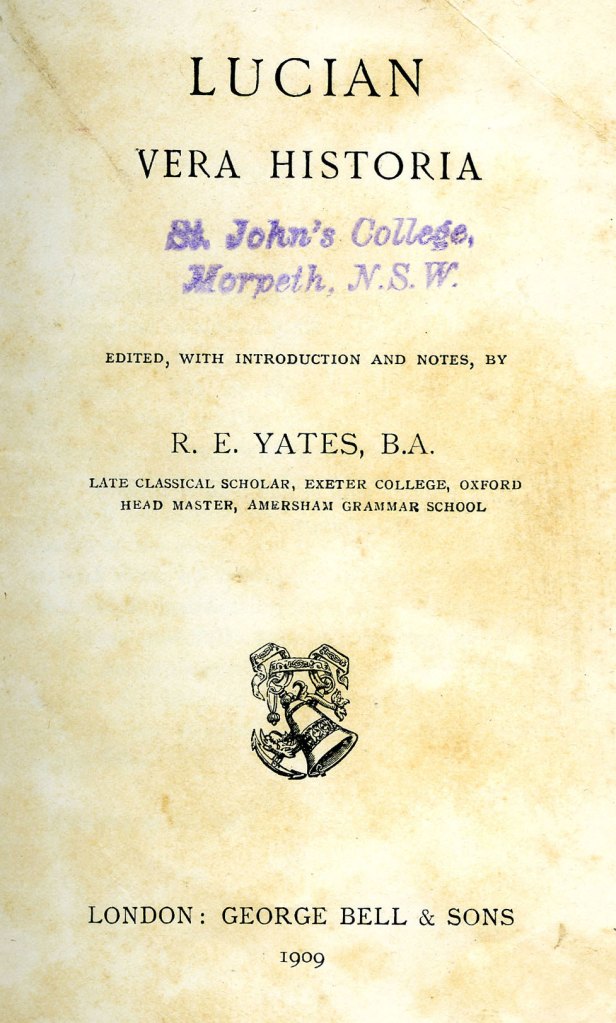
Lucian: The ancient Greek Steven Spielberg


A Syrian-Greek writer responsible for the first fictional accounts of extraterrestrial life. Lucian, whose parents had hoped he might become a sculptor, made a fortune by traveling around Asia Minor, Greece, Italy and other lands giving entertaining speeches, before settling down in Athens to study philosophy. This was a time – the second centuryAD – when faith in the old gods had all but evaporated, Greek culture and thought was in decay, and the great literature of Greece at its height had given way to shallow novels of adventure or romance. All this was grist to Lucian's satirical mill and in his two extraterrestrial stories – precursors of science fiction – he parodies the kind of feeble fantasy that had become popular.

 The concluding sentence of the preface to his True History reads: "I give my readers warning, therefore, not to believe me." And with that he launches into a tale of a group of adventurers who, while sailing through the Pillars of Hercules (the Strait of Gibraltar), are lifted up by a giant waterspout and deposited on the Moon. There they find themselves embroiled in a full-scale interplanetary war between the king of the Moon and the king of the Sun over colonization rights to Jupiter, involving armies which boast such exotica as stalk-and-mushroom men, acorn-dogs, and cloud-centaurs. 


«...τυφὼν ἐπιγενόμενος καὶ περιδινήσας τὴν ναῦν καὶ μετεωρίσας ὅσον ἐπὶ σταδίους τριακοσίους οὐκέτι καθῆκεν εἰς τὸ πέλαγος, ἀλλ᾿ ἄνω μετέωρον» 
 A watersprout typhoon made the ship ascend to the skies  300 stadiums high without afterwards falling down to the sea, it remained on the air.
A passage from Lucian's(Lucianos in Greek) Αληθής Ιστορία(Alithis Istoria)=True story. 


Before you read below and acquire the wrong impression about Lucian. I recommend you to read his biography in wikipedia in order to understand what kind of a person he was.http://en.wikipedia.org/wiki/Lucian


Lucian of Samosata. A Syrian sophist/author who was writting in Greek.


Jules Verne wrote his science fiction works and foresaw the creation of submarine in the 19th century. In the 60's the U.S.A achieved to send humans on the moon.However before all this in 160 A.D Lucian wrote about a journey to the moon using an air-ship  and about a moon base called Lychnopolis. With an imagination that even Steven Spielberg and George Lucas would envy Lucian an author of the late antiquity with an excellent potential on written discourse takes us to to worlds to which even now many centuries later we can only travel  with our imagination.


In his book he says that he decided to make this trip because of curiosity and to learn what nations are living on the other side of the  Great Ocean. After 80 days of travelling across the unknown ocean they reached a strange island.There they found an inscription written in Greek an mentioned that Hercules and Dionysus had been there.(Stories about voyages of Hercules beyond the Atlantic and campaigns of Dionysus as far as India were very common in the ancient Greek world) 
When they landed on the island they saw a big river but instead of water there was wine coming from the roots of the vineyards. There were also some strange fish around there and once you ate them you would get drunk.


They left the island behind and when they went in the middle of the Ocean suddenly a tornado made their ship to fly above the water but didn't let it to fall down. For 7 days they were travelling on the skies and in the 8th day they saw in front of them a new earth on the air which seemed like a shining island in a shape of a circle. They achieved to land on it and when they took a look around they found out that the land was inhabited and fertile.


Lucianos mentions that this new earth was inhabited by monstrous looking beings.One of those beings arrested them and took them in front of their king who was called Endymion. The king realised that they were Greeks from their outfit and asked them how did they achieve to fly through the skies until his land. He also explained to them that they were on the moon which they are able to see every night from their
earth.

Moreover he revealed that there were also many other kingdoms. Lucianos mentions the Selenites and Heliotes who had a common colony in Eosphoros and a peace treaty. Here there's a really impressive show of Lucianos' imagination. He mentions that the treaty was written on an electric column and they left it in the middle of the air standing between the borders of the two kingdoms.


Lucianos mentions many other paradoxical habits and facts about the "moon-people" . One of them was that men were giving birth to children and that there were no women. Men were marrying men. Except the sexual paradox Lucian says that when that moon people get old they don't die but they just vanish like  smoke.


The really extraordinary mind of Lucian has many other oddities to narrate.He says that the moon-people were coming into contact with the people on earth by using a large mirror which was over a big hole on the ground. If somebody entered that hole, he could hear everything that the people of earth were saying. Lucian mentions that he used it himself and that he was able to see his home. He also added that if somebody doesn't believe that this exists he should travel to the moon to see by himself!!!!


After staying on the moon Lucian travelled between the star clusters of Pleiades and the Hyades to a place called Lychnopolis. It was called like that because there were only lamps there(lychnos=lamp polis=city)


This was the space travel of Lucian in his work called "The true story". Later he mentions how he returned to earth and was eaten by a sea monster in which he lived until it died.


No Lucian was not a crazy person. The true story was a parody of some fantasy stories by contemporary or ancient sources that were considered true by the majority of the people.However there is also an alternative opinion that it was purely a science fiction work containing the following elements that prove it

  • travel to outer space
  • encounter with alien life-forms, including the experience of a first encounter event
  • interplanetary warfare and imperialism
  • colonization of planets
  • artificial atmosphere
  • liquid air
  • reflecting telescope
  • motif of giganticism
  • creatures as products of human technology (robot theme)
  • worlds working by a set of alternate 'physical' laws
  • explicit desire of the protagonist for exploration and adventure


sources:http://www.echedoros-a.gr/2009/05/to.html(in Greek), translation made by me
wikipedia.org
 http://www.daviddarling.info/encyclopedia/L/Lucian.html

Friday, April 15, 2011

Agnodice: the first female gynekologist


Women Physicians were not uncommon in the ancient world but in the city state of Athens around the 4rth century BC women were forbidden on pain of death to practice medicine because they were thought to perform abortions.
Agnodice
Agnodice defied the law and with the help of her grateful patients ,suceeded in having it changed. Her story is recounted by the Roman historian Hyginus and was traslated into English in 1687. Agnodice was a wealthy woman of Athens.


According to legend, Agnodice wanted to learn medicine. By cutting her hair and wearing men's clothing, she was able to become a student of the famous Alexandrian physician, Herophilus. After her studies were completed, she heard a woman crying out in the throes of labor and went to her assistance. The woman, thinking Agnodice was a man, refused her help. However, Agnodice lifted up her clothes and revealed that she was a woman. The female patients then allowed Agnodice to treat them. When the male doctors discovered that their services were not wanted, they accused  Agnodice of seducing their patients. They also claimed that the women had feigned illness in order to get visits from Agnodice.

Many women died during childbirth or of private diseases because they were too embarassed to visit male physicians . Speaking to one potential patient , Agnodice confessed her secret . The other women then allowed Agnodice to treat her and was cured perfectly . Word spread and she became popular and succesful among women.


The male doctors discovered the truth and Agnodice was put on trial.Her patients among the most influential women in Athens stormed the courtroom.They told the judges that they would no longer account them for husbants and friends but as enemies .
They even threatened to die with her.

When Agnodice was brought to trial, she was condemned  by the leading men of Athens. At this point, their wives became involved. According to Hyginus, they argued that "you men are not spouses but enemies, since you're condemning her who discovered health for us." Their argument prevailed and the law was amended so that freeborn women could study medicine."

Bowing on the women's pressure the men not only released Agnodice  but changed the law.After that any freeborn Athenian woman could become a physician as long as she treated only female patients.


According to an article of  University of Virginia  Health sciences library website Agnodice may "belong to the realm of myth and folktale rather than having been a historical figure. However her story illustrates real problems that women patients and women who gave other women medical help during childbirth, called midwives faced in Athens.


sources : A to Z women in Maths and science ,Lisa Yount
   Apollodorus' Library and Hyginus' Fabulae: two handbooks of Greek mythology

Saturday, February 12, 2011

Modern Arts vs History how famous greeks have been depicted by their contemporaries and how they are depicted today. .

                       
Miltiades: The general whose tactics brought the Athenean victory in the battle of Marathon during the Persian wars.

Aristotle: One of the big three of ancient Greek philosophy. The first scientist , Tutor of Alexander the Great.


Hypatia: The first female philosopher. A victim of religious fanatism.

                                             Above:  Socrates the founder of Western philosophy


Pericles: The ruler of the Athens during the Golden
   Plato: One of the big three of the ancient Greek Philosophy. Student of Socrates


 Alexander the Great: The Macedonian conqueror

 Aspasia : Pericle's wife . Otherwise called "The first lady of Athens"


                                                            Queen Cleopatra of Ptolemaic Egypt                                                                  


King Leonidas of Sparta

put your country on top

free counters