Showing posts with label Ancient Corinth. Show all posts

Friday, August 19, 2011

The modern Isthmus of Corinth and the ancient Diolkos

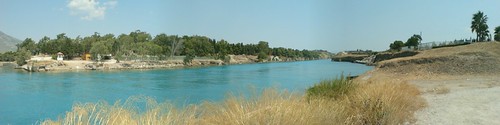
DSC02285
The Isthmus of Corinth

An Isthmus is defined as  a narrow strip of land connecting two larger land areas usually with waterforms on either side.The Isthmus of Corinth was an important crossroad of the ancient world. It was the land bridge that connected Peloponnese with mainland Greece. 


The ancient Greeks and later the Romans and Byzantines attempted numerous times to fortify this narrow strip.During the Persian wars there was a plan for the Greeks to build wooden walls along the Isthmus and wait for the Persians there.


Herodotus argued that a wall on Isthmus was useless if the defender couldn't control the seas. Likely he took the historic example of the Dorian invasion in the Mycenean Peloponnese in which the Dorians didn't invade through Isthmus but instead they used sea transports.


Remains of the examilion wall


In the 5th century, the Eastern Roman empire built a wall in Isthmus to stop the invading Visigoths. The wall had two gates and it was considered the biggest building in Greece at its time. It was called examilion(six miles) maybe because its length was 6 miles. The material used for the buiding were marbles from the nearby temples of Poseidon and Hera in Isthmus and Perahora.


During emperor Justinian more towers were added to increase the effectiveness of the defences.
Herodotus seemed to be right about his opinions on the wall cause during the Slavic invasions the Slavs just went around the wall through the sea and invaded Peloponnese.


Later many other Byzantine emperors tried to repair the walls but all these attempts were futile when the gunpowder technology was mastered by the Ottoman armies.


The canal of Corinth


The concept of cutting a canal through the Corinth Isthmus to link the Ionian and Aegean seas was first proposed by Periander tyrrant of Corinth at the end of the 7th century BC. The magnitude of the task defeated him so he opted instead to build a diolkos across which sailors dragged ships from the Ionian port of ancient Corinth called Lechaion to Cenchreai the Aegean port(http://akrokorinthos.blogspot.com/2009/08/kechries.html) and vice versa.

Later many great persons like Alexander the Great and Caligula had the "canal idea" but it was during Nero in 67 AD that diggings started for the opening of the canal.  6000 Jewish prisoners were working on this project  but unfortunately for Nero it was halted because of Gaulish invasions.

The canal was ultimately completed some decades after the creation of the modern Greek state in the 19th century by a French company(1883-1893). The architects were Istvan Turr and Bela Gerster, both of them Hungarians. This made Peloponnese officially an island(the ancient Greeks mistakenly thought it was already an island Peloponnesos  Pelops= an ancient Greek King  and  nesos=island

The canal is 6 kilometers long and 23 meters wide(79 feet).The land sides rise 90 meters above the water.

 An estimated 11,000 ships per year travel through the waterway, most of them full of tourists. When the canal was originally built it was meant to allow all boats to pass through, but unfortunately due to its narrow width of 24 metres it is too narrow for modern day ships that are built too large to pass through. One main bridge crosses overhead while at both ends seashore roads cross using submersible bridges that are lowered to allow ships to pass through. Sometimes, when the bridge rises, fish are caught and come up with the bridge as kids run to collect them.

The first strike in the modern Greek history

The workers in the Corinth canal opening were the first ones to organise a strike.


90 years after the creation of a modern Greek state in 1888 the workers in the Isthmus of Corinth declared a strike demanding a fair way of calculating their working time.This resulted a new agreement between the workers and the contractors about estimating the salaries and working times in order to avoid exploitation and fraud.


Wednesday, August 26, 2009

The Aegean port of Ancient Corinth. Kechries


In ancient times, Kenchreai was one of the two ports of the inland city-state of Corinth. While Kenchreai served the eastern trade routes,Lechaion on the Corinthian Gulf served the trade routes leading west to Italy and the rest of Europe. SItuated on the eastern side of the Isthmus of Corinth, Kenchreai sat at a natural crossroads for ships arriving from the east and overland traffic heading north and south between central Greece and the Peloponnese. The origin of Kenchreai is unknown, but it must have been inhabited from early times, probably in prehistory, on account of the deep natural harbor that was favorable for landing ships. The area is endowed with abundant water sources, a massive bedrock of oolitic limestone that excellent building stone, and several defensible positions with good viewpoints. The name of the site seems to derive from the ancient Greek word for millet, and the area's capacity for agricultural production is still evident.
The earliest textual sources for Kenchreai, an epitaph of the Late Archaic period (late 6th-early 5th century BC) and references in historical and geographical writings of the Classical to Hellenistic eras (5th-2nd centuries BCE), reveal that there was a permanent settlement and a fortified naval station. Few archaeological remains survive from this early settlement, but it seems to have been located westward form the modern coast, along the prominent ridge that borders the modern village to the north.

Panoramic view of the area of Cenchreai
Kenchreai flourished during the Roman Empire, when the settlement was focused around the crescent-shaped harbor enclosed by massive concrete breakwaters and protected by sea-walls. The local community was small but prosperous, and it was distinguished by its social, cultural, and religious diversity. Ancient literature and inscriptions from the site attest to the presence of cults of Aphrodite, Isis, Asklepios, Poseidon, Dionysos, and Pan. Christianity also arrived at Kenchreai early in the religion's history. According to acts 18:18, the Apostle Paul stopped at Kenchreai during his second missionary journey, where he had his hair cut to fulfill a vow. He mentions the place and a deaconess named Phoebe in the local assembly in his epistle to the Romans . A later ecclesiastical tradition recorded the existence of a bishop at Kenchreai, but the veracity of these accounts is hard to establish.
the ancient harbor
The ancient harbor was partly excavated in 1962-1969 by a team sponsored by the American school of classical studies under the general direction of Professor Robert Scranton. Excavations have uncovered several buildings that attest to the commercial vitality of the port throughout the Roman Empire and into the 7th century, when maritime activity and local habitation apparently diminished. The most impressive buildings located at the north and south ends of the harbor include blocks of rooms near the waterfront (probably warehouses); fishtanks; monumental complexes decorated with sculpted marble, mosaic pavements, and wall-painting (either sacred structures, lavish seaside villas, or rich public benefactions); and a small Christian basilica.=
Since 2002, survey and excavation jointly sponsored by the American School and the Greek Ministry of Culture has explored the area immediately north of the harbor on the low coastal ridge called Koutsongila. These new investigations have concentrated on a vast cemetery of Early Roman chamber tombs and Roman to Early Byzantine cist graves, an opulent residential quarter facing seaward, and other large structures overlooking the harbor. The bountiful artifacts and structures found both at the harbor and on Koutsongila reveal the considerable wealth of local residents, including several objects of exceptional artistic quality, and a connection to points of production and exchange to the east in the Aegean islands, Asia Minor, and the Near East.
Historical and geographical texts of the Byzantine and post-Byzantine eras indicate that Kenchreai was still used by travelers and Imperial expeditions. While the ancient harbor could still receive ship traffic after antiquity, the archaeological evidence for medieval occupation is thin, and any permanent settlement must have been smaller than in ancient times. A small harbor facility operated during early modern times, mostly serving to export local produce, including grains, citrus fruit, and tomatoes.
www.wikipedia.org


Thursday, March 27, 2008

Ακροκορινθος-Akrokorinth.


Korinth is only 100kms away from Athens.
You can take a bus or rent a car in order to reach Akrokorinthos.Akrokorinthos is an archaeological sight situated near the village of ancient Corinth and the modern city Korinthos.
You can see there the notorious Apollo temple , you can climb the hill and see the fortifications and the ruins of buildings of different ages(Roman,medieval,Turkish).
Near Akrokorinth, for those who get bored with archaeological sights , there are many beautiful beaches at the nearby coastal region like Kiato, xilokastro and diminio.At summer these touristic spots have an active nightlife as also does Korinthos.
Well let me return to the main subject. Akrokorinth isn't advertised so much by the greek ministry of tourism .Nevertheless it is a worth seeing archaelogical sight.
Akrokorinthos is near my home so that's why i begin my blog with it. Historically Akrokorinthos was the place where ancient Corinth was founded and expanded. The great hill served as a protection from enemy invasions. Every greek city in the past had an acropolis(hilltop castles).Gradually these hilltops served also as spiritual areas with the construction of temples dedicated to the protector god of the city.


put your country on top

free counters