Showing posts with label archaeology. Show all posts

Tuesday, February 11, 2014

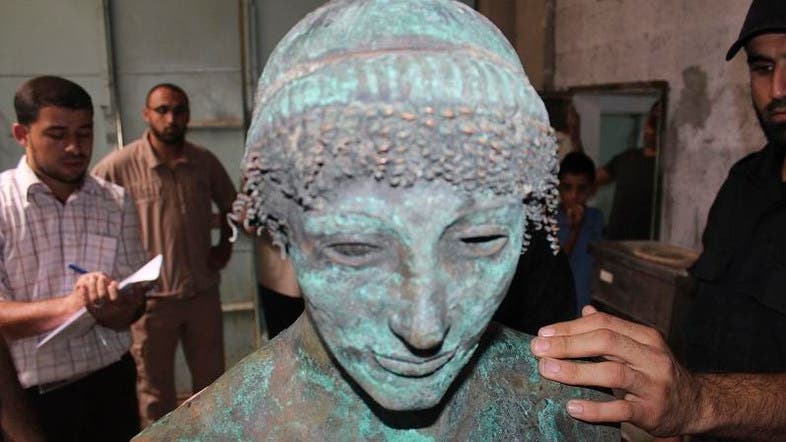
Statue of the Greek god Apollo was found in Gaza strip.


Lost for centuries, a bronze statue of the Greek god Apollo mysteriously resurfaced in the Gaza Strip, only to be seized by police and vanish almost immediately from view, Reuters reported on Monday.
A local fisherman says he dragged the 500kg statue from the seabed last August, and carried it home on a donkey cart, unaware of its significance.
After the statue briefly appeared on eBay last year, with a $300,000 price tag - well below its true value, Hamas police seized it and say they are investigating the affair.
Archeologists have not been able to examine the statue first hand, but from what they can tell from released photographs it was cast sometime between the 5th and the 1st century BC, making it at least 2,000 years old.
“It’s unique. In some ways I would say it is priceless. It’s like people asking what is the [value] of the painting La Gioconda [the Mona Lisa] in the Louvre museum,” said Jean-Michel de Tarragon, a historian with the French Biblical and Archaeological School of Jerusalem.
“It’s very, very rare to find a statue which is not in marble or in stone, but in metal,” he told Reuters television.
The archeologist speculated that the true location of where the statue was unearthed was not revealed to avoid arguments over ownership, saying its apparently pristine condition implied it was not found at sea.
“This wasn’t found on the seashore or in the sea … it is very clean. No, it was [found] inland and dry,” he said.
However, Palestinian fisherman Joudat Ghrab tells a different tale.
The 26-year-old told Reuters that he saw a human-like shape lying in shallow waters some 100 meters off the coast, just north of the Egyptian-Gaza border.
He says it took him and his relatives four hours to drag the find ashore.
“I felt it was something gifted to me by God,” Ghrab told Reuters. “My financial situation is very difficult and I am waiting for my reward.”
The discolored greenish-brown figure depicts the youthful, athletic god standing upright on two, muscular legs with one arm outstretched.
Officials at Gaza’s tourism ministry told Reuters the statue would not be shown to the public until a criminal investigation into who tried to sell it on eBay was completed.
However, the ministry’s director of archaeology, Ahmed al-Bursh, said he had seen the statue promised that Ghrab would receive a reward.
“It is a precious treasure, an important archaeological discovery,” said Bursh.
“International institutions have also contacted us and have offered to help with the repair process,” he said, adding that the Louvre in Paris wanted to exhibit it on loan.
Some 5,000 years of history can be found beneath the sands of the area, which was ruled by ancient Egyptians, Philistines, Romans, Byzantines and crusaders at various times.

http://english.alarabiya.net/en/life-style/art-and-culture/2014/02/11/Police-seize-ancient-statue-netted-by-Gaza-fisherman.html

Thursday, May 5, 2011

Was the myth of the quest for the golden fleece based on reality?


The Golden necklace from a tomb in Volos

A golden necklace found in an ancient tomb in the greek city of Volos is assumed to be originated from Colchis.That explains the myth of the argonauts and the golden fleece.


Recently in the museum of Louvre four golden samples found in Georgia(ancient Colchis) were examined along with a golden necklace found in Volos(ancient Iolkos) and the result was that they had common origin. All the objects according to the scientists were made from alluvian gold from a river of Georgia.


For the confirmation of the results examinations of the objects will be repeated with the inclusion of more objects this time.If the new examinations show the same result then we can say that Greeks in the supposed time of the mythical quest of Jason knew about the existence of Gold in Colchis. Therefore the theories of the archaeologists who alleged that the quest of jason was a metaphor for the explorations of greek navigators in the black sea and the golden fleece was the gold of the rivers of Colchis and its stealing by the argonauts implied the way the Greeks took the technology of collecting gold from rivers by the Colchians.


In ancient times the gold was collected from rivers with the method of the goat's fleece .This method was known since prehistorical times.


However there are some doubts on this research cause the river's identity was not yet recognised by laboratory examination. In both the two locations(Colchis and Iolkos) there are rivers that produce gold.
Therefore the gold from the necklace could be also Greek .


The research should have been completed long ago but the war between Russia and Georgia made the Georgian archaeologists delay the dispatching of the extra golden objects requested for the comparative analysis. The Greek findings(among them the golden necklace) are dated from15th century BC to the late 14th century BC . Archaeologists allege that at the area where the golden objects were found there were large structures built which make us assume how much advanced were the people of Iolkos in the 15th century.


14 ancient shipwrecks make the myth of the Argonauts reality
The sea archaeology has brought essential information to archaeologists and historians over the last years.The research of the coast where the historic city of Iolkos was located has unveiled  14 ancient shipwrecks and two land facilities


Among the most significant settlements that were found undersea was one that dates back to 1700 BC and contains remains of pottery,  graves and remains of buildings.

The most fascinating findings lie in the Greek islands of Skopelos and Allonesos(near Iolkos) which used to be a passage for ships heading towards the Black sea.The findings(sealed pots with products) prove the existence of early trade connection of ancient Greece with the coastal people of the Black sea and Colchis.


source: enet.gr (translations of both articles are made by me)

Saturday, April 2, 2011

The oldest readable writting in Europe found in Greece.


The back of a tablet.
The table fragment with Mycenean Linear B letters alledged to be  3500 years old

Marks on a clay tablet fragment found in Greece are the oldest known decipherable text in Europe, a new study says.
Considered "magical or mysterious" in its time, the writing survives only because a trash heap caught fire some 3,500 years ago, according to researchers.
Found in an olive grove in what's now the village of  Iklaina, the tablet was created by a Greek-speaking Mycenaean scribe between 1450 and 1350 B.C., archaeologists say.
The Mycenaeans—made legendary in part by Homer's Iliad, which fictionalizes their war with Troy—dominated much of Greece from about 1600 B.C. to 1100 B.C. 
So far, excavations at Iklaina have yielded evidence of an early Mycenaean palace, giant terrace walls, murals, and a surprisingly advanced drainage system, according to dig director Mickael Cosmopoulos.
But the tablet, found last summer, is the biggest surprise of the multiyear project, Cosmopoulos said.
"According to what we knew, that tablet should not have been there," the University of Missouri-St. Louis archaeologist told National Geographic News.
First, Mycenaean tablets weren't thought to have been created so early, he said. Second, "until now tablets had been found only in a handful of major palaces"—including the previous record holder, which was found among palace ruins in what was the city of Mycenae.
Although the Iklaina site boasted a palace during the early Mycenaean period, by the time of the tablet, the settlement had been reduced to a satellite of the city of Pylos, seat of King Nestor, a key player in the Iliad.
"This is a rare case where archaeology meets ancient texts and Greek myths," Cosmopoulos said in a statement.
Tablet Preserved by Cooking
The markings on the tablet fragment—which is roughly 1 inch ( 2.5 centimeters) tall by 1.5 inches (4 centimeters) wide—are early examples of a writing system known as Linear B.
Used for a very ancient form of Greek, Linear B consisted of about 87 signs, each representing one syllable. 
The Mycenaeans appear to have used Linear B to record only economic matters of interest to the ruling elite. Fittingly, the markings on the front of the Iklaina tablet appear to form a verb that relates to manufacturing, the researchers say. The back lists names alongside numbers—probably a property list.
Because these records tended to be saved for only a single fiscal year, the clay wasn't made to last, said Cosmopoulos, whose work was funded in part by the National Geographic Society's Commitee for research and exploration. (The Society owns National Geographic News.)
"Those tablets were not baked, only dried in the sun and [were], therefore, very brittle. ... Basically someone back then threw the tablet in the pit and then burned their garbage," he said. "This fire hardened and preserved the tablet."

Not the Oldest Writing
While the Iklaina tablet is an example of the earliest writing system in Europe, other writing is much older, explained Classics professor  Thomas Palaima, who wasn't involved in the study, which is to be published in the April issue of the journal Proceedings of the Athens Archaeological Society.
For example, writings found in China, Mesopotamia, and Egypt are thought to date as far back as 3,000 B.C.
Linear B itself is thought to have descended from an older, still undeciphered writing system known as Linear A. And archeologists think Linear A is related to the older hieroglyph system used by the ancient Egyptians.

Magical, Mysterious Writing
Still, the Iklaina tablet is an "extraordinary find," said Palaima, an expert in Mycenaean tablets and administration at the University of Texas-Austin.
In addition to its sheer age, the artifact could provide insights about how ancient Greek kingdoms were organized and administered, he added.
For example, archaeologists previously thought such tablets were created and kept exclusively at major state capitals, or "palatial centers," such as Pylos and Mycenae.
Found in the ruins of a second-tier town, the Iklaina tablet could indicate that literacy and bureaucracy during the late Mycenaean period were less centralized than previously thought.
Palaima added that the ability to read and write was extremely restricted during the Mycenaean period and was regarded by most people as "magical or mysterious."
It would be some 400 to 600 years before the written word was demystified in Greece, as the ancient Greek alphabet overtook Linear B and eventually evolved into the 26 letters used on this page.

Wednesday, August 26, 2009

The Aegean port of Ancient Corinth. Kechries


In ancient times, Kenchreai was one of the two ports of the inland city-state of Corinth. While Kenchreai served the eastern trade routes,Lechaion on the Corinthian Gulf served the trade routes leading west to Italy and the rest of Europe. SItuated on the eastern side of the Isthmus of Corinth, Kenchreai sat at a natural crossroads for ships arriving from the east and overland traffic heading north and south between central Greece and the Peloponnese. The origin of Kenchreai is unknown, but it must have been inhabited from early times, probably in prehistory, on account of the deep natural harbor that was favorable for landing ships. The area is endowed with abundant water sources, a massive bedrock of oolitic limestone that excellent building stone, and several defensible positions with good viewpoints. The name of the site seems to derive from the ancient Greek word for millet, and the area's capacity for agricultural production is still evident.
The earliest textual sources for Kenchreai, an epitaph of the Late Archaic period (late 6th-early 5th century BC) and references in historical and geographical writings of the Classical to Hellenistic eras (5th-2nd centuries BCE), reveal that there was a permanent settlement and a fortified naval station. Few archaeological remains survive from this early settlement, but it seems to have been located westward form the modern coast, along the prominent ridge that borders the modern village to the north.

Panoramic view of the area of Cenchreai
Kenchreai flourished during the Roman Empire, when the settlement was focused around the crescent-shaped harbor enclosed by massive concrete breakwaters and protected by sea-walls. The local community was small but prosperous, and it was distinguished by its social, cultural, and religious diversity. Ancient literature and inscriptions from the site attest to the presence of cults of Aphrodite, Isis, Asklepios, Poseidon, Dionysos, and Pan. Christianity also arrived at Kenchreai early in the religion's history. According to acts 18:18, the Apostle Paul stopped at Kenchreai during his second missionary journey, where he had his hair cut to fulfill a vow. He mentions the place and a deaconess named Phoebe in the local assembly in his epistle to the Romans . A later ecclesiastical tradition recorded the existence of a bishop at Kenchreai, but the veracity of these accounts is hard to establish.
the ancient harbor
The ancient harbor was partly excavated in 1962-1969 by a team sponsored by the American school of classical studies under the general direction of Professor Robert Scranton. Excavations have uncovered several buildings that attest to the commercial vitality of the port throughout the Roman Empire and into the 7th century, when maritime activity and local habitation apparently diminished. The most impressive buildings located at the north and south ends of the harbor include blocks of rooms near the waterfront (probably warehouses); fishtanks; monumental complexes decorated with sculpted marble, mosaic pavements, and wall-painting (either sacred structures, lavish seaside villas, or rich public benefactions); and a small Christian basilica.=
Since 2002, survey and excavation jointly sponsored by the American School and the Greek Ministry of Culture has explored the area immediately north of the harbor on the low coastal ridge called Koutsongila. These new investigations have concentrated on a vast cemetery of Early Roman chamber tombs and Roman to Early Byzantine cist graves, an opulent residential quarter facing seaward, and other large structures overlooking the harbor. The bountiful artifacts and structures found both at the harbor and on Koutsongila reveal the considerable wealth of local residents, including several objects of exceptional artistic quality, and a connection to points of production and exchange to the east in the Aegean islands, Asia Minor, and the Near East.
Historical and geographical texts of the Byzantine and post-Byzantine eras indicate that Kenchreai was still used by travelers and Imperial expeditions. While the ancient harbor could still receive ship traffic after antiquity, the archaeological evidence for medieval occupation is thin, and any permanent settlement must have been smaller than in ancient times. A small harbor facility operated during early modern times, mostly serving to export local produce, including grains, citrus fruit, and tomatoes.
www.wikipedia.org


Saturday, May 17, 2008

N. Anhialos (Honouring my father's land)

The ruins of  Pyrasos


New Anchialos is located in Magnesia in Central Greece. 30 years before it was a small village but now it has become an almost small city.
N. Anchialos took its name from from the greek refugees who fled from the city Anchialos in 1906 when the bulgarian troops occupied the city.They chose the spcific site for their new home because it was a coastal place . N. Anchialos is built over the ruins of the ancient city of Pyrassos.
Everyone who visits the N. Anchialos can see the remnants of the old akropolis and many columns of themples of the Roman era.
Nowadays the small city is inhabited also by people who came from the surrounding villages
as there were many financial opportunities in a new society. The great development over the last years brought many tourists in the city. The coastal road is only for walkers and along there are many bars,clubs and coffeeshops. The sandy beach is big enough and the sea is clear.

Magnesia undoubtely offers us much better touristic spots like Pelion or the islands called Sporades.However i think that it would be right to show less advertised touristic spots.N.Anchialos is one of them. It's worth visiting

put your country on top

free counters