Showing posts with label 19th century Greece. Show all posts

Saturday, April 6, 2013

An uknown heroine of the Greek independence war


Domna Visvizi

Domna Visvizi was a pretty much uknown heroine of 1821. She was the wife of the shipowner Antonios Visvizis.
She followed her husband during in all his military operations on the sea.When her husband died she took the role of the commander of their ship which was called Kalomira(good fortune)."During the siege of Euripos a city in Euboea, Antonios Visvizis was killed by Ottoman fire. At that moment Domna got in front and ordered the crew to continue fighting.Specifically she said: Take my husband down to his sons to cry for him, i'll have time to cry for him after we win this war."

During the independence war her ship was active in the North-eastern Aegean. In 1823 before retiring she put her ship under command of the Greek government which converted it into a fireship. With that ship Andreas Pipinos achieved to burn the Ottoman frigate Hazine Gemisi in 1824.

Domna Visvizi never forgot her role as a mother. She tried to send her son in England for studies but eventually he was sent in Paris.Before leaving for France she left a note for him saying:My dear son, when you return back perhaps i'll be dead. Avenge the death of your father.
After the independence of Greece she had many financial problems.Initially she lived in Nauplion in Hydra in Syros where her son lived and she ended up in Piraeus where she died poor in 1850.Demetrios Ypsilantis described her as a noble and polite woman.

Nowadays there is a statue of her in the "highway of heroes" in Athens.

Monday, March 25, 2013

The tragic end of the heroes of the war for the Greek independence.


Boubouli_Anntroutsos(an article from Greekreporter.com)
The Greek War of Independence commenced in 1821 and waged until 1832 when the Greek free state was finally established under the blessings and the needs of the then powerful allies of the Greek revolutionaries, the British, the French and the Russian. The national day celebrated on March 25th pays tribute to all men, women and children who lost their lives for the dream of a sovereign free country, and especially to the heroes of the Greek Revolution that risked their lives for freedom from the Ottoman Empire. But as always, there are black pages in every history book of the world, and Greece’s were not an exception. Although it goes mostly unnoticed, the fact is that many Greek captains of the Revolution were sent to jail during and after the war against the Ottomans. Others were pushed aside by the newly formed state as too dangerous for the common good or too unpredictable for the reigning forces.
Here follow some of the most exemplary and tragic stories of the Greek captains of 1821, who ended up underprivileged, captured, begging on the streets and even dead.
Nikitaras
Nikitaras
Nikitas Stamatelopoulos or Nikitaras or the Turk-eater died in September 25, 1849, totally forgotten and poor.The brave and honorable man who stood out in the battle of Dervenakia and was told to have broken three swords with his fury in the battlefield, was groundlessly accused of conspiracy against King Otto and was sent to prison first in Palamidi (along with his uncle and Revolution captain Theodoros Kolokotronis) and then on the island of Aegina.
When the then Greek Prime Minister Ioannis Kolettis asked him to kill a rival and former captain of the Greek Independence war, Odysseas Androutsos, in exchange for a government position, Nikitaras refused the offer and became angry with Kolettis. He also refused to take booty after the victorious battle of Tripolis, a normal practice of Balkan irregulars at the time.
 4.1.2
Odysseas Androutsos
Nikitaras was released from prison in 1841, but the period in jail broke his health and he was almost blind due to diabetes problems. The Greek state refused to grant him and his family any descent pension to make a living, but instead allowed him to beg before a Virgin Mary church every Friday. In 1843, when King Otto was forced to sign the Constitution, Nikitaras was given the title of major general and an insignificant pension. He died in 1849 in Piraeus.
A major hero of the Greek War of Independence, Odysseas Androutsos earned the title of Commander in Chief of the Greek forces in Roumeli, but his glory did not last long. His intense personality and constant conflicts with the “kalamarades” as he called the politicians and the clergy resulted in making him suspicious of the politics followed at the time. In spring 1822 Ioannis Kolettis accused him of betrayal and cooperation with the Ottomans, so that Androutsos gave up his title as Commander in Chief but never gave up his fighting against them. Seieng through the scheming of politics, Androutsos retired in a cave, the Black Hole, totally disappointed with the newly emerged state of the Greeks after the independence war.
There, in his cave north of Parnassus Mountain, Androutsos’ isolation made Kolettis and his enemies even more suspicious of his intentions and soon he was accused of making agreements with the enemy against the interests of the Greeks. Androutsos, however, is said to have called for the cooperation of the Ottomans in order to take them by surprise and fight them from the inside. The arrest of Kolokotronis made Andoutsos even more hostile towards politicians. Then the government in 1825 assigned to Yiannis Gouras, a close lieutenant of Androutsos, with the mission to take care of Androutsos. Androutsos finally surrendered to the government forces and was led to an Athens prison. Karaiskakis, another major figure of the Greek Independence war, was outraged by his imprisonment and even attempted to rescue his fellow fighter. The attempt failed and to cool things down Gouras asked for the government’s help.
The trial date for Androutsos was pending now, but on June 5 at midnight Gouras gave the order and five men including an unknown priest entered Androutsos’ cage and killed him after hours of torture. The lifeless body of Androutsos was then pushed off the prison tower of Goula down to the Temple of Athena Nike of the Acropolis. Androutsos’ death was declared as a failed escape attempt.
Bouboulina_Friedel_engraving_1827
Lascarina Bouboulina
Laskarina Bouboulina was a Greek naval commander and heroine of the Greek Revolution. Being married twice to prosperous husbands, Bouboulina bought arms and ammunition at her own expense and brought them secretly to the island of Spetses on her ships, to fight for the sake of her nation. Construction of her ship Agamemnon was finished in 1820. She bribed Turkish officials to ignore the ship’s size and it was later one of the largest warships in the hands of Greek rebels. She also organized her own armed troops, composed of men from Spetses. She used most of her fortune to provide food and ammunition for the sailors and soldiers under her command.
The people of Spetses revolted on 3 April, and later joined forces with ships from other Greek islands. Bouboulina sailed with eight ships to Nafplion and began a naval blockade. Later she took part in the naval blockade and capture of Monemvasia and Pylos.
When the opposing factions erupted into the second civil war in 1824, the Greek government arrested Bouboulina for her family connection with now-imprisoned Kolokotronis; the government also killed her son-in-law Panos Kolokotronis. With the order to be arrested, she was exiled back to Spetses poor and disappointed by the new Greek reality. In 1825, while Ibrahim Pasha of Egypt disembarked in Pylos in a final attempt to smother the revolution, Bouboulina began preparing for new battles despite her animosity towards the politicians. However, on May 22 of the same year, Bouboulina would die a tragic death. Her younger son from her first marriage fell in love with the daughter of the powerful Koutsaios family of Spetses and the couple fled to the house of Bouboulina’s first husband. Bouboulina and the Koutsaios soon arrives at the house and after a long and furious dispute, Ioannis Koutsis shot her in the head fatally. The case was closed and no-one ever put the perpetratorson on trial.
Friedel_-_Manto_Mavrogenous
Manto Mavrogenous
Manto Mavrogenous was a Greek heroine of the Greek War of Independence. A rich woman,who spent all her fortune on the Hellenic cause. Under her encouragement, her European friends contributed money and guns to the revolution. When the struggle began, she went to Mykonos, the island of her origin, and invited the leaders there to join the revolution.
She equipped, manned and “privatized” at her own expense, two ships with which she pursued the pirates who attacked Mykonos and other islands of the Cyclades. She also equipped 150 men to campaign in the Peloponnese and sent forces and financial support to Samos, when the island was threatened by the Turks. Later, Mavrogenous sent another corps of fifty men to Peloponnese, who took part in the Siege of Tripolitsa and the fall of the town to the Greek rebels. She spent money on the relief of the soldiers and their families, the preparation of a campaign to Northern Greece and the support of several philhellenes. She also sent a group of fifty men to reinforce Nikitaras in the Battle of Dervenakia.
She moved to Nafplio in 1823, in order to be in the core of the struggle, leaving her family as she was despised even by her mother because of her choices. After her unfortunate love story with Dimitrios Ypsilantis, Mavrogenous lived depressed for a while in Nafplion. After Ypsilanti’s death and her political conflicts with Ioannis Kolettis, she was exiled from Nafplio and returned to Mykonos to live in extreme poverty. When the war ended, Greek Prime Minister Ioannis Kapodistrias awarded her the rank of the Lieutenant General and granted her a dwelling in Nafplio, where she moved. She left for the island of Paros in 1840, where she died in July 1848, in oblivion and poverty.


Saturday, April 21, 2012

Images from the Ottoman Greek world of the early 19th century by Louis Dupre


Louis Dupre was a French painter, especially noted for his travels in Greece and the Ottoman Empire and his numerous paintings with Orientalist and Philhellene themes.
He often traveled and changed his work location, including Paris, Kassel, Naples, Rome, , Naples , Istanbul, Greece , Paris, and Vienna.

His visit to Greece was on the very eve of the Greek War of Independence.


Acropolis was inhabited during the ottoman times. The parthenon operated as a mosque

An Albanian of the early 19th century

A view of Ottoman Athens. Athens at this time was no bigger than a village.

An Athenian girl. Obviously from a wealthy Athenian family

the begining of the Greek revolution in Salona. Mitropoulos is depicted holding the revolutionary flag over the corpses of Ottoman soldiers.

A man from Ottoman Thessaly

A wealthy Armenian. Armenians were all spread allover the ottoman empire working mainly as merchants.

The grandchildren of the Vizier of Ottoman Janina(Ioannina)

Ioannes Logothetis. Prokritos(governor of Greeks) of Livadeia. After Greece was liberated he became governor of the island  Aigina

Ali Pasha was the Pasha(governor) of Epirus(western Rumelia).Greeks showed a sympathy towards him  cause as a native Albanian he used the languages(Greek and Albanian) of the native peoples of the area to interact with them.
During his rule a greek educational enlighment took place.At some point he turned his pashalik independent from Istanbul. This eventually cost him his life.

An Armenian of the Ottoman empire and his wife.

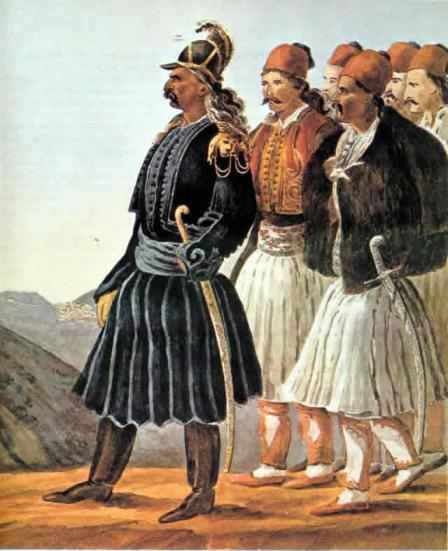
This was the most common outfit of the Greek revolutionaries during the Greek independence war. it was called foustanella.

Another one Ottoman Greek posing for Dupre

A Greek Orthodox priest on the left and a Turkish muslim priest on the right.

A Greek woman from Leivadia

An Ottoman Greek merchant

A Greek bride in Athens dressed for her wedding.

A Janissary who is part of the imperial palace guard in Istanbul and the gardener of the palace on the right.

A Mameluk sitting

Michael Soutzos member of a prominent Greek family from Constantinople. He became prince(governor) of Moldavia in 1819.

Princess Helena Soutsou

On the left a woman from Theba and on the right a woman from the outskirts of Athens


Thursday, March 24, 2011

Greek Revolution part 4: The battle of Dervenakia

The battle of Dervenakia is perhaps the most crucial battle of the Greek revolution. It took place in 1822 just one year after the revolution broke out and its success allowed the Greeks to continue their struggle for independence.


The Greeks ambush the main body of the Ottoman army.

It was July of 1822 and the Sultan upset of the revolution's success decided to send a regular army to quell any ressistance once and for all.After he defeated the rebel Ali pasha he had available forces to send to Peloponnese

He chose as a commander the talented Mahmut Pasha or Dramalis.
Dramalis proceeded with an army of 25.000 soldiers facing no ressistance until he reached the Isthmus of Corinth. Sources mentioned that the Greeks were fleeing in the sight of such a large army and the high morale of the initial stages of the war had been lost as many considered that there was no force in Greece that could beat this army.


Dramalis' aim was to reclaim Tripolitsa the capital of Peloponnese or Morea as it was called in this time. The landscape of Peloponnese is mountainous and moving a large force was slow through narrow roads.Therefore even though the geographical proximity was small it was dangerous to make a direct attack.The advisors of Dramalis old him to use Corinth as a base of operations but he mistakenly did the opposite. Likely because of arrogance he decided to recalim the forts of Morea one by one before entering Tripolitsa.

Theodoros Kolokotronis in black
Mahmut Pasha "Dramalis"
       As it is aforementioned the Greeks were demoralized and were fleeing from the areas the Ottoman army was approaching. So it was done when Dramalis decided to move towards the plains of Argos to take Nauplion an important port. Noone stood against him while he was passing with his army from mountainous regions which were fit for guerilla war and ambushes.


Dramalis took Nauplion and the greek government that was stationed near it fled panicked towards the ships .
In these dire moments a great leader arose Theodoros Kolokotronis .While anarchy and despair prevailed among the the Greeks he was the one who organised a ressistance to slow down Dramalis' advance.


    He succeeded to keep Dramalis' army in the Nauplion region by putting defences in strategic spots that were leading to Tripolitsa, by reinforcing the defences of local forts, and by using a scorched earth policy to cause starvation in Dramalis' large army.He also mobilised the demoralized Greeks through his majestic appearance(he wore a western military outfit) his reputation(he was already a succesful and experienced officer) and his fiery speeches.

Kolokotronis rallies the troops
Dramalis was not able to secure all the forts in Nauplion region and therefore he couldn't march for Tripolitsa without securing his rear. The crucial point for the turning of the events was Dramalis' decision to return back to Corinth and expect reinforcements and to take supplies for his starving soldiers.It's worth to mention the efforts of the Greek navy which effectively blockaded the region from ships that could bring supplies thus forcing Dramalis to return back to Corinth


Dramali chose to return through the narrow passes being unaware of the surprise awaiting him. This decision was taken  due to the calm passage of his forces when he was marching towards Nauplion. Kolokotronis' foresaw the return of  Dramalis through the narrow pass and orchestrated a series of guerilla attacks to slow down Dramalis' army at the Dervenakia narrow pass. The casualties of Dramalis' army by these series of attacks were heavy but in Dervenakia his army was almost annihilated and Dramalis himself barely escaped towards Corinth. In the Dervenakia battle it is estimated that 3.000 Ottoman soldiers were slain while it is not sure how many were killed from the other attacks.

The Greek force was estimated at 2.500 soldiers which was a 1:10 ratio comparing to Dramalis' army. It was sure that an open battle was a suicide for the Greeks and Kolokotronis knew that .He wasn't characterized unfairly as a strategic genius because to defeat a 10 times larger force with an irregular force was a great achievement.But even greater was his tactics to trap and defeat his enemy not by using full force but by causing attrition through shoot and go tactics.

Thursday, March 10, 2011

Christos o Arapis (Chris the Coloured man)

Christos' portrait by the famous Greek painter Nikolaos Gyzis
Christos Arapis was a "distinguished" personality in the society of Athens in 19th century.
 He was a beloved person and often the press was hosting articles about him. He was  multilingual  and had a good knowledge of politics and diplomacy which was in fact weird cause he was brought as a slave in Greece from Ethiopia  to serve as a soldier of the Ottoman empire.After the Greek revolution in 1821 and the formation of the Greek state in 1830 he defected towards the Greek side and lived until his death in Athens.
According to the Athenean press of the period he was fully aware of the celebrations and the events in his city and his flowers along with his wishes were arriving first than any other presents. Many modern Greek painters have painted his portrait and a poem was also dedicated to him when he died.
He died in Athens dissapointed about how the things were going about the recently formed Greek state. There's a memorable quote he uttered before his death.«την ελευθερία σας καταντήσατε κλεφτερία» which means You have turned your freedom into stealing  Adressing towards the corrupted financial ministers of the government.


put your country on top

free counters