Friday, September 2, 2011

An answer to the question: why the Jews couldn't get along with the Ancient Greeks


Chanukah is a Jewish celebration that takes place near the time of the Christian Christmas .It's about the revolt of a group of Jews against the Hellenistic authority based in Syria which was trying to convert the temple of Jerusalem into a temple of Zeus and generally convert all Jews to the hellenistic religion. I found an interesting set of articles  that present the difference of Hellenistic and Jewish  thinking from either a Jewish point of view or greek(through an imaginary  ancient dialog) therefore from a subjective point of view but it is still interesting to read .


Antiochus IV Epiphanes. During his reign the events that are celebrated in Jewish Chanukah took place.


"It's hard for me to get into Chanucah. As far as I can see, the whole thing was a major disaster. Here we have a meeting of two rich cultures, with so much to share, so much to contribute to the world together, so much synergy that could happen, and instead, BOOM! -- the extremists of both sides hit the battlefield.
I don't get it. The Greeks were universalists. They were open to new ideas from wherever they came. They spread knowledge and understanding throughout the Mediterranean. Here was an opportunity to take Jewish values to the world, to go public. Why couldn't those Maccabee hotheads work out some sort of compromise?

The Short Answer:
Actually, this was the greatest thing that could have happened to the Greek mind: To discover that one thing it could not tolerate -- something like the massage therapist who helps you to find that one trigger point where you can't be touched.
For the Jew, as well, this was a defining experience. The red lines became clear, and with those guidelines, the essential Torah was made able to survive to this day.

The Long Answer:
You're right about one thing: The whole Chanukah story was completely out of character for Ancient Greece. I don't believe there was any other culture they ever oppressed or forbade. Every new culture had its set of gods and rituals, and that was just great. "Hey, you got gods? We got gods, too! Here, let's trade god cards! How 'bout mix and match? You got rituals? You got belief-systems? We're into all that stuff! We'll even help you make big, pretty statues!" Greeks were great syncretists -- meaning, they could jerry together every culture of the known world and make one big tzimmes out of all of it.
So what on earth did they have against the Jews?
Sure, there were political power-plays going on that were the ostensible reasons for the conflict. But it's obvious there was something deeper at play. Some subliminal annoyance that brought out the worst in the Greek and pushed the Maccabees to revolt. Apparently, there was something about the Jewish mind that didn't mix and match.
Now look at it from the Jewish side: Jews have also borrowed from every culture they've come in contact with. Whatever your grandmother tells you,Abraham did not smear his gefilte fish with chrane. One culture we borrowed more from than perhaps any other was that of Ancient Greece. The Talmud tells us that the only language the Torah could be translated into elegantly is Greek. They said it was a beautiful language. They say that of all peoples, the Greeks had ideas closest to ours. They praised many of the Greek philosophers.  Maimonides wrote that Aristotle was half a prophet. The Seder Hadorot, a kind of classic Jewish history book, claims that Aristotle was really Jewish!
So what is going on here? Why such a violent clash? Why were the Jews unable to work out some sort of compromise with a Hellenist ruler?
We need to know because in a very real way, Chanukah lives on. Our society today is a bizarre grafting of these two cultures, the Hellenist and the Jewish. If this conflict existed back then, the question is, has there been some resolution over time? Or are we still fighting Greek elephants? Simply put: Is our society schizoid?

Head-To-Head -- and Beyond
So here's how the conversation goes. Which conversation? The conversation that's been going on ever since the Greek mind and the Jewish mind met one another, almost two and a half millennia ago. Where does it happen? Mostly, somewhere deep inside Jewish minds:
Greek: So tell us about your gods, Mr. Maccabee.
Jew: Um, that's singular.
Greek: Okay, tell me about your gods.
Jew: No, not you. G-d. G-d is singular. Only one god.
Greek: Don't worry, we've got so many I'm sure we can spare a few.
Jew: That's okay, one is enough.
Greek: So, this one G-d, what does He look like? We'd love to make some nice statues for you. You poor, uncultured people, you have no statues!
Jew: That's because He doesn't have looks.
Greek: No looks? Ugly? That's cool! A god of ugliness! Don't worry, we can make ugly statues, too.
Jew: No, no. He has no looks at all. You can't see Him.
Greek: An invisible G-d? Well, maybe we can do that in glass. But you have to give us some description.
Jew: Nope. Sorry. No description.
Greek: You mean nobody ever saw Him? How can you worship something if you don't know what it looks like? I mean, how do you know He exists in the first place?
Jew: It's not that we don't know what He looks like. He doesn't have any looks. He has no image.
Greek: Well, I'm sorry then. If He has no image, we can't make a statue.
Jew: That's fine with us.
Greek: But we'd like to write books about Him. So just give us some definition and we'll work around it.
Jew: Oh, our G-d can't be defined.
Greek: Come, now. Everything has to have a definition. Or else it's not a thing.
J: But G-d is not a thing. He creates things. But He isn't a thing.
G: Oh! So He is the Cosmic Mind Who conceives and shapes all forms from the primal essence-matter.
J: No, He doesn't just form them, He creates them. Out of nothing.
G: Now you're getting silly. You can't make something out of nothing. You need stuff to make it out of.
J: But there wasn't any stuff when things began.
G: There was always stuff. How else could the Cosmic Mind make anything?
J: Out of nothing!
G: Look, you Jews don't really think straight. But that's okay. We've conquered all sorts of primitive cultures. You'll learn, too. So, you worship the Cosmic Mind -- you'll get along just great with Aristotle and…
J: No, He's not just the Cosmic Mind.
G: Well, nothing's higher than the Cosmic Mind.
J: Because that's not who He is. I mean, even if He didn't make a world, He would still be G-d. So you can't say, "that's who He is -- the One that makes a world." There doesn't have to be a world for Him to exist.
G: Of course there has to be a world. Otherwise, why is there a world if there doesn't have to be one? The world makes sense. The Cosmic Mind makes sense. That's what it's all about. Reason. The highest and most perfect of all things. We Greeks will teach you all about that. So, now tell me about your rituals. We Greeks really dig rituals. Any that have to do with wine? Parties?
J: Sure, we make kiddush on Friday night to commemorate the Creation of the world from nothing.
G: Well, you can give up that one now, since I've just shown you that creation of the world from nothing makes no sense whatsoever.
J: We don't eat milk with meat.
G: Why not?
J: G-d says so.
G: For what reason?
J: Reason? He needs a reason? For the same reason He created heaven and earth!
G: Which is?
J: He just wanted to.
G: That's not a reason!
J: Sure it is. He decided He would like a world where there would be milk and meat and He would tell people, "Don't eat that milk and meat together!" and they would listen.
G: That makes no sense. That's not a reason!
J: Reason is just another of His creations.
G: Reason is the ultimate! There is nothing higher than Reason!
J: Okay then, explain to me why the world is the way it is. Why does one plus one equal two? Why does the square of the length of the hypotenuse equal the sum of the squares of the lengths of the other two sides? Why do parallel lines never meet?
G: Because those are the rules of geometry!
J: So why does the Cosmic Mind, as you call Him, have to follow your rules of geometry?
G: They're not our rules! They are the self-evident truths of nature!
J: Why are these the truths and not something else?
G: You stubborn Jew! Don't you see that this is the most elegant, rational way things could be?
J: I'll bet you He could break them. I'll bet our G-d could make a world where parallel lines meet. He could break any of the laws of nature.
G: You can't break laws of nature! They're not like laws of the state or like your silly laws about cheeseburgers. They are truths. They are perfect. They are the ground of reality. They are because they have tobe.
J: Nothing has to be. Nothing but the Source of Being. But He could be any way He wants.
G: Geometry has to be. Cause and effect has to be. Logic has to be. If A = B then B = A. That is an absolute Truth. It must be.
J: Why?
G: Why?! Because if they don't have to be, then I and you and this whole world have no real substance! And that cannot be!
J: That's just what I was trying to tell you. This world has no real substance. They only truth is…
G: Don't say it, Mr. Maccabee! You people are downright dangerous.
And that is why the Greeks did not forbid Jewish practice altogether. What they (initially) forbade were those practices that they saw as irrational. Those practices that Jews do simply because they believe they have a relationship with a Being who is higher than reason. That, they could not tolerate.
Of course, as you know, eventually some bright boys came up with geometries where parallel lines meet; cause and effect got bumped out of quantum physics; the world was discovered to have had a beginning; and even now it still is really nothing because the sum of all radiant energy minus all of the universe's mass equals zero. Most of us today have accepted that there are things that are the way they are not for any reason, but just because that's the way they are. Nothing has to be the way it is. Why do masses attract? Why is the grass green? Why is there anything at all? There doesn't have to be a reason for everything, because reason is not the foundation of reality. So what's so absurd about connecting to the Foundation of Reality through mitzvot that are beyond reason?

Mind Under Matter
Nevertheless, the battle continues. You see, as mentioned above, the Greek mind, aside from worshipping human intellect, is also a great syncretist. That means it can hammer together the most incongruous ideologies without blinking an eyelid. You've heard of Rice-Christians? Peyote-Catholics? The Greek mind could do any of that, and more.
The two characteristics go hand in hand: When there's nothing higher than intellect, intellect has no guiding light. Everything, even the stupidest thing -- as long as it doesn't deny intellect -- can be tolerated. Aristotle knew that the pantheon of Athenian gods was nonsense. But what's wrong with the common people, who cannot understand any better, having their way?
You can easily see that a knowledge of an absolute Divine Will beyond reason has become a necessity for human survival. Without the supposition of a Divine Will, whatever you wish to make sense can make sense. If your system of logic cannot support an idea, just change the postulates and rethink the data. Anything can be made to make sense when you determine the assumptions. Every society has had its philosophers and philosophers have justified everything imaginable -- from coliseum killing games to gas chambers.
Strangely, this may have worked to humanity's advantage in one regard: The Greek mind applied itself to figuring out the material world. When your belief system begins with Divine revelation you don't necessarily apply yourself to mundane matters of how things work. So technological progress became chiefly the domain of the Greek mind throughout history.
But it also has some nefarious consequences. Because when you marry intellect and materialism (a good description of Stalin's Russia and Hitler's Germany), you've entered a bottomless pit of quicksand.
Which brings us to a fascinating point. The Lubavitcher Rebbe points out that in Hebrew, the name for ancient Greece, Yavan, has another meaning: quicksand (as in Psalms 40:3 and Talmud, Eruvin 19a). Water mixes with sand, dirt and clay. You step in it and you can't get out. The more you try to climb up, the further down you go.
Take a look at the letters that spell Yavan in Hebrew: יון . It starts with a small point of a  yud -- representing wisdom. That stretches down to become a  van. And the vav stretches even further down, below the line, to become a long nun. It's all a description of the process of intellect sinking into the material world and, with nothing to hold it in place, sinking further and further.

A Donkey and an Ox
Today, we have those syncretists who wish to marry materialism with Torah. And nothing is less congruous than that.
Materialism is the ultimate of Greece stuck in the mud. It is the idea that all that exists is that which can be observed, described and explained. Evolutionism, for example, is a materialistic explanation of existence. When people became disillusioned with the church and with faith, they needed an explanation of existence that relied on Chance and Necessity alone, without recourse to G-d. Darwinism and current cosmologies provide just that. So do the standard interpretations of history we are taught today.
Torah is an understanding that behind the world lies a Divine Will, unhampered by the limitations of nature or human logic -- because it is the source of all this. Why are there laws of nature? Because G-d generally chooses to work in consistent ways. Why did history unfold the way it did? Because that is all in G-d's plan.
When someone tries to provide a materialistic explanation for Torah and mitzvot, they are creating a Promethean bed, killing all sense of Torah in the process. So too, attempting to resolve conflicts between evolutionary doctrines and Torah makes less sense than marrying a donkey to an ox.
Yes, we try to understand as much as we can. The Torah commands us to think deeply, to immerse our intellects in study and comprehension. Whatever we can fit into intellect, we must strive to do so. Whatever explanation we can give, we must give it. But always with the sense that with every new grain of understanding, we have expanded the seashore of the Infinite Unknowable.
We can have a thousand reasons for not mixing meat and milk, but when it comes down to it, we do it because that is our personal connection with the Divine Will, the Life of All Things. And that is the victory of Chanukah."


Hebrew culture is based on a single book, the Word of God. Greek culture, by contrast, is based on a thousand books, all of them by human authors. The god of the Hebrews sternly rejected graven idols. Consequently, the Hebrew tradition is iconoclastic—it scorns all attempts to materialize the divine. The Greek gods, conversely, admired the material world. Their admiration, as a matter of fact, often seems to be tinged with envy, as though they considered the material world better than the celestial. They wanted to be materialized. They approved of statues, and the statues they inspired were so beautiful that they eventually set standards for human beauty
O.B. Hardison


http://www.chabad.org

Saturday, August 27, 2011

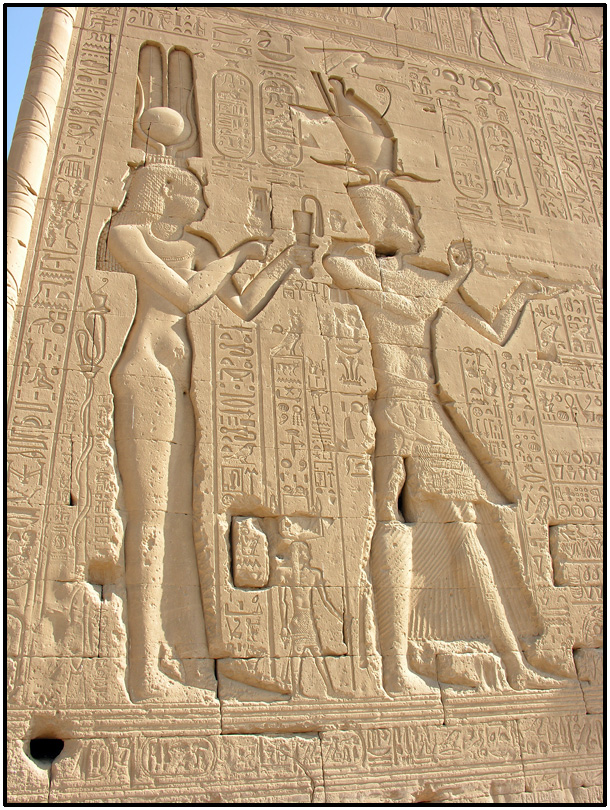
Ptolemy Caesar(Caesarion) The son of Gaius Julius Caesar and Cleopatra


Alexandrian Kings
The Alexandrians turned out in force
to see Cleopatra’s children,
Kaisarion and his little brothers,
Alexander and Ptolemy, who for the first time
had been taken out to the Gymnasium,
to be proclaimed kings there
before a brilliant array of soldiers.

Alexander: they declared him
king of Armenia, Media, and the Parthians.
Ptolemy: they declared him
king of Cilicia, Syria, and Phoenicia.
Kaisarion was standing in front of the others,
dressed in pink silk,
on his chest a bunch of hyacinths,
his belt a double row of amethysts and sapphires,
his shoes tied with white ribbons
prinked with rose-colored pearls.
They declared him greater than his little brothers,they declared him King of Kings.

The Alexandrians knew of course
that this was all mere words, all theatre.
But the day was warm and poetic,
the sky a pale blue,
the Alexandrian Gymnasium
a complete artistic triumph,
the courtiers wonderfully sumptuous, Kaisarion all grace and beauty
(Cleopatra’s son, blood of the Lagids);
and the Alexandrians thronged to the festival
full of enthusiasm, and shouted acclamations
in Greek, and Egyptian, and some in Hebrew,
charmed by the lovely spectacle—
though they knew of course what all this was worth,what empty words they really were, these kingships
                                                            Kavafy's poem called Alexandrian kings.


Partly to throw light on a certain period,
partly to kill an hour or two,
last night I picked up and read
a volume of inscriptions about the Ptolemies.
The lavish praise and flattery are much the same
for each of them. All are brilliant,
glorious, mighty, benevolent;
everything they undertake is full of wisdom.
As for the women of their line, the Berenices and Cleopatras,
they too, all of them, are marvelous.

When I’d verified the facts I wanted
I would have put the book away had not a brief
insignificant mention of King Kaisarion
suddenly caught my eye...

And there you were with your indefinable charm.
Because we know
so little about you from history,
I could fashion you more freely in my mind.
I made you good-looking and sensitive.
My art gives your face
a dreamy, an appealing beauty.
And so completely did I imagine you
that late last night,
as my lamp went out—I let it go out on purpose—
it seemed you came into my room,
it seemed you stood there in front of me, looking just as you would have
in conquered Alexandria,
pale and weary, ideal in your grief,
still hoping they might take pity on you,
those scum who whispered: “Too many Caesars.”


                                                        Kavafy's poem called Kaisarion


Ptolemy Caesar

Just as Kavafy says in his poem Kaisarion(Caesarion) there are not many references about Caesarion and if there some, they are completely insignificant or they lack reliability.These sources are really so few for someone who was the  son of the Great Caesar the "ruler" of Rome and Cleopatra the Queen of the strongest of the Hellenistic kingdoms in the east  and for someone who bore the two strongest and most prestigious names in the world during his time.Ultimately this deadly combination of names was Caesarion's doom...


Caesarion was born in 47 BC and according to Cleopatra he was Caesar's son. Cleopatra aimed at making him the successor of her kingdom and heir of Caesar as head of the Roman republic. Mainly because of pressure from the Romans Caesar didn't officially recognise Caesarion . However he was brought to Rome for two years from 46 BC to 44 BC when Cleopatra was invited by Caesar to Rome. In 44 BC when Caesar was assaninated Caesarion was declared as co-ruler at the age of three by his mother. This action was part of Cleopatra's policies with Rome but also a part of her ambitious plans about her son's future and part of her attempt to present to her subjects her realtionship to her son similar to the relationship of the Egyptian goddess Isis and Horus. It was very important to present a religious legitimacy for her son in order to preserve the loyalty of the Egyptians to her and Caesarion. Apparently Caesar found the "chosen by the gods" tactic very effective and along with his megalomania he tried to implement it in the Roman world by presenting himself as a god but he ultimately failed.


Cleopatra's charm was very effective to an another Roman general Marcus Antonius.In 34 BC Mark Antony seduced by Cleopatra granted to Caesarion many Eastern lands of the Roman republic making the Egyptian kingdom almost equal in power to Rome and a potential threat for the Romans.

The lands given to Ptolemy Caesar by Mark Antony. This act caused the final breach in  his relations with Octavian.


The battle of Actium canceled all the plans of Cleopatra and Mark Antony for the creation of a strong Eastern empire. Caesarion who was 17 at this time was sent at the port of Verenice for safety and in case that Romans invaded in Egypt he would sail for India. From this point the historical sources are a bit unclear about Caesarion's fate.Plutarch says:


"Caesarion, who was said to be Cleopatra's son by Julius Caesar, was sent by his mother, with much treasure, into India, by way of Ethiopia. There Rhodon, another tutor like Theodorus, persuaded him to go back, on the ground that [Octavian] Caesar invited him to take the kingdom"


Plutarch assumes that Octavian  presuaded by a Greek philosopher of Alexandria decided to execute Caesarion. The Philosopher called Arius Didymus  said  to Octavian: "Too many Caesars is not good"


But was actually Caesarion a Caesar or was he just his mother's chess piece? All these titles that he received and the really heavy name that he had to carry as a burden  weren't really mirroring the reality around him. Egypt during Cleopatra's reign was already a client kingdom of Rome and its independence was only guaranteed by Caesar and later by Mark Antony. 


When Caesar died Cleopatra persuaded Mark Antony to adopt Caesarion as his own child and even though he had two other children with Cleopatra Caesarion was the first in line of succession. Therefore only if Caesar(if he had lived) or Mark Antony wanted it, Caesarion would have been all that he was promised that he was destined to become.Technically we could say that since he was nominated co-ruler by Cleopatra Caesarion was the last male Pharaoh of Egypt.


Cleopatra and Caesarion depicted as Isis and Horus(their mythological equivalents)


Tuesday, August 23, 2011

Lucian: The ancient Greek Steven Spielberg


A Syrian-Greek writer responsible for the first fictional accounts of extraterrestrial life. Lucian, whose parents had hoped he might become a sculptor, made a fortune by traveling around Asia Minor, Greece, Italy and other lands giving entertaining speeches, before settling down in Athens to study philosophy. This was a time – the second centuryAD – when faith in the old gods had all but evaporated, Greek culture and thought was in decay, and the great literature of Greece at its height had given way to shallow novels of adventure or romance. All this was grist to Lucian's satirical mill and in his two extraterrestrial stories – precursors of science fiction – he parodies the kind of feeble fantasy that had become popular.

 The concluding sentence of the preface to his True History reads: "I give my readers warning, therefore, not to believe me." And with that he launches into a tale of a group of adventurers who, while sailing through the Pillars of Hercules (the Strait of Gibraltar), are lifted up by a giant waterspout and deposited on the Moon. There they find themselves embroiled in a full-scale interplanetary war between the king of the Moon and the king of the Sun over colonization rights to Jupiter, involving armies which boast such exotica as stalk-and-mushroom men, acorn-dogs, and cloud-centaurs. 


«...τυφὼν ἐπιγενόμενος καὶ περιδινήσας τὴν ναῦν καὶ μετεωρίσας ὅσον ἐπὶ σταδίους τριακοσίους οὐκέτι καθῆκεν εἰς τὸ πέλαγος, ἀλλ᾿ ἄνω μετέωρον» 
 A watersprout typhoon made the ship ascend to the skies  300 stadiums high without afterwards falling down to the sea, it remained on the air.
A passage from Lucian's(Lucianos in Greek) Αληθής Ιστορία(Alithis Istoria)=True story. 


Before you read below and acquire the wrong impression about Lucian. I recommend you to read his biography in wikipedia in order to understand what kind of a person he was.http://en.wikipedia.org/wiki/Lucian


Lucian of Samosata. A Syrian sophist/author who was writting in Greek.


Jules Verne wrote his science fiction works and foresaw the creation of submarine in the 19th century. In the 60's the U.S.A achieved to send humans on the moon.However before all this in 160 A.D Lucian wrote about a journey to the moon using an air-ship  and about a moon base called Lychnopolis. With an imagination that even Steven Spielberg and George Lucas would envy Lucian an author of the late antiquity with an excellent potential on written discourse takes us to to worlds to which even now many centuries later we can only travel  with our imagination.


In his book he says that he decided to make this trip because of curiosity and to learn what nations are living on the other side of the  Great Ocean. After 80 days of travelling across the unknown ocean they reached a strange island.There they found an inscription written in Greek an mentioned that Hercules and Dionysus had been there.(Stories about voyages of Hercules beyond the Atlantic and campaigns of Dionysus as far as India were very common in the ancient Greek world) 
When they landed on the island they saw a big river but instead of water there was wine coming from the roots of the vineyards. There were also some strange fish around there and once you ate them you would get drunk.


They left the island behind and when they went in the middle of the Ocean suddenly a tornado made their ship to fly above the water but didn't let it to fall down. For 7 days they were travelling on the skies and in the 8th day they saw in front of them a new earth on the air which seemed like a shining island in a shape of a circle. They achieved to land on it and when they took a look around they found out that the land was inhabited and fertile.


Lucianos mentions that this new earth was inhabited by monstrous looking beings.One of those beings arrested them and took them in front of their king who was called Endymion. The king realised that they were Greeks from their outfit and asked them how did they achieve to fly through the skies until his land. He also explained to them that they were on the moon which they are able to see every night from their
earth.

Moreover he revealed that there were also many other kingdoms. Lucianos mentions the Selenites and Heliotes who had a common colony in Eosphoros and a peace treaty. Here there's a really impressive show of Lucianos' imagination. He mentions that the treaty was written on an electric column and they left it in the middle of the air standing between the borders of the two kingdoms.


Lucianos mentions many other paradoxical habits and facts about the "moon-people" . One of them was that men were giving birth to children and that there were no women. Men were marrying men. Except the sexual paradox Lucian says that when that moon people get old they don't die but they just vanish like  smoke.


The really extraordinary mind of Lucian has many other oddities to narrate.He says that the moon-people were coming into contact with the people on earth by using a large mirror which was over a big hole on the ground. If somebody entered that hole, he could hear everything that the people of earth were saying. Lucian mentions that he used it himself and that he was able to see his home. He also added that if somebody doesn't believe that this exists he should travel to the moon to see by himself!!!!


After staying on the moon Lucian travelled between the star clusters of Pleiades and the Hyades to a place called Lychnopolis. It was called like that because there were only lamps there(lychnos=lamp polis=city)


This was the space travel of Lucian in his work called "The true story". Later he mentions how he returned to earth and was eaten by a sea monster in which he lived until it died.


No Lucian was not a crazy person. The true story was a parody of some fantasy stories by contemporary or ancient sources that were considered true by the majority of the people.However there is also an alternative opinion that it was purely a science fiction work containing the following elements that prove it

  • travel to outer space
  • encounter with alien life-forms, including the experience of a first encounter event
  • interplanetary warfare and imperialism
  • colonization of planets
  • artificial atmosphere
  • liquid air
  • reflecting telescope
  • motif of giganticism
  • creatures as products of human technology (robot theme)
  • worlds working by a set of alternate 'physical' laws
  • explicit desire of the protagonist for exploration and adventure


sources:http://www.echedoros-a.gr/2009/05/to.html(in Greek), translation made by me
wikipedia.org
 http://www.daviddarling.info/encyclopedia/L/Lucian.html

Friday, August 19, 2011

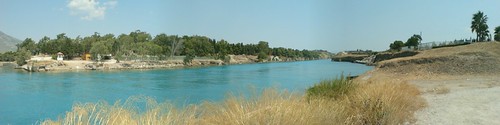
The modern Isthmus of Corinth and the ancient Diolkos

DSC02285
The Isthmus of Corinth

An Isthmus is defined as  a narrow strip of land connecting two larger land areas usually with waterforms on either side.The Isthmus of Corinth was an important crossroad of the ancient world. It was the land bridge that connected Peloponnese with mainland Greece. 


The ancient Greeks and later the Romans and Byzantines attempted numerous times to fortify this narrow strip.During the Persian wars there was a plan for the Greeks to build wooden walls along the Isthmus and wait for the Persians there.


Herodotus argued that a wall on Isthmus was useless if the defender couldn't control the seas. Likely he took the historic example of the Dorian invasion in the Mycenean Peloponnese in which the Dorians didn't invade through Isthmus but instead they used sea transports.


Remains of the examilion wall


In the 5th century, the Eastern Roman empire built a wall in Isthmus to stop the invading Visigoths. The wall had two gates and it was considered the biggest building in Greece at its time. It was called examilion(six miles) maybe because its length was 6 miles. The material used for the buiding were marbles from the nearby temples of Poseidon and Hera in Isthmus and Perahora.


During emperor Justinian more towers were added to increase the effectiveness of the defences.
Herodotus seemed to be right about his opinions on the wall cause during the Slavic invasions the Slavs just went around the wall through the sea and invaded Peloponnese.


Later many other Byzantine emperors tried to repair the walls but all these attempts were futile when the gunpowder technology was mastered by the Ottoman armies.


The canal of Corinth


The concept of cutting a canal through the Corinth Isthmus to link the Ionian and Aegean seas was first proposed by Periander tyrrant of Corinth at the end of the 7th century BC. The magnitude of the task defeated him so he opted instead to build a diolkos across which sailors dragged ships from the Ionian port of ancient Corinth called Lechaion to Cenchreai the Aegean port(http://akrokorinthos.blogspot.com/2009/08/kechries.html) and vice versa.

Later many great persons like Alexander the Great and Caligula had the "canal idea" but it was during Nero in 67 AD that diggings started for the opening of the canal.  6000 Jewish prisoners were working on this project  but unfortunately for Nero it was halted because of Gaulish invasions.

The canal was ultimately completed some decades after the creation of the modern Greek state in the 19th century by a French company(1883-1893). The architects were Istvan Turr and Bela Gerster, both of them Hungarians. This made Peloponnese officially an island(the ancient Greeks mistakenly thought it was already an island Peloponnesos  Pelops= an ancient Greek King  and  nesos=island

The canal is 6 kilometers long and 23 meters wide(79 feet).The land sides rise 90 meters above the water.

 An estimated 11,000 ships per year travel through the waterway, most of them full of tourists. When the canal was originally built it was meant to allow all boats to pass through, but unfortunately due to its narrow width of 24 metres it is too narrow for modern day ships that are built too large to pass through. One main bridge crosses overhead while at both ends seashore roads cross using submersible bridges that are lowered to allow ships to pass through. Sometimes, when the bridge rises, fish are caught and come up with the bridge as kids run to collect them.

The first strike in the modern Greek history

The workers in the Corinth canal opening were the first ones to organise a strike.


90 years after the creation of a modern Greek state in 1888 the workers in the Isthmus of Corinth declared a strike demanding a fair way of calculating their working time.This resulted a new agreement between the workers and the contractors about estimating the salaries and working times in order to avoid exploitation and fraud.


Sunday, August 14, 2011

August full moon and ancient Greece


Every year each August when it's full moon the archaeological sites remain open all night for visitors. The whole full moon atmosphere along with the energy that the these ancient sites are transmitting , attract thousands of people every year for a free night visit . The municipal authorities often organise events like theatrical festivals , concerts and anything related to culture that wouldn't be insulting for the archaeological site.This year nearly 70 archaeological sites remained open for this event.


The temple of Poseidon in Sunion during August full moon


What's so important about the August full moon? There is a  modern Greek proverb that says Του Αυγούστου το φεγγάρι, παραλίγο μέρα μοιάζει(tou avgoustou to feggari paraligo mera moiazei) which means: The night of the fullmoon of August is almost like morning. This proverb is not far from reality cause the in August the full moon in the northern hemisphere is very low on the horizon and this makes it seem to be very close to earth so close that some people by instict stretch their hands to touch it. The proximity of moon to earth increases the light and makes the moon look like a sun. The whole night is like an endless dusk or twilight.


The ancient Greek calendar like many other calendars of the ancient world was lunisolar and therefore the moon phases were important for counting time.

Greek mythology has associated many deities with the moon.


A very known myth is  the  myth of Endymion and Selene, the moon (Selene) fell in love with a handsome young king named Endymion and bore him 50 daughters. One version of the story says that Selene placed Endymion in eternal sleep to prevent him from dying and to keep him forever beautiful.
This myth inspired John Keats to write his homonymous poem.


Another pre-Olympian deity associated with the moon was Hecate. Hecate was a cthonian goddess related with the darkness and the underworld(not with bad connotation).

Hekate


Pasiphae was called the moon goddess of the Cretans.Pasiphae was an immortal daughter of the sun-god Helios. Like her two siblings, Aeetes and Kirke, she possessed the powers of witchcraft (pharmakeia). Pasiphae wed King Minos of Krete, and bore him a number of sons and daughters. However, as punishment for some offence against the gods committed either by herself or her husband, she was cursed with the desire to be coupled with the king's finest bull. The Queen conscripted the great artisan Daidalos to assist her in the endeavour, and he built for her a hollow wooden cow, wrapped in a bovine skin and endowed with mechanical life. Hiding herself inside this contraption she conceived and bore a hybrid child, the bull-headed Minotauros. Pasiphae's husband Minos also proved unfaithful. When the Queen learned of his indiscretions she cast a spell on him which caused him to ejaculate poisoned creatures and so destroy his lovers. Pasiphae herself, being an immortal, was alone immune. Minos was eventually cured by the Athenian girl Prokris who devised a remedy for his strange afflication.


Pasiphae


Among the Olympians Artemis/Diana symbolised the moon. She was a twin sister of Apollo who was the god that symbolized the sun. Artemis' cult probably was imported from Minor Asia. She was the goddess of moon and hunting and patron goddess of the mythical Amazons.
Artemis. Notice the moon crescent on her forehead
There is not, perhaps any spectacle more enchanting than that of a clear night, when the moon shines in all her splendour and advances in silent majesty through the stars.Nature has at that time resigned the variety of her colours , and their shades have disappeared ,but the placid light shed on every object is perhaps not less attractive,whether it is reflected from the bottom of the smooth wave or illuminates the contour of the objects around.The summits of the mountains exhibit a splendid amphitheatre, while the woods below form a darker shade.The general calm that reigns the nature the solemn silence , so propitious to thought and solitary meditation, and which is only disturbed by the plaintive sounds of sorrow, or the tender accents of love, adapt the mind to every soft impression.
diodorus sicelus


sources:http://spcom.ca/hellenicspirit/2011/07/30/Month-Of-Metageitnion-%CE%9C%CE%AE%CE%BD%CE%B1%CF%82-%CE%9C%CE%B5%CF%84%CE%B1%CE%B3%CE%B5%CE%B9%CF%84%CE%BD%CE%B9%CF%8E%CE%BD.aspx ,http://www.mythencyclopedia.com, ://www.theoi.com

Wednesday, July 20, 2011

The Ku Klux klan and the first Greek immigrants


The name Ku Klux Klan derives at its 2/3 from the greek word κύκλος=kyklos which means circle. Many of its founding members were admirers of the Greek civilization. However this didn't stop them from persecuting Greek immigrants.

The KKK was founded in 1865 in Tenesee but was disbanted 20 years later. In 1913 a second KKK was founded in Atlanta by a protestant pastor. During the height of its power it had 5 million members, but eventually this one was disbanted too under pressure of moral scandals and accusations of collaboration of the KKK with the Nazis. The organization was founded for a third time as a reaction to a law that the Congress implemented about tolerance and social equality.


The American perspective on Greek immigrants

One of the numerous national and religious communities that the KKK targeted were the Greeks. Many Greeks migrated to the U.S during the late 19th and early 20th century 

Although most of them were uneducated workers who were forced to leave because of the meagre economic prospects of Greece they kept their customs and traditions resisting to foreign influences. This proved to be a negative point towards their assimilation to  the American society and a very good pretext for the xenophobic KKK to turn against them.
All these young Greeks worked very hard in order to achieve a financial stability. Most of them came to America only with their clothes. Their hard work involved also some "less prestigious" jobs like sellers of small items at the streets without the permission of the authorities. Such illegal jobs caused troubles between the Greeks and the police.

Greek3
1910, A greek immigrant wearing a Cretan outfit
In a report(D.Mingham Commission report,1911) the Greek immigrants were characterized as uneducated people without proper manners with bizarre names, language and customs.This harsh report represented the Greek immigrants as sub-human beings. 

The bad relations of the Greeks with the police led to the first and last pogrom conducted by KKK against Greeks. Particularly in 1919 after an argument between a Greek worker and an American policeman in the town of South Omaha in Nebraska  the worker killed the officer. This event along with the economic crisis and the unemployment increased the temper in the area and many Americans aimed to unleash their anger on the Greek community. The KKK accused the 2.500 Greeks who worked in the town for everything bad that happened to  U.S and compelled the rest of the town to turn against them by representing them as a threat who  steal jobs from Americans. A local newspaper following the tensions that prevailed wrote that "We must get rid of these hideous people for killing our officer. One drop of American blood is more valuable than the blood of all the Greeks in the world."

As a result in the evening of the 21rst of February in 1909 an angry mob invaded in the Greek quarter utterly destroying it. The Greek communities in the US protested to the the federal government for the incident, which in turn paid large  sums as compensation.

These  events made the Greek Americans to reorganise themselves. They had to aim at their successful integration in the American society so that they wouldn't be a target of xenophobic groups anymore. In 1922 a Greek organisation called Ahepa(American Hellenic Educational Progressive Association) was founded in Atlanta under Georgios Nikolopoulos and Ioannes Aggelopoulos. At the beginning they were active in areas were the KKK was having a big influence but later they expanded all over the U.S with the purpose of making easier the settling of Greek immigrants in America and protect them from KKK.
At some point Ahepa reached the other side and was accused of dehellinizing the immigrants. However they achieved to change the image Americans had on the Greeks and made the Greek American community a progressive and respective element in the American society.

American Hellenic Educational Progressive Association
the symbol of AHEPA
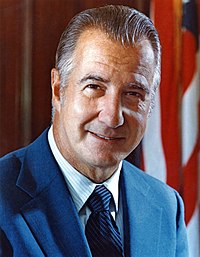
The last reaction against Greeks by KKK was in 1970 during the electorial campaigns. Robert Shelton turned against the Greek descended vice president Spyro Agnew(Spyros Anagnostopoulos)  and despite that Agnew's mother was American and he himself was a Protestant ,Shelton characterized him as a malevolent Greek who is coming to give false promises in order to gain votes.However this was a weak attack from a weak organization which was only a shadow of what it used to be.
Spyro Agnew

source: magazine ιστορικά θέματα
translation made by me

Saturday, July 16, 2011

İsmet İnönü: The Second President of Turkey

     If you talk about the early years of Turkish politics, you are supposed to know İsmet İnönü as the close friend of Mustafa Kemal Atatürk and the Second President of Turkey. İsmet İnönü may be less popular compared to Atatürk, but he was also a very successful politician and brave soldier who deserved to be mentioned by history. I wanted to stress that before starting to write as he was less known abroad and people did not know about him very well. That's the reason why I and Spiros desired to introduce him to you.

    İsmet İnönü was born in 1884 at İzmir. It is known that he is originally from Malatya. There is also a university there dedicated to İsmet İnönü for that reason. In his early years, he attended the Ottoman military academy and became a splendid soldier. By the time he met Atatürk, Ottoman Empire was about to come to an end because of the WW1. He approved Atatürk's plans, and they initiated the Turkish war of independence together. They saved the country from the invasions due to İnönü's big efforts.

   He agreed on the new democratic Turkey idea and helped Atatürk in founding Turkey in 1923. He promoted democracy and reforms whole heartedly. He was always by Atatürk's side and did not leave him until his last breath. It is said that they disagreed sometimes about economics. Some historians claim İnönü was money-minded and Atatürk got mad at him because of that. There is not any official documents about this special detail among them, though.


   After Atatürk died in 1938, İsmet İnönü became the Second President of Turkey. During his early political career as a president, Turkey was in danger because of the begining of the WW2. Germany wanted Turkey to participate in WW2 on its side while England and Russia threatened the new government, as well. Turkey was not capable of coping with a new war and İsmet İnönü was surely aware of this case. He followed a  hard and neutral stance in order not to be involved in this war. That did the trick, and Turkey was rescued from the WW2 thanks to İnönü's political intelligence that was questioned by Churcill's England, Russia during the WW2 trials of Germany.

   That achievement mirrored to the International Press widely and was mentioned by important newspapers. For instance a quote by William L. Cleveland  said that “If one defines a successful foreign policy as the pursuit of national interest, then President Inönü‘s conduct of Turkish diplomacy during World War 2 must be considered as a triumph. Resisting pressures for an alliance by both the Allies and the Axis, Inönü guided his country along a cautious path of friendly neutrality until the outcome of the war was decided.”


   What about the Turkish society at that time? People were scared of a new war since they had already lost  everything so that Turkey could be saved in the previous decades . They made many economic sacrifices during İnönü's time, too. People even waited in line in order to buy bread or gas. They paid taxes and were exposed to a rough economical situation. Some people whined about the policy of İnönü that time. He answered the whinings: 'It is true that i caused starvation. However, I did not make your children lack  their fathers.' This saying of him is very popular in Turkish history.

   But, there is a fact that few people know in Turkey. It is not true that Turkey had no casualties during the WW2. Many Turkish soldiers died during the WW2 though they did not go to army officially. The soldiers died for Germany and its daydreaming failed attacks. It was not recorded as there would be a rebellion. Even today, it has been questioned by some historians and researchers. It is a strong possibility, so historians keep us updated about that phenomenon.


  Another detail about İnönü era would be related to the Jewish genocide. By the time Germany committed genocide, Turkey spoke out and defended the Jews' rights. Turkish embassies in Europe, especially the French and Hungarian ones, rescued many Turkish Jews from the genocide and helped them come to Turkey in care of İnönü. They also made a claim to other Jews who did not have Turkish identity, though. This event allured a Turkish author and directed her to write a book about this era. She dedicated her book to the embassy officers of that time helping the Jews.


  İsmet İnönü served the Turkish Republic during his life and he remained as one of the biggest political idols of Turkey. He is still considered an intelligent brave man by Turkish society. He died in 1973, but he is remembered and loved by everyone as much as Atatürk. His grave is at Anıtkabir, where Atatürk's grave is situated.

Sources: http://en.wikipedia.org/wiki/%C4%B0smet_%C4%B0n%C3%B6n%C3%BC, http://www.ww2talk.com/forum/general/6538-turkey-ww2.html,
http://www.hri.org/docs/turkey.WWII.html


Thursday, July 14, 2011

Jerzy Iwanow Szajnowicz(Γεώργιος Ιβάνοφ)

Jerzy Iwanow


Jerzy Iwanow was born in the 14th of  December of 1911 in Warsow.His father Vladimir was an officer at the Czar's army and his mother a Polish.

In 1925 Iwanow settled with his mother in Thessalonica as she married for second time a Greek man called Ioannis Labrianidis(his father had died somewhere in Caucasus). In 1928 he  registered as an athlete in the athletic club Iraklis. Initially he was part of the football team of the club but later he joined the swimming team. In 1934 he won the first position at the panhellenic 100m free swimming race .

In 1935 he took a Polish identity and in 1938  he acquired his degree in agriculture from the university of Louvain in Belgium.He was able to speak perfectly many languages including English Greek and Polish.

When he heard about the German invasion in Poland he attempted to come into contact with the exiled Polish army in France in order to assist the Polish as a soldier. However he only achieved to become an intermediary for the transportation of Polish refugees in Palestine. Ironically he would take the same route two years later when the Germans invaded Greece.

In Palestine he was hired by the Polish intelligence which was based in Jerusalem. Seeing his potential abilities the Polish trained him for Sabotage and spying missions. Paradoxically Jerzy ended up working under the commands of the British intelligence in Egypt.

In Greece

Iwanow arrived in Marathon from Egypt with the submarine thunderbolt at the begining of 1941. He disembarked along with some other spies and a radio transmitter that they would have to hide somewhere nearby. He had orders to get in touch with some Greeks who were part of the resistance and would help him in his missions.

In Athens he created a fake identity under the name Nikolaos Tsenoglou. His code name was Athos. He achieved to bring  the radio trasmitter in the house where he was hosted without notice. He started gathering important information related to the presence of the German army in Athens.

In November of 1941 he met an old childhood friend called Giannis Pantos. The same night Gestapo entered his house and confiscated his radio transmitter. Iwanow suspected his friend as a traitor and arranged a new meeting with him in order to confirm it. However this meeting turned out to be a trap.

In 18th December Gestapo arrested Iwanow and put him into a prison in Athens. One day his jail-mate was about to be transferred but he was asleep and Iwanow took the chance and assumed his jail-mate's identity.
While he was transported by car Iwanow managed to exterminate his guard an jumped out running into the small streets of Athens in order to get lost.

After these incidents Iwanow stopped having a permanent residence.With the help of a Greek girl who was a chemistry student they decoded German messages sent to the Middle East. By this way they aided the allies to sink many German supply ships weakening Rommel's army in N. Africa. However after sometime the Germans spotted their trasmitter and they abandoned it.

After that Iwanov turned on more active methods of resistance. His first sabotage success was the destruction of a Greek factory that was repairing German air plane engines. He achieved this with the help of a greek resistance organisation called Panhellenic union of fighting youth.

Sabotage of the U133


A U-class German submarine
In January of 1942 after many victories of the allied navy against the Italians , the Germans sent a fleet to start patrolling in the Mediterranean  in order to protect the supply ships. Iwanow acquired a fake Greek sailor's identity in order to have access in the shipyard. His aim was to damage a German U133 which had achieved many victories against the British including sinking a British frigate. 

In order to familiarize with the area Iwanow worked as a shipyard worker. He had let his beard grow in order  to make his face unrecognisable. In this mission Iwanow used his swimming skills. One night under the cover of darkness he swam a big distance with a clock bomb attached in his back. He put the bomb on the side of the submarine some minutes before it was going to sail. After two hours in the middle of the sea the bomb exploded and the submarine along with 145 members of the crew went to the bottom of the Aegean.

Other activities and second arrest

Iwanow's great success with the u133 made him follow the same tactic on sabotaging vehicles. He was responsible for sinking the steamboat San Isidoro in the port of Piraeus. Later he continued sinking ships in the port of Patras with the assistance of the aforementioned chemistry student.

In Athens he achieved to destroy many German airfighters by putting explosives in the main airport of Athens. This is considered one of the greatest achievements of the Greek resistance.

Eventually Iwanow was arrested by Italian carabinieri in Athens. It is said that his position was revealed by a greek officer after the Italians promised him a large sum of money in exchange.

Iwanow's trial was a parody(like almost all trials conducted by the german court. He was condemned to death by execution.As he was escorted at the place of execution he made his last move and he exterminated two of his guards but his task to escape was really hard and a bullet injured him in the back and he fell down .
Almost dead he was put on the line along with other members of the resistance. Before the last signal of the german officer he shouted Long live Greece Long live Poland.

The German intelligence achieved to find many of Iwanow's collaborators and executed them.However noone knows what happened to the chemistry student and close partner of Iwanow. During the German occupation Iwanow had only a few chances to see his mother because of the fear of getting caught.After the WW2 ended the British queen Elisabeth order the donnation of 1000 pounds to Iwanow's mother. There is a basketball arena in Thessaloniki named after Iwanow(Ivanofeion)


put your country on top

free counters