Sunday, November 20, 2011

Quotes from ancient theatrical plays: Aeschylus "Agamemnon"


Agamemnon was the leader of the Greeks in the Trojan expedition. In the Homeric epics his feud with Achilles made the latter withdraw from fighting the Trojans.


I omit many other important quotes cause sometimes translation from one language to another makes some parts lose their initial meaning. Theatrical translation doesn't have to do always with meaning but also with other aspects of theatrical discourse like verses and the musicianship of the lines.


Agamemnon
Agamemnon begins with a Watchman on duty on the roof of the palace at Argos, waiting for a signal announcing the fall of Troy to the Greek armies. A beacon flashes, and he joyfully runs to tell the news to Queen Clytemnestra. When he is gone, the Chorus, made up of the old men of Argos, enters and tells the story of how the Trojan Prince Paris stole Helen, the wife of the Greek king Menelaus, leading to ten years of war between Greece and Troy. Then the Chorus recalls how Clytemnestra's husband Agamemnon (Menelaus' brother) sacrificed their daughter Iphigenia to the god Artemis to obtain a favorable wind for the Greek fleet.

The Queen appears, and the Chorus asks her why she has ordered sacrifices of thanksgiving. She tells them that a system of beacons has brought word that Troy fell the previous night. The Chorus give thanks to the gods, but wonder if her news is true; a Herald appears and confirms the tidings, describing the army's sufferings at Troy and giving thanks for a safe homecoming. Clytemnestra sends him back to Agamemnon, to tell her husband to come swiftly, but before he departs, the Chorus asks him for news of Menelaus. The Herald replies that a terrible storm seized the Greek fleet on the way home, leaving Menelaus and many others missing.

The Chorus sings of the terrible destructive power of Helen's beauty. Agamemnon enters, riding in his chariot with Cassandra, a Trojan Princess whom he has taken as his slave and concubine. Clytemnestra welcomes him, professing her love, and orders a carpet of purple robes spread in front of him as he enters the palace. Agamemnon acts coldly toward her, and says that to walk on the carpet would be an act of hubris, or dangerous pride; she badgers him into walking on the robes, however, and he enters the palace.

The Chorus expresses a sense of foreboding, and Clytemnestra comes outside to order Cassandra inside. The Trojan Princess is silent, and the Queen leaves her in frustration. Then Cassandra begins to speak, uttering incoherent prophecies about a curse on the house of Agamemnon. She tells the Chorus that they will see their king dead, says that she will die as well, and then predicts that an avenger will come. After these bold predictions, she seems resigned to her fate, and enters the house. The Chorus' fears grow, and they hear Agamemnon cry out in pain from inside. As they debate what to do, the doors open, and Clytemnestra appears, standing over the corpses of her husband and Cassandra. She declares that she has killed him to avenge Iphigenia, and then is joined by her lover Aegisthus, Agamemnon's cousin, whose brothers were cooked and served to Aegisthus' father by Agamemnon's father. They take over the government, and the Chorus declares that Clytemnestra's son Orestes will return from exile to avenge his father.


lines 160-166


Chorus
God, whoever he may be,—if by this name it pleases him to be invoked, by this name I call to him—as I weigh all things in the balance, I have nothing to compare [165] save “God,” if in truth I must cast aside this vain burden from my heart.


line  249
Chorus


Justice inclines her scales so that wisdom comes at the price of suffering


line 456-7
Chorus


Dangerous is a people's voice charged with wrath—it acts as a curse of publicly ratified doom.


lines 461-473
Chorus


In the end the black Spirits of Vengeance bring to obscurity that one who has prospered in unrighteousness and [465] wear down his fortunes by reverse. Once a man is among the unseen, there is no more help for him. Glory in excess is fraught with peril; [470] the lofty peak is struck by Zeus' thunderbolt. I choose prosperity unassailed by envy. May I not be a sacker of cities, and may I not myself be despoiled and live to see my own life in another's power!


lines 551-554
Herald


Yes, all's well, well ended. Yet, of what occurred in the long years, one might well say that part fell out happily, and part in turn amiss. But who, unless he is a god, is free from suffering all his days? [555] For were I to recount our hardships and our wretched quarters, the scanty space and the sorry berths——what did we not have to complain of . . 


lines 788-798
Chorus


Many of mortal men put appearance before truth and thereby transgress the right. [790] Every one is ready to heave a sigh over the unfortunate, but no sting of true sorrow reaches the heart; and in seeming sympathy they join in others' joy, forcing their faces into smiles.
Clytaemnystra with her lover ready to kill her husbant Agamemnon


lines 832-837
Agamemnon


For few there are among men in whom it is inborn to admire without envy a friend's good fortune. For the venom of malevolence settles upon the heart and [835] doubles the burden of him who suffers from that plague: he is himself weighed down by his own calamity, and groans to see another's prosperity. 


line 885
Clytaemnestra


it is natural  for men to trample all the more upon the fallen


lines 1327-1329
Cassandra


Alas for human fortune! When prosperous, a mere shadow can overturn it; if misfortune strikes, the dash of a wet sponge blots out the drawing.


line 1369
Chorus


We should be sure of the facts before we indulge our wrath. For surmise differs from assurance


More Quotes:
Iketidae by Aeschylus http://akrokorinthos.blogspot.com/2011/11/quotes-from-ancient-theatrical-plays.html


sources:
perseus.tufts.edu for the translated lines
sparknotes.com for the summary of the play


Friday, November 18, 2011

How the Papal Rome became the capital of Italy.


The Italian peninsula in 1861.


Since the time of the first independence movements in the 19th century, the issue of the ineligibility of the political and spiritual authority of the pope arose. Napoleon III was approving the Italian unification and the restraining of the papal territories but in the same time as a leader of a catholic state he didn't want to see a pope growing weaker and weaker.Additionally the pope was the spiritual father of Napoleon's III son who would be the future king of France.


The Italians were discontent  with the existence of the French papal guard in Rome and didn't cease to remind the issue of Rome to Napoleon III. Napoleon III was trying to find a consenting decision than would satisfy the Italians and wouldn't infuriate the catholics in his country and the catholic bishops.

Napoleon III emperor of France
Paradoxically Garibaldi's conquest of the kingdom of Naples would trigger new developments on the matter. In 1861 Garibaldi encouraged secretly by the Italian government sailed to Palermo to recruit soldiers in order to march towards Rome and occupy it. However Napoleon III was so enraged that the Italians themselves attempted to stop Garibaldi . In 1862 in the battle of Aspromonte Garibaldi was captured and his army was scattered.The next days negotiations between Italy and France began and eventually ended in 1864 with the agreement of September. According to the agreement Napoleon III had to withdraw the french guards from Rome and the Italian king had to respect the papal authority. Victor Emmanuel the Italian king moved his capital to Florence phenomenically quitting from claiming Rome.


Napoleon III  worried about the reaction of the Italian minorities in France was tried to find a way to pay a compensation to Italy. He found a perfect pretext for this in the eve of the war between the Austrians and the Prussians.  Before engaging into war with Vienna, Bismark enquired Napoleon III about his neutrality in this war. Napoleon III told him that he would keep his neutrality and in exchange he wanted Bismark to cede Venice to Italy in case of a Prussian victory.


The Austrians also worried by the prospect of an alliance of the French with the Prussians negotiated to cede Venice to Italy and in exchange if they were victorious they would annex Silesia. Therefore a new situation was created by which Italy would be favoured one way or another.

Giuseppe Garibaldi
Although everything was favourable for Italy in the battlefield the Italian army and navy proved to be much weaker than the circumastances demanded.  Fortunately for the Italians the Prussians were victorious against Austria and set out peace negotiations as winners. Although Bismark didn't negotiate in favour of the Italians, Napoleon's III intervention achieved the annexation of Venice to Italy. This unexpected annexation made the Italians turn their eyes once again to Rome. However the French emperor who was the one who encouraged and supported the Italian unification was the main obstacle in the Italian claims about the political authority of the Pope over Rome.


Once again Garibaldi led a new expedition in 1867 against Rome but Napoleon III under pressure of the French catholics sent a French regiment to Italy in order to stop Garibaldi. The French were successful at stopping Garibaldi and this triggered a series of tensions between the two nations. The French prime minister's speech in the parliament made the situation even worse. He said : Italy will never conquer Rome.France will never tolerate such a violence against its honor and catholicism. The day that Italy will attempt to take Rome France will stand and defend it. 


However these words didn't seem to have much of  importance as three years later when France was in the verge of war with Prussia and negotiated with Italy about a potential alliance. Although the French were not negotiating the Rome issue, after the French defeat in the battle of Sedan and the capture of Napoleon III by Prussian forces the French guard of Rome withdrew and after a parody battle the Italians captured Rome and Victor Emmanuel moved his capital there. Later via a referendum the Italian king ratified the annexation of Rome to Italy.


Napoleon discusses with Otto von Bismark after being captured in the battle of Sedan
source: based on History of Europe by Serge Berstein, Pierre Milza

Sunday, November 13, 2011

Quotes from ancient theatrical plays: Aeschylus "The suppliants"

Aeschylus
Occasionally i will be posting interesting quotes from ancient literature.This time i will the post the most interesting quotes from the  play by Aeschylus called "The suppliants"(Ικέτιδαι).

The Suppliants is a play about some Egyptian women called Danaids who flee from Egypt to avoid a forced marriage and try to find refuge in a Greek city called Argos.

lines (86-101)  Chorus

εὖ δ᾽ εἴη Διόθεν παναληθῶς. 
Διὸς ἵμερος οὐκ εὐθήρατος ἐτύχθη. 
παντᾷ τοι φλεγέθει 
κἀν σκότῳ μελαίνᾳ ξὺν τύχᾳ 
90
μερόπεσσι λαοῖς.
πίπτει δ᾽ ἀσφαλὲς οὐδ᾽ ἐπὶ νώτῳ, 
κορυφᾷ Διὸς εἰ κρανθῇ , πρᾶγμα τέλειον. 
δαυλοὶ γὰρ πραπίδων 
δάσκιοί τε τείνουσιν πόροι 
95
κατιδεῖν ἄφραστοι.
ἰάπτει δ᾽ ἐλπίδων 
ἀφ᾽ ὑψιπύργων πανώλεις 
βροτούς, βίαν δ᾽ 
οὔτιν᾽ ἐξοπλίζει: 
100
πᾶν ἄπονον δαιμονίων. 

But may Zeus grant that it go well with us. For Zeus' desire is hard to trace: it shines everywhere, even in gloom, together with fortune [90] obscure to mortal men.
Safely it falls, and not upon its back, whatever deed comes to pass at Zeus' nod; for the pathways of his understanding stretch dark and tangled, [95] beyond comprehension.
From their high-towering hopes he hurls mankind to utter destruction; yet he does not marshal any armed violence— [100] all that is wrought by the powers divine is free from toil. Seated on his holy throne, unmoved, in mysterious ways he accomplishes his will.

line (165)  Chorus


χαλεποῦ γὰρ ἐκ 
πνεύματος εἶσι χειμών.

 a stormy sea follows a harsh wind.


line (203)  Danaus

θρασυστομεῖν γὰρ οὐ πρέπει τοὺς ἥσσονας.

Bold speech does not suit the weak.

The Danaids


lines (381-186) Chorus

τὸν ὑψόθεν σκοπὸν ἐπισκόπει, 
φύλακα πολυπόνων 
βροτῶν, οἳ τοῖς πέλας προσήμενοι 
δίκας οὐ τυγχάνουσιν ἐννόμου. 
385
μένει τοι Ζηνὸς ἱκταίου κότος 
δυσπαραθέλκτους παθόντος οἴκτοις.

Look to him who looks down from above, to him, the guardian of mortals sore-distressed, who appeal to their neighbors, yet do not obtain the justice that is their right. [385] The wrath of Zeus, the suppliant's god, remains, and will not be softened by a sufferer's complaints.


lines (434-436) Chorus

ἴσθι γάρ: παισὶ τάδε καὶ δόμοις, 
ὁπότερ᾽ ἂν κτίσῃς, 
435
μένει ἄρ ἐκτίνειν 

For be assured of this—whichever end you bring to pass, to your children and house [435] does it remain to make full payment. Consider these just ordinances of God.


lines (442) King

ἢ τοῖσιν ἢ τοῖς πόλεμον αἴρεσθαι μέγαν 440
πᾶσ᾽ ἔστ᾽ ἀνάγκη, καὶ γεγόμφωται σκάφος 
στρέβλαισι ναυτικαῖσιν ὡς προσηγμένον. 

There is no result without grievous hurt


lines (697-700) Chorus

φυλάσσοι τ᾽ ἀτρεμαῖα τιμὰς 
τὸ δάμιον, τὸ πτόλιν κρατύνει, 
700


 May the people who control the state guard its privileges free from fear— [700] a prudent government counselling wisely for the public prosperity.


lines (792-798) Chorus

πόθεν δέ μοι γένοιτ᾽ ἂν αἰθέρος θρόνος, 
πρὸς ὃν νέφη μυδηλὰ γίγνεται χιών, 
ἢ λισσὰς αἰγίλιψ ἀπρόσ- 
δεικτος οἰόφρων κρεμὰς 
γυπιὰς πέτρα, βαθὺ 
πτῶμα μαρτυροῦσά μοι, 
πρὶν δαΐκτορος βίᾳ 
καρδίας γάμου κυρῆσαι;

Ah that somewhere in the upper air I might find a seat against which the dank clouds turn into snow, or some bare, inaccessible crag, [795] beyond sight, brooding in solitude, beetling, vulture-haunted, to bear witness to my plunge into the depths before I am ever forced into a marriage that would pierce my heart!


theatrical masks. All the actors should wear one.


lines (998-1005) Danaus


ὥραν ἐχούσας τήνδ᾽ ἐπίστρεπτον βροτοῖς. 
τέρειν᾽ ὀπώρα δ᾽ εὐφύλακτος οὐδαμῶς: 
θῆρες δὲ κηραίνουσι καὶ βροτοί, τί μήν; 
1000
καὶ κνώδαλα πτεροῦντα καὶ πεδοστιβῆ. 
†καρπώματα στάζοντα κηρύσσει Κύπρις 
καλωρα κωλύουσαν θωσμένειν ἐρῶ,† 
καὶ παρθένων χλιδαῖσιν εὐμόρφοις ἔπι 
πᾶς τις παρελθὼν ὄμματος θελκτήριον 
1005


 The tender ripeness of summer fruit is in no way easy to protect; beasts despoil it—and men, why not?— [1000] and brutes that fly and those that walk the earth. Love's goddess spreads news abroad of fruit bursting ripe. . . . So all men, as they pass, [1005] mastered by desire, shoot an alluring arrow of the eye at the delicate beauty of virgins.


lines (1037-1042)

τίεται δ᾽ αἰολόμητις 
θεὸς ἔργοις ἐπὶ σεμνοῖς. 
μετάκοινοι δὲ φίλᾷ ματρὶ πάρεισιν 
Πόθος ᾇ τ᾽ οὐδὲν ἄπαρνον 
1040
τελέθει θέλκτορι Πειθοῖ. 
δέδοται δ᾽ Ἁρμονίᾳ μοῖρ᾽ Ἀφροδίτας 
ψεδυρᾷ τρίβῳ τ᾽ Ἐρώτων.

And in the train of their mother are Desire and she to whom nothing is denied, [1040] winning Persuasion; and to Harmonia has been given a share of Aphrodite, and to the whispering touches of the Loves.


line (1048-1049)

ὅ τί τοι μόρσιμόν ἐστιν, τὸ γένοιτ᾽ ἄν. 
Διὸς οὐ παρβατός ἐστιν 

Whatever is fated, that will come to pass. The mighty, untrammelled will of Zeus cannot be transgressed.


Thursday, November 3, 2011

Can continuous loaning reduce or increase the public debt of a country? Let's go back in history and see.


Between 1822 and 1826  Great Britain which was at the time  a world power as an intention of goodwill(?) offered loans to the countries of Latin America which were under Spanish and Portuguese colonial occupation.The loans were worth of 23 million golden sterlings. We can compare this aid like the Marshall plan undertaken by U.S.A for helping the severely damaged from the WW2 European countries.


These loans were about to be used by the countries to develop an infrastructure, create new working positions for the impoverished population, and develop and prospering economy.Once the loan was approved immediately its amount was reduced by taxation,interest and various expenses.Latin America received the remaining money which which were...7 million sterlings. However those who received the loan should repay the whole amount of the loan and not the amount that eventually ended up in their countries.


One of those loans was given to Argentina in 1824  by the British bank Baring brothers with a guarantee from the British bureaucracy. From the one million sterlings again because of some economic factors only 575.000 were given to Argentina in banknotes instead of pure gold as it was agreed.The governments of these countries were consisted of corrupted aristocrats who were in the sphere of influence of various European countries As a result not even a sterling was used for the development of their countries. There was no infrastructure created no industrial developement and generally there were no positive conditions for these countries to cut the colonial economic bonds with the Europeans.On the contrary the money was spent for personal reasons of the members of the governments and inevitably some years later Argentina was not able to pay the instalments of a loan that technically never received.


The British were not upset for the inability of Argentina to repay the loan.By showing generosity(?) they approved new loans for Argentina so that it could be able to pay the instalments of the old loans.This procedure became permanent . Argentina was receiving new loans in banknotes from which as usual the 50% of money remained in Britain for taxation and etc. Argentina was  paying with that money the instalments of previous loans in the price they were approved and not in the price of money which eventually were received by Argentina.


The first loan which ended up in the pockets of aristocrats was fully repaid in the end of 19th century. With the interest rate Argentina repaid a loan of 500.000 sterlings giving back 4 million sterlings.When Argentina repaid its first loan the whole amount that it owed to Britain for the subsequent loans was 130 million sterlings. This was nearly 260 times higher than the initial amount of money loaned by Britain to Argentina.


This was just a prologue of what was coming 100 years later in 2001.

Wherever you see Argentina replace the name with Greece. And wherever you see Britain replace it with banks. There you go, now we now that history is recursive.

Sunday, October 30, 2011

A communist says: Laziness is a right

 Paul Lafargue :Born in 1842 by Creole parents in Cuba .He  later moved in to France to study medicine.


In 1883 Paul Lafargue who was in a French prison as a political prisoner published at the newspaper l'egalite a series of strange texts which had as a general title "The right to be lazy". Some years later he published a book with the same title causing awkwardness to right wing and leftist politicians in France and all over Europe. In this book Lafargue analyses with a strong argumentation something unprecedented.He claims that a human being doesn't need to work that working is slavery and that it exhausts physically and mentally somebody without being necessary at all.

Someone may presume that Lafargue was a lazy and unworthy person who wanted the others to work for him.However Paul Lafargue was an esteemed personality. He was a doctor and his family were owners of coffee plantations in Cuba.He was a member of the communist party with a very high position in its hierarchy and he was a secretary of the comintern department that focused on the Iberian peninsula.

Lafargue's  "The right to be lazy" has been translated in many languages 


The communist ideology wasn't against working. On the contrary they believed that the working class could change the world. Therefore working was "sacred" for Communism. However Lafargue was encouraging his comrades to quit their jobs at the factories and go enjoy love and laziness.He was justifying his thought by presenting details which showed that a French worker was working more than a prisoner in prison labour or a slave in Antilles but he was earning the same money as they did and had the same quality of life.


Diachronically the leftist parties used to "ostracize" the members who deviated from the ideological correctness of the left.However the communist party had a serious problem on ostracizing Lafargue.
Lafargue had married Laura Marx who was Carl Marx's daughter and moreover best man in their wedding was Friedrich Engels. The question was, who would dare to delete from the communist party the son in law of the founder and the best man of the co founder of the Ideology of communism.? The answer was noone obviously.The communist party tolerated Lafargue's views and was always trying to cover Lafargue's unprecedented opinions by filtering them with the communist ideology. So the time in the communist party was passing like this. Lafargue persuaded the members of the party to stop working the one day, the other day the members were persuaded to return back to work cause the revolution would begin from there.


If a member of the communist party being a champion of laziness was considered awkward then Lafargue's death was even more awkward for the communist party.In 28th November of 1911 Lafargue commited suicide along with his wife .He left a note saying that he didn't want the old age to deprive him from the joys he fought for during his life. This was a really controversial statement that caused even more awkwardness in the communist party. Lafargue was 70 years old when he commited suicide. Despite his own ideology he remained loyal to the communist ideology too. Among his last words in his last note was also : Long live communism.


As we read in http://www.kersplebedeb.com/mystuff/texts/lafargue.html


Twenty thousand people attended their funeral, and revolutionaries from around the world paid their respects. Lenin – who befriended the couple while in exile – could not decide which ascetic lesson to draw from their suicide. At one point he approvingly noted that “if one no longer has the strength to work for the party, it is necessary to look at the truth squarely and to know how to die as did the Lafargues.” At another he complained that “a socialist does not belong to himself but to his party. If he can still be useful to the working class, for example to write an article or make an appeal, he had no right to commit suicide.”[ 4 ]
Of course Lenin missed Lafargue’s point, which more resembles the bohemianism of Harold and Maude than the stoic dedication of a Christian martyr. Lafargue was ideologically committed to pleasure, and seems to have felt that only a life filled with fun was a life worth living, and he could not conceive of old age being fun. That he was in good health when he killed himself, and that his wife seemingly followed suit without leaving any note of her own, seems to indicate the poverty of this position. The idea that life must be fun in order to be worthwhile seems to produce a similarly brutal economy of existence as the capitalist injuction that only a productive life is worth living.
Following his death the international communist movement forgot about most of Lafargue’s intellectual contributions. The communist press, particularly in the 1920s, underscored his ‘errors’, and with the rise of Stalinism works like The Right to Be Lazy fell into relative disrepute. It was mainly amongst independent socialists, anarchists and the small “ultra-left” that he retained his stature.


Thursday, October 27, 2011

History beyond crowns and palaces: The potato miracle

History is not only what we have learned in school about kings palaces and glorious battles.Beyond the kings the generals and the artists there is also the mass. These are the majority of the people who are always in the background and never make it into the pages of history.We know a little about what these people were thinking ,where they were living and what they were eating.That history is unknown to us but this is the history of our ancestors since the chances of someone being a descendant of kings or generals is tiny.
Peruvian potatoes. One of these species was brought by Spaniards and expanded in Europe .

In medieval Europe lunch was the main objective in a peasant's life.A peasant was working and struggling in order to find his daily ration of food to ensure the survival of himself and his family.The menu in a medieval house was only bread. The meat was very expensive and vegetables were very rare to find.The frequent bad harvests of wheat caused starvations which resulted the death of thousands of people.The lack of fruits and vegetables in a   peasant's diet was the main cause that many people were suffering from avitaminosis. The worse thing about avitaminosis was that it was the basic cause for various skin diseases which were all named as leprosy.Leprosy was a very common disease during these times, it could hit you like a nowadays common flu.
Leprosy was common among the peasants and it was caused by avitaminosis because of the lack of fruits and vegetables in their diet.

The situation changed a bit in 1530. The Spaniards except from the annihilation of the American tribes did also something good for humanity and more particular for the Europeans. They brought a fruit from Peru which they called potato.The discovery of potato was so valuable for the peasants and farmers that we could compare it with the importance of the discovery of compass for the navigators.


In contrast with the difficult to cultivate wheat  the potato could grow even in not fertile grounds and its cultivation demands are a lot cheaper.Only one potato was enough to provide a lunch for a multi member family. Chamberlain a historian of the renaissance estimates that potato from 1580 to 1700 saved from starvation 50 million people.

Greek potato
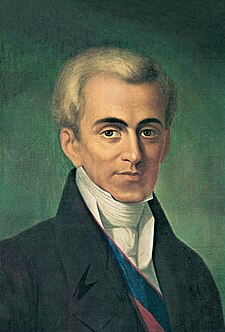
Ioannis Kapodistrias: the man who brought potato in Greece

Because of the Ottoman occupation Greece was in the eastern sphere of influence and its acquaintance with the potato was postponed some centuries.Particularly during the 19th century Ioannis Kapodistrias the first governor of Greece was the man that brought  potatoes in Greece.
 At the beginning the Greeks were suspicious with this new "vegetable". There were so many rumours about what it could cause when it was eaten or how bad was its taste that noone accepted to take any potato seeds from the government's storeroom.Kapodistrias then thought of making a trick to encourage the greeks to start producing potatoes.He ordered some soldiers to guard the storeroomwith the potato seeds. The rumour spread among the Greeks that Kapodistrias was putting guards in front of the building with the potato seeds.This made them think that these seeds were valuable since the governor was putting guards specially in the front of that building. One by one many farmers were sneaking in the building to steal the potato seeds with the consent of the guards who had orders to turn a blind eye on what was happening.

Wednesday, October 26, 2011

The photos from Marathon

Click this link for the videos and about what happened there.
http://akrokorinthos.blogspot.com/2011/09/mini-battle-of-marathon-live-in-2011.html

Here are the photos from the attempt for a re enactment of the battle of Marathon.


In the photos you'll also see a manmade hill. That hill is the tomb of the Athenians who died at the battle.
The single white column is a representation of the trophy of the battle(the original one is destroyed)

Monday, October 24, 2011

The Colossus of Rhodes

The perception that most people have about how the Colossus looked like. 

Everyone of us has a common image in our mind about the Colossus of Rhodes which was one of the seven wonders of antiquity. When we hear that name we imagine a very tall statue standing with spread legs at the gate of the port and ships passing under it and with one hand raised holding a torch.


This image was consolidated by a lithography of Rotier in 1835.  The contemporary historians though consider this image as fictional and they add that during this period there was no technical knowledge to construct such a large statue in such stance.Historically Colossus was a 33 meters tall statue and it is the second tallest statue in  history only to be surpassed by the statue of liberty in New York which is 46 meters tall.


The version that the archaeologists and engineers accept today is that the colossus had his legs closed and was located somewhere else in the port of Rhodes and not at its gate.The one who built that statue was called Charis of Lindos and it took him 15 years to accomplish it. The money for the construction of this statue came from the selling of the siege machines that Demetrius Poliorcetes had left behind in 307 BC after he failed to storm Rhodes.

the left is a more realistic depiction comparing to the right  one.


This grand statue was constructed between 292 and 280 BC but it stood on its position for only 56 years.Nevertheless the awe that this tall statue caused made it remain in the memories of people for many years.In 222 BC an earthquake struck Rhodes and the knees of the Colossus broke making the  whole statue to collapse.The pieces of the statue remained there for many centuries without being moved. There are written references to a fallen hollow statue which was admired by all visitors.Plinius mentioned that only a few people were able to hug its big finger. He also refers to the technique by which Charis of Lindos build the statue. He says that Charis built the statue just like he would built  a house. He began from the legs by adding pieces of copper while he was also filling the area with dirt to reach the height of the statue to which he was working.When the statue was finished it was all covered by dirt  which was gradually removed.
Demetrius Poliorcetes attempted to conquer Rhodes for  his father Antogonus the one  eyed  who was  at the time the strongest candidate to the vacant throne of the empire of Alexander the great. His defeat lead the Rhodians to built a big statue to thank the god Helios.

In 653 AD during the reign of the Byzantine emperor Constas the Arabs occupied Rhodes. The emir of Damascus in order to repay for the expenses of the campaign ordered the selling of the statue.A Jewish merchant from Edessa(modern Urfa) bought it, cut it into many pieces and he transferred it into Minor Asia to be sold a copper.


Even nowadays the construction of such a tall statue is really difficult.Imagine Charis of Lindos doing it in 292 BC.Colossus of Rhodes represented the god Helios(sun) whose cult was very popular in Rhodes.

put your country on top

free counters