Tuesday, December 17, 2013

Byzantine swords

It’s strange that we in the West have not hitherto paid greater attention to the study of the Byzantine world, the lineal descendant of Rome, and that Constantinople is often viewed as somehow disconnected from the Ancient Roman world when in no way was this true. Byzantium was the closest the medieval world came to fielding a super power, was unquestionably the cause of the Renaissance, and was a military force so pre-eminent that victories were routine, while defeats were studied and celebrated by that culture. There is so much to fascinate us there, and yet, we still have a long way to come in terms of appreciating it.
Between the Catholic world and the Islamic however, much has been done to throw sand over the legacy of the Romans; though we have the great fortune to live in an age where the religious and cultural reasons for suppressing the memory of Byzantium are now being swept aside in the interest of knowledge of the longest lived Empire mankind has ever produced.
Byzantine Swords represent a tradition of swords that is both familiar to the Western tradition and completely alien to it. The traditional and well trod Oakeshott Typology, as useful as it is in categorising the swords of the Catholic West, is at odds with the swords of the Byzantine World. However A. Bruhn Hoffmeyer established a typology for Byzantine Swords that is infinitely more relevant in 1966:
There are many swords which have now been identified as Byzantine which will be discussed and examined in due course. Of great use to the student of the Byzantine Sword however is depictions in Byzantine Art, which frequently show in amazing detail the Byzantine Sword as it existed in the Byzantine World contemporary to the artwork.Below is one such example showing a cruciform sword with a Type R (spherical) pommel. It is worth noting here that the Byzantine fondness of the Type R pommel extended from antiquity right through until the fall of Constantinople to the Turks in 1453:
Furthermore sometimes the Type R pommel was not peened but was attached by way of a rivet in the manner of the swords of the cavalry of the steppe:
Here the Byzantine Spherical pommel is depicted on a slightly curved one edged sword referred to as the Paramerion:
Here the Type R pommel is shown affixed to the end of a hand and half or two handed sword of the later Medieval period:
This example shows another classic cruciform design also showing a Byzantine preponderance towards hilt furniture of copper alloy, as well as spherical pommels:

One the many advantages of the Type R pommel is that it allows a pommel to have a smaller profile, as a sphere contains more mass than a disc of the same profile, which can be used to create a pleasing aesthetic such as in these examples:
This example shows a slightly flattened sphere with a Romanesque peenblock:
Below is a sword the Dr. Timothy Dawson has indicated is more likely than not Byzantine in origin, by way of decoration on the blade and its unusual (for the West) globular pommel:
The same sword was examined in Ian Pearce’s Swords of the Viking Age, below is an extract detailing the sword:
A tradition of swords existed throughout Constantinople’s history as a Christian Empire that very closely emulated the slender and long styles of swords of their Persian neighbours. The Hoffmeyer Typology lists examples at numbers 11 & 28 – 31.These swords tend towards a lenticular or pillow cross section and came in single and double edged varieties. More often that not they had parallel edges for most of the blade’s length.
Frequently the swords had a metal cross guard, but either no pommel, or an organic pommel, but in either case it is likely the pommel was a continuous part of the wood of the handle.
In other cases the swords featured copper alloy cross guards with sleeves which extended down the blade, which would enclose the mouth of the scabbard, thereby precluding rain from entering, and a grip and pommel that were attached with rivets. This method of construction extended to other types of Byzantine Swords.
This sword find from the Serce Limani shipwreck has previously been designated as Islamic in origin, but has now been confirmed as Byzantine and corroborated with contemporary pictorial evidence by Professor Valeri Yotov.It features a lenticular blade form, most of which is lost, and shows the Byzantine custom of a sleeve like projection running down the blade. It too is attached to the blade by way of rivets.
Below are accurate measurements of the find for interested parties (for some reason measurements are given in metres):
This is an example of style that was popular in Byzantine in various forms, which featured a square pommel, the square sitting on its corner rather than sitting on its side:
The pommel on this sword is somewhat like a flower bud:
The ‘Spanish’ style of hilt is represented in Byzantine Art, but who influenced whom remains a mystery.
This sword below features the Spanish style of hilt, but this style of blade may or may not have enjoyed contemporary use, or may have been artistic license. Raeffele D’Amato believes forward curved swords were in use in a period continuous from antiquity.
An example of a very large, almost Claymore-like, Byzantine Sword:
This Serbian Warrior Saint is equipped in the Byzantine fashion, the ikon comes from the late Byzatine period.
This fresco, referenced in part above, shows both a beautiful example of a Spathion and a Paramerion.
This image appears to show a Byzantine Sword like the Serci Limani shipwreck example:

A slender, compact cruciform sword from the late Byzantine Period.

There is a high probability that this sword as depicted in Oakeshott’sRecords of the Medieval Sword is Byzantine in origin, given its form being an anomaly in the West, but extremely common in the Byzantine Realms:
Examples of hexagonal pommels:
A beautiful Byzantine Sword showing an offset fuller, much like those still found on Caucasian Qamas.
As previously touched upon the Byzantine way of war frequently utilised a curved sword adapted from the Avar sabre. This appears to have been, for the most part, single edged, though pictorial sources seem to indicate that double edged variants may have existed.
The now defunct Microsoft Encarta hosted this image, which it described as “A Byzantine & German Sword”. While the top sword is definitely Byzantine in form, and the bottom may be Byzantine also, the top sword is definitely not German in origin. Thusly we may conclude that the top sword is the Byzantine.I have so far been unable to find out any other information about this superlative specimen, but continue to be on the look out for it.
The image of the sword comes courtesy of Raffaele D’Amato and shows a find from Bulgaria. It was located at the site of a Byzantine battle and was the possession of a Varangian Guardsman. What is so exceptional about this specimen is that it clearly demonstrates the mixed nature of the panoply of the Varangian Guard, even down to individual items. This is a Viking Sword but with a distinctly Byzantine cross guard.
Below is another example of the mixed nature of Varangian Guardsmen’s gear. This sword (bottom right) is a Viking Sword but with a grip and pommel riveted on in the style of Steppe Swords. It has been identified as Byzantine by Professor Valeri Yotov.
Our Lord and Saviour, comes: “not to bring peace, but to bring a sword…” (Matthew 10:34) Note again the comparatively compact hilt configuration.

Unfortunately it is no longer possible to discern what sort of pommel this sword bore, but the blade and guard are beautiful examples of the Byzantine style.

Compact hilts:

A rare depiction of a Byzantine wielding a dagger. This weapon also bears the pommel style the Byzantines made their own – Type R, or the spherical.
This image from a Byzantine site in Kosovo again depicts J.C., this time with a beautiful onion pommeled sword:
A Byzantine sabre / Paramerion variant:
A spectacular late Byzantine example with a globular pommel and stiff medial ridge:
It is not uncommon to see Byzantine examples of swords with guards which turn downward towards the hand. This configuration is sometimes seen on 20th and 21st century knives. It is surprisingly comfortable when used with a stiff wrist and strong arm.
The onion pommel together with the very Byzantine spherical peen block:
The Tetrarchs from late antiquity bear swords in the Romano-Persian style of the kind that were also implemented by Eastern Romans then and in the early medieval era:
Spherical terminals mark the ends of this crossguard, a very common feature on Byzantine swords:
Another elegant spherical pommel:
Another demonstration, this one particularly exquisite, of the Byzantine preponderance for small and refined sword hilts:
A flattened spherical pommel:
Unknown but remarkable for the detail on the scabbard:
Type R:
This example is best described as bearing the ‘pillowed’ style of guard that found favour in Byzantium:
These examples appear from time to time. I am uncertain whether they are of the ‘mushroom’ style or lobed, in other words somewhat cylindrical or flattened, as a result of artistic license. The mushroom style is corroborated, the lobed I am not as sure about:
A closer picture of Nestor bearing an attractive gold hilted sword:
Paramerions, showing the variety of shapes they came in:
This example from the 13th century:
A very interesting example showing a sword without a crossguard? Μybe a Byzantine Romphaia?


:
A Varangian Guardsman (An Imperial Guard Unit composed of Anglo-Saxons and Scandinavians)

Another compact hilted, spherically pommeled Byzantine Sword.
This exceptional fresco clearly shows a very beautiful Byzantine sword, this examples hails from 14th century Macedonia:


Sunday, November 10, 2013

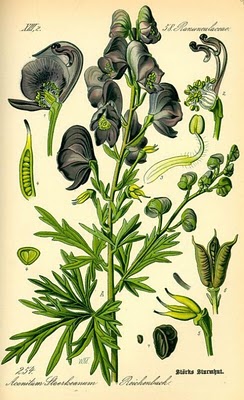
The Poison Aconite or Wolfsbane Byzantine herbs and drugs


Monkshood – Aconitum napellus, Wolfsbane - Aconitum lycoctonum; and other species

Aconite is a powerful plant, used in the past as a medicinal herb, a poison and in potions for incantations. It belongs to the Aconitum genus of flowering plant belonging to the buttercup family (Ranunculaceae).
There are over 250 species of Aconitum. The most common plant in this genus, Aconitum napellus (the common Monkshood) was considered to be of therapeutic and of toxicological importance. These herbaceous perennial plants are chiefly natives of the mountainous parts of the northern hemisphere, growing in moisture retentive but well draining soils on mountain meadows.
Some species of Aconite were well known to the ancients as deadly poisons. It was said to be the invention of Hecate from the foam of Cerberus, and it was a species of Aconite that entered into the poison which the old men of the island of Ceos were condemned to drink when they became infirm and no longer of use to the State. Aconite is also supposed to have been the poison that formed the cup which Medea prepared for Theseus. The Greeks hailed it as the Queen of Poisons, and until the 20th century, it was the deadliest toxin known to man.
The leaves and root yield its active ingredient, a potent alkaloid called Aconitine, which was frequently used to poison the tips of hunting darts or javelins. Until its toxic properties were discovered, tincture or liniment of aconite was used to relieve sciatica, neuralgia and rheumatism, for the heat-production and mild anaesthetic properties of the potion gave comfort to many an aching joint. However, its popularity took a plunge when it was discovered that the mere rubbing of preparations on skin produced symptoms like poisoning by ingestion, and thereafter was sought primarily by those who had more sinister uses for the plant. Already the author Nicander of Colophon (fl 130 BC) advised of aconite toxicity.
The poison works by targeting the cardiovascular and central nervous system, and gastrointestinal tract. All the species contain the active poison Aconitine, which exists in all parts of the plant, but especially in the root. The poison takes effect quickly. At one time, Aconite was a homeopathic remedy used in western medicine. Today, Aconite use in medicine has been discontinued in favour of safer medications.

Ancient knowledge of Aconite usage

The Greeks called Aconite lykotonon, meaning wolf slaying (Wolfsbane); this plant earned the name because it was rubbed on the arrows used when hunting wolves. Several species of Aconitum have been used as arrow poisons. Soldiers would dump aconite down wells in order to poison an enemy’s water supply.
Monkshood originated from the spittle of the beast Kerberos was dripped on the ground and this lead to the sprouting of Monkshood.
The art of poisoning was carefully cultivated in Rome, and became a flourishing industry since the early Emperors. Our knowledge of poisons available during Roman times is derived from the writings of Dioscorides, Scribonius Largus, Nicander, Pliny the Elder, and Galen. Poisons were of vegetable, animal and mineral origin. Vegetable poisons were best known and most frequently used. They included plants with belladonna alkaloids, e.g. henbane, datura, deadly nightshade and mandrake; aconite from monk’s hood; hemlock, hellebore, colchicum (from autumn crocus), yew extract and opium.
Galen understood the very deleterious qualities of botanical poisons, some cultivated for nefarious use, and others combined with beneficial drugs to engender stimulant effects (aconite, hyoscyamus, mushrooms, hemlock, mandrake, this last common in Roman times as a reliable anaesthetic). Galen commanded the technical details, best recorded in Greek by Dioscorides of Anazarbus, of animal, botanical, and mineral pharmacology.

An illustration of the species “Akoniton napellus”, folio 67V
In De Materia Medica (“The Materials of Medicine”), Dioscorides describes two different plants, the first Akoniton lycoctonum, which was used to kill panthers, wolves, and other wild beasts, and as an anodyne (pain reliever) in eye medications. In the next chapter, he describes “the other aconitum,” Aconitum napellus (monkshood), which also is toxic. Aconitum napellus is so named, says Theophrastus, because the tuberous root of the plant was thought to resemble a small turnip (napus) and “in this root resides its deadly property” (the alkaloid Aconitine). He goes on to say that, depending upon how it is compounded, the effect of the poison can be immediate or fatal in several months or even a year or two, the longer the time, the more painful the death. In general, it was deadly to any four-footed animal and “kills them the same day if the root or leaf is put on the genitals”.

Byzantine usage of Aconite as a poison

Of the 88 emperors who reigned from 324 to 1453— from Constantine I to Constantine XI— 29 died violent deaths, including several poisonings. Evidence for the use of aconitum as a poison in the Byzantine period can be found in the case of Emperor John I Tzimisces (ruled 969—976), who appears to have been poisoned by a disgruntled eunuch. He died suddenly in 976 on his return from his second campaign against the Abbasids, and was buried in the Church of Christ Chalkites, which he had rebuilt. Several sources state that the imperial chamberlain Basil Lekapenos poisoned the emperor to prevent him from stripping Lekapenos of his ill-gotten lands and riches.

John I Tzimisces entering Constantinople in Triumph with the Preslav Icon
Nowadays, Aconite’s natural habitat comprises the lower mountain slopes of the north portion of the Eastern Hemisphere; from the Himalayas through Europe to Great Britain. The Via Egnatia, one of the most important roads in the Byzantine Empire, built during the Roman Empire, to facilitate the communication between Rome and Constantinople, and connecting Durrеs to Lychnidos (Ohrid), Thessalonica (Thessaloniki), Adrianople (Edirne) and Constantinople (Istanbul), is known to be the spiritual and cultural axis, first for the spreading of Orthodox Christianity in South East Europe, and later on the spread of monkshood.

References

•            “Poisons, Poisoning, and Poisoners in Ancient Rome”, Francois P. Retief & Louise Cilliers
•            Botanical.com – Aconite
•            “Drugs for an Emperor”, John Scarborough
•            “Medicine in the Crusades: warfare, wounds, and the medieval surgeon”, Piers D. Mitchell
•             Cultural Corridors of South East Europe
All figures were borrowed from public domains in the Internet.

Related articles:

Eighteenth Annual Runciman Lecture by Judith Herrin - “We are all children of Byzantium”

Monday, September 30, 2013

Saint Christopher. A dog headed saint.


Saint Christopher is considered by the church the patron of motorcars and baby buggies.His legendary acts were mainly centered in the Black sea region.According to his hagiography Saint Christopher was a giant belonging to cynocephalic race, in the land of Chananeans(the Canines),who eat human flesh and only form of communication is barking. His original name was Reprebos(the condemned) and corresponded to his nature. He was black,ferocious and dreadful.One day he asked the god to show his power by giving him the gift of human speech.Then an angel came down, blew on in his mouth and suddenly the Saint was able to speak Greek.Still a proud giant he is cut down to size by the Christ child who commands that he carry him over a river. As he advanced into the flood,the child was becoming heavier and heavier. When Christopher was not able to go further,the child revealed its true nature and Christorer having learned his lesson devoted himself to Christian service. He was later caught by Roman authorities and martyred in the region of Lycia(land of the wolves).


source:David Gordon White, Myths of the dogman, University of Chicago press,

Sunday, September 8, 2013

Samantha Smith:The youngest peace ambassador in history


Samantha Smith holding the letter she sent to the Soviet leader Yuri Andropov.

"Actually, the whole thing started when I asked my mother if there was going to be a war.  There was always something on television about missiles and nuclear bombs.  Once I watched a science show on public television and the scientists said that a nuclear war would wreck the Earth and destroy the atmosphere.  Nobody would win a nuclear war.  I remembered that I woke up one morning and wondered if this was going to be the last day of the Earth.
I asked my mother who would start a war and why.  She showed me a news magazine with a story about America and Russia, one that had a picture of the new Russian leader, Yuri Andropov, on the cover.  We read it together.  It seemed that the people in both Russia and America were worried that the other country would start a nuclear war.  It all seemed so dumb to me.  I had learned about the awful things that had happened during World War II, so I thought that nobody would ever want to have another war.  I told Mom that she should write to Mr. Andropov to find out who was causing all the trouble.  She said, "Why don't you write to him?" So I did."
When Samantha Smith was killed in a plane crash on August 25, 1985, millions of people all over the world grieved as if for their own child.  For, in a way, she was a child of the world - a symbol of childhood itself, a guardian of our dreams and hopes for children everywhere.  The heads of the two most powerful nations on earth sent the following condolences to Samantha's mother, Jane. 

Dear Mr. Andropov,My name is Samantha Smith. I am ten years old. Congratulations on your new job. I have been worrying about Russia and the United States getting into a nuclear war. Are you going to vote to have a war or not? If you aren't please tell me how you are going to help to not have a war. This question you do not have to answer, but I would like to know why you want to conquer the world or at least our country. God made the world for us to live together in peace and not to fight.Sincerely,Samantha Smith

December 1982:  Ten-year old Samantha Smith of Manchester, ME writes a letter to Soviet Premier Yuri Andropov to express her worry about the United States and The USSR getting into a nuclear war.
April 1983:  Andropov replies to Samantha reassuring her that the Soviet Union wants no war with the United States.  He invites her to visit the Soviet Union.
July 1983: Samantha, accompanied by her parents, leaves for a two-week trip to the Soviet Union.  She visits Moscow, Leningrad, and the summer camp 'Artek'.
December 1983: Samantha goes on a 10-day trip to Japan, where she delivers a speech at the Children's International Symposium.
February 1985:  An action-adventure television series featuring Samantha is announced.  The show, starring Robert Wagner, is first called "J.G. Culver", then renamed "Lime Street."
In an international kid's camp in Soviet Union.
August 25, 1985:  Samantha, 13, and her father, Arthur Smith, are killed in a Bar Harbor Airlines crash near Auburn, ME.
October 1985:  The Samantha Smith Foundation is established.  It is a non-profit foundation fostering international understanding.
December 1986:  A statue of Samantha is unveiled in front of the State Cultural Building.  It shows Samantha releasing a dove, with a bear cub at her side.

Monday, August 19, 2013

The Hellenism of Syria and its historical decline


Map with the sites of the Greek settlement in Syria


The presence of Hellenism in the area of historical Syria and middle East starts from the 4rth century BC, after the conquests of Alexander the Great. It was boosted by the founder of the Seleucid kingdom Seleucus I who was son of Antiochus the general of King Philip of Macedon.There are some references though about Greek presence in Syria earlier than the 4rth century BC. Philosopher Livanius stated that the Greek town of Ione which was located near Antiochia of Syria was a Greek colony that was established since the times of the Assyrian empire.Ione was founded by Greek people from Argos and later it was settled by Cypriots and Cretans too.
 As a memorial for his victory against the Persians in the battle of Issus, Alexander the Great founded a city called Nicopolis and a city called Alexandria over Issus.One of the diadochi of Alexander called Antigonus founded a city called Antigoneia and settled it with Atheneans.Later Seleucus, according to Libanius founded many Greek cities in Syria to create a Greek core in his multinational empire. Libanius exaggerated by saying that Seleucus founded so more Greek colonies than Athens and Miletus did during the big colonization of the Mediterranean.
Apamea
 According to the chronographies of Malalas and Pausanias, Seuleucus founded 75 cities in Mesopotamia and Persia. The area of Syria was colonised and many cities were created and promoted Greek culture.The most famous of these was Antioch.It was founded in 300 BC and was colonised by Atheneans,Cretans,Macedonians and Cypriots. It became the center of the Hellenism and later of Christianity in Syria.
Palmyra. The ruins the findings by archaeologists suggest a strong Hellenistic presence in this ancient city.
 Antioch became a metropolis considering the city sizes of antiquity.It became a center of Greek arts,philosophy and rhetorics.Near Antioch there was an another Greek city called Apameia. Apameia was the name of the wife of Seleucus.Its citizens were also calling it Pella. According to Strabo near Apameia were also built several Greek towns like Megara, Larisa and Apollonia.
The coastal city of Laodicea took its name from Seleucus' mother.It was a prominent city in Syria just like Seleukeia over Orontes which was the port city of Antioch.Other famous Greek cities in Northern Syria were Arethousa,Epiphaneia,Ierapolis,Veroia,Herakleia,Poseidion,Herakleion, Germanikeia,Doliche,Nikopolis ,Kiristine and Seleukovilos.
Damascus was not founded by Greeks but during the Seleucid rule it was colonised by Greeks. Historians refer that Olympic games were taking place in Damascus.Another famous Greek city was Chalkis over Velus which was the hometown of philosopher Iamblichus.Homs which during the Hellenistic times was named Emessa was the hometown of the Stoic philosopher Poseidonius. Palmyra was also settled by Greeks. There are numerous of Greek inscriptions that were excavated by archaeologists.
Representation of how Antioch would look like in Antiquity
 Some of the most renowned Greeks who were born and lived in Syria were the historian Apollodorus of Artemita, the physician Apollonius of Antioch, the philosopher Apollophanes from Antioch,the son of Iamblichus Ariston, the poet Archias from Antioch, the rhetor Demetrius the Syrian, the stoic philosopher Diogenes from Seleucia and the historian Selecus from Emessa.

Antioch was the city were the terms Christians and Christianity were coined.The language of the Antiochian church was Greek. Paul the apostle who founded the church in Antioch wrote his letters in Greek.The Greek orthodox christians of Syria descend from these first christians. There are many christian text authors that were born and lived in Syria. All of the them had Greek education.

Seleucus I founder of the Seleucid kingdom which streched from Syria to India but later it would be confined only in the Hellenized region of Syria.
Until the 7th century and the rise of Islam Syria was primarily a christian country with a Greek speaking population.Antioch was the gate of Greek culture in the middle east.When the Arabs took the city, Hellenism and christianity bagan to dwindle.After 1453 and the fall of Constantinople to the Ottomans the Orthodox patriarchs of Antioch were found in a position fighting the Catholic propagnada and the massive conversion of Christians to Islam due to their persecution and for economic reasons.

 Since the 16th century when a latin bishop settled in Sidon many Orthodox christians converted to catholicism.In 1837 the Uniate church was acknowledged by the Ottoman Sultan and acquired many of the assets of the orthodox church.The Patriarchs of Antioch had meagre economic means to confront the Catholic influence.Afterwards a Russian called Porphyrius Uspensky appeared in 1843 and founded the Palestinian company which would promote the interests of Russia in the area.The Russians who wanted to take the primacy of the Orthodox world from the Greek orthodox patriarchate in Constantinople incited the Arab issue. They compelled the Syrians to abandon the Greek language as their church language and change it with the Arab language.
This scandalous intervention of the Russians caused the resignation of the Patriarch of Antioch in on April the 15th 1897 and the election of an Arabic speaking patriarch, excluding the Greek speaking candidates.
"Convent of our lady" Greek orthodox church in Syria
In the end of the 19th century the area of Syria was populated by Ansari, Chriastian and Islamic Arabs, Amenians,Bedouins,Druze(people from Libanon,Greeks,Jacobites,Ismailites(shiite Persians),Israelites,Circassians,Kurds,Latins,Maronites(people who settled there hunted by the Byzantine as heretics who adhered Monothelitism),Melkites(christianized Arabs),Syrians,Turks,Turkomans,Chaldeans,Roma people and Persians.
Byzantine Emperor Justinian and Theodora in an Orthodox church fresco.
We can say that generally these populations were descended from Ancient
 Syrians(Aramaeans),Ancient Greeks,Arabs,Turks and Western Europeans.Regarding the religion the Greek speaking populations which were under the jurisdiction of the Antioch patriarchate were located in Tarsus, Adana, Erserum and Diyarbakir.All these areas were out of historical Syria and this illustrated the general demise of Hellenism in Syria.According to unofficial statistics of the Patriarchate there were 500,000 Greek speaking people in the area that streched from Syria to Lebanon and Iraq.
The current events in Syria attract now the global attention.It's a country that traditionally had many antitheses concerning its populations that lived there.Among these populations still continue to live the remnants of the once dominant Hellenism of Syria and they are also endagered by this ongoing civil conflict. 

source: American-Greek newspaper "Hellas"(page 32)
translation of the Greek text done by the blog owner.

Saturday, August 17, 2013

The Celts in the heart of the Hellenistic world

Continuing from: http://akrokorinthos.blogspot.gr/2011/12/celts-and-greeks-acquaintance-of-two.html and
http://akrokorinthos.blogspot.gr/2011/12/celts-and-greeks-acquaintance-of-two_08.html
The regions of Asia Minor during the Hellenistic era

The Celts were unsuccesful at their campaigns in Greece. Although they plundered many of the riches of Macedonia and Thessaly, they were not able to settle down somewhere as they intended to do(They brought their families with them)

As we were saying in the part 2, one part of the Gauls returned  to the Danube,  a second one went northeast where they established the kingdom of Tylis in Thrace(Nowadays Bulgaria) and a third one was cut off from Brenus' army to join the pretender of the throne of Bithynia Nicomedes I who was fighting against his brother.

                                            Tylis: The Celts in Thrace

The Celts failed to find a new homeland in Greece but achieved it temporarily in Thrace.Comontorius found a city called Tylis and estalished a short lived realm in 279 BC. The reason for this was that later the Celts would migrate once again towards Asia Minor where they would later establish Galatia.Tylis was destroyed by local Thracian tribes in 212 BC. 

Crossing the Hellespont into Asia minor


The dying Gaul. A famous statue that was displayed in Pergamum the capital of the Attalids after their victory of the Gauls.
In the 270s three Celtic tribes numbering 10.000 men able to fight and 10.000 women and children,crossed the Hellespont under the leadership of Leonnorios and Leotarios, responding to the invitation of Nicomedes I.The Gauls settled in the area were Phrygia was located in the central Anatolian plateau. Since then the area would be called Galatia.With the use of the Celts Nicomedes I defeated Zipoetes II and was able to unite the whole of Bithynia under his rule. 
As it is aforementioned the Gauls settled in Galatia and were also reinforced with new Celtic populations that migrated from Thrace.They made their living by raiding nearby areas in Asia minor. This caused frictions and war with the powerful Seulecid empire.Eventually the Gauls were defeated by the Seleucid king Antiochus I who used war elephants in the battleground.The Gauls also sided with a pretender Seulecid King  who wanted to overthrow the rule of the Attalids in Pergamum. The Attalids however defeated the false king and his Celtic allies confining them finally back to their original territory in Asia minor.
Galatia was the Easternmost settlement of Celts in antiquity. Another feature was that this settlement was completely isolated from the Celtic world. It was like a Celtic islet within the Hellenistic world.

Galatia

Gaulish art. The face of a Gaul. The hellenistic influence is obvious.
Even though afterwards the area was named after them, the Gauls never formed a majority in Galatia. They rather formed a military aristocracy which governed the Celtic tribes in the area. The other populations in Galatia like the native Phrygians were left to control their own affairs undisturbed as long as they would pay tribute to their overlords.
A Gallic chieftain kills his wife and commits suicide. After their defeats y Antiochus I and Attalus Soter, the Gauls had to retreat back to Galatia.

The Gaulish tribes were frequently fighting each other and a Gaulish kingdom was never formed.However they were able to keep control of the region until the arrival of the Romans.
Contemporary historians called the Galatians GalloGraeci and the area Gallo-Graecia. It seems that they had adopted some aspects of Greek/Hellenistic culture.Consequently the Galatians were hellenized to a degree of almost full assimilation. During the Roman conquests of Galatia, Roman writers were marking that many Galatians were of mixed race. This suggested that there were a lot of intermarriages during the previous years.

The Organisation of tribes in Galatia.
  1. the Tectosages in the centre, round with their capital Ancyra,
  2. the Tolistobogii on the west, round Pessinus as their chief town, sacred to Cybele, and
  3. the Trocmi on the east, round their chief town Tavium. Each tribal territory was divided into four cantons or tetrarchies. Each of the twelve tetrarchs had under him a judge and a general. A council of the nation consisting of the tetrarchs and three hundred senators was periodically held at Drynemeton.

Tuesday, August 6, 2013

The Greek captain of the early U.S navy.

 George Colcovoresses


George Colvocoreses (Γεώργιος Κολβοκορέσης) was a Greek-American officer of the US navy.He was born on 22 October 1816 in Chios, descended from a noble family.During the Chios massacre by the Ottomans he was caught by the Turks along with his 2 sisters and his mother.His remaining 6 simblings were all killed.His family's property was destroyed and confiscated.

His father,with the assistance of American missionaries,achieved to release him when he was 8 years old and sent him to Baltimore in U.S.A.There he was adopted by the lieutenant Alden Partridge who was the founder of the American scientific and military academy(nowadays university of Norwich) which was the first private military educational institute in U.S.A. In 1831 he graduated and was accepted in the ranks of the American navy.In 1832 he was appointed as a recruit and in 1836 he served in the frigate "United States" which was part of the U.S naval unit of the Meditteranean which would later become the 6th fleet.From 1838 until 1842 he served in the research team of the U.S.A in the Pacific Ocean.His impressions were illustrated in a book that he wrote bearing the title:Four years in a Government Exploring Expedition.
The outbeak of the American civil war found him fighting for the North.On January 29,1862. He was captain of the frigate USS Supply and achieved to capture a transport ship of the South which was carrying war supplies.In 1864 as captain of the warship Saratoga he was distinguished  in many naval missions.In 1867 he retired with the rank of the captain.
George Kolkovoresis was assassinated on June 3,1872  at Bridgeport of Connecticut while waiting for the ship for New York.Initially his death was attributed to suicide. The case is still unsolved today.He got married twice and had 4 children.
Three of his descendants followed a military career. His son George Colcovoresses reached the rank of admiral and his great grandson Alden  Colcovoresses became a colonel.
In his honor a sea strait in the Piugit canal of Washington state was named Kolvos passage and a gulf in Antarctica was named Colcovoresses bay

 George Colcovoresses' grave

Προς τιμή του, ένα θαλάσσιο στενό στον Πορθμό Πιούτζιτ της πολιτείας της Ουάσινγκτον ονομάστηκε «Πέρασμα Κόλβος» (Colvos Passage), καθώς κι ένας κόλπος στην Ανταρκτική (Colvocoresses Bay).

put your country on top

free counters