Wednesday, March 9, 2011

Carlos Mavroleon: A Greek Mujahideen


Carlos Mavroleon

Carlos Mavroleon


 He was the old Etonian heir to a £100m fortune. He was close to the Kennedys and almost married a Heseltine. He'd been a Wall Street broker and a war correspondent. He'd even been a leader of the Mujahideen. So why did Carlos Mavroleon die of a heroin overdose in a rundown hotel near the Afghan border?


Peshawar is a rough town. Its bazaars are thick with suppressed violence and its traders rarely smile. Five times a day the call to prayer howls through the air in a clatter of static and guttural vowels. At night the roads rattle with automatic gunfire and it is impossible to tell if there has been a wedding or an assassination.
Many people die in Peshawar, violently or otherwise. Nobody chooses to end their days there. No one asks for his ashes to be scattered in the churned mud of the Storytellers Bazaar or from the battlements of the Purana Qila, the old fort. To the west of the city, the Khyber Pass leads up through the dusty, rocky hills of the Hindu Kush towards the border with Afghanistan. When the pollution above the city clears, the hills are sharp against a very blue sky. But they are gritty, sullen mountains and no traveller wants his bones to lie among them.
Carlos Mavroleon didn't want to die here. Certainly not in the small, claustrophobic hotel room where they found his heroin-soaked body, on 27 August 1998. Carlos didn't want to die anywhere. Perhaps more than at any other time in his incredible life, Carlos wanted to be alive.
He had packed it in to his 40 years. The old Etonian heir to a £100m fortune, he had been a war correspondent, a Wall Street broker, a lover of glamorous women from glamorous political dynasties (the Kennedys) and from less glamorous ones (the Heseltines). He had been a cool, gimlet-eyed war reporter, blowing off the tension of his assignments in the bars and clubs of Notting Hill. He had commanded a unit of Afghan Mujahideen against the Red Army and had been a bodyguard for a Pakistani tribal chief. And, for most of his adult life, Carlos had been a regular user of speed, coke, Ecstasy, heroin and enough pharmaceutical products to stock a large, if specialised, chemist.
But through it all, it seems, he knew what he was doing. Carlos was rarely, if ever, out of control. He pushed it to the edge, looked over - and came back again. And again and again and again. Except in Peshawar on that stinking hot August day two years ago.
On 7 August 1998, two massive blasts devastated the American embassies in Tanzania and Kenya and killed more than 200 people. American investigators followed the trail of the bombers from East Africa to Pakistan and on, via Peshawar, into eastern Afghanistan. Thirteen days after the explosions, President Clinton launched 75 cruise missiles against the camps that the CIA believed were run by Osama Bin Laden, the terrorist mastermind supposedly behind the attacks. It was called, slightly optimistically, Operation Infinite Reach, and successfully killed a dozen or so young Pakistanis who were training in the camps as well several blameless old men and a large number of goats. When the missiles went in, I was in Kandahar, a fiercely Islamic city in the desert south of Afghanistan. We heard of the attack at about midnight and I spent much of the night filing to my newspaper. It was only at dawn that I really began to realise the situation. We sat tight in the United Nations compound and listened to the radio and the chanting from the mosque.
Feelings ran high in the aftermath of the strike. In Kandahar, it took a long speech from the most senior cleric in the city to stop the mob marching on us. In Kabul, the capital 300 miles to the north, two UN peacekeepers were machine-gunned, one fatally. There were huge demonstrations against the Americans across Pakistan. Reports started circulating in Peshawar that a bounty of $15,000 had been offered by Bin Laden for dead Westerners.
Carlos was staying with his family at his father's seaside home in Athens when the missiles went in. He arrived back at his flat in Fulham, west London, to find 12 messages winking at him on the answerphone. Carlos was known to other journalists as a 'shithole specialist'. The worse the war, the deeper the poverty, the nastier the place, the better Carlos liked it. His favourite shithole was Afghanistan. The calls on his answerphone can't have been unexpected. He rang CBS, the American TV network, to accept an assignment for their flagship Sixty Minutes programme. Leslie Cockburn, the producer at CBS, knew him well. 'I can't imagine why you are calling,' he joked when he called her. 'By the way, I have a multiple Afghan visa.'
CBS wanted him to get to Peshawar as soon as possible to try to get to the camps. The hardline Taliban militia who ruled much of Afghanistan - including the bit I was stuck in - were not letting any journalists into Afghanistan. To get into the country would mean travelling in disguise. It would be very risky. Even a team of Afghan journalists had been badly beaten up and narrowly escaped execution when they tried the same exercise. But if anyone could pull it off, he could. Carlos called his fiancée, a 26-year-old TV researcher who he was due to marry in November, and then rang his father. 'Don't worry, papa, I'll be careful,' he told him. He packed his gear, picked up a $5,000 expenses advance and flew straight out to Pakistan on Emirates first class. He arrived in Peshawar on 23 August and checked into Green's hotel just off the central Saddar Bazaar. He had four days to live.
Saddar police station is only a mile from Green's hotel. Ten days after Carlos' death a smiling detective called Nisar Ali Marwat flicked a brown file on to his glass-topped desk and told me to read it. Under a slowly rotating fan, I leafed through the badly typed pages. A heavily moustached sergeant brought sweet, milky tea in stained cups. Another, sitting on a broken chair behind me, played with his handgun while I read, emptying and refilling the magazine with small, snub-nosed bullets.
The death certificate was numbered 83/98. It gave the cause of death as 'Heroin poisoning (self)'. The autopsy was conducted at 8am on 28 August by Professor Inayatur Rehman Khalil of the Khyber Medical College, Peshawar. Time of death: between 18 and 24 hours before the time of the autopsy. Carlos's body was fully rigormortised and showed no visible signs of violence. All organs were normal. The face and upper part of the chest were 'livid'. There was a blood-stained discharge from the right nostril. The left arm showed a prick-mark in the ante-cubital region and an insulin syringe contaminated with blood lay beside the body. The syringe tested positive for diacetyl morphine (heroin). Carlos's stomach also tested weakly for diacetyl morphine. There were three small packets of drugs in the room. One, opened, was diacetyl morphine. The second was crude powdered opium. The third was an antihistamine tranquilizer called chlorophenaramine maleate.
According to the police statements, Carlos was sitting upright on his bed when he was found, a cigarette between his lips. The bloody syringe was on the coffee table in front of him. There was also a blackened coin. He had died of 'heroin asphyxiation'.
A press photograph taken of his body as it was removed from the hotel shows a swarthy, good-looking man with tight, black curly hair that made him look much younger than his 40 years and a lean, muscular body. He was stripped to the waist when he died and was wearing baggy, local-style trousers.
Another sheet of paper listed his belongings: satellite phone and spare battery, camera charger, British passport B451472, small video camera, Leatherman-style knife/tool, Sony audio recorder, first-aid kit, Maglite torch, tripod and head, Sony shortwave radio stethoscope, four syringes, duty-free pack of Marlboro Lights, sewing kit, video camera battery packs and charger, two shalwar kameez (local baggy trouser and shirt), white local prayer cap, local leather sandals, Holy Koran (translation), books of Islamic history - four, $1,800 in $100 bills, $2,400 in $50 bills, and 12,265 Pakistani rupees [£150].
I read the list and looked up at Nisar Ali Marwat. The man behind me had put his pistol away. The tea cups had left oily stains on the glass of his desk. He shrugged.
When 'Bluey' Mavroleon said goodbye to his son for the last time he cannot have been too reassured by his promise to be careful. Carlos may have been kind, brave, intelligent and charming. But, by ordinary standards, he was not careful.
But then Carlos had never lived by ordinary standards. He was born in April 1958 and grew up in the rarefied air of real high society, not the ersatz Hello! version. His father is a Greek shipping tycoon who was once married to Somerset Maugham's granddaughter Camilla. She eventually left him, when Carlos was three, for Count Freddy Chandon, head of the champagne house Moët et Chandon. Carlos's mother, Giaconda, is Mexican. His brother, Nicky, is married to the filmstar Barbara Carrera. The family fortune is estimated at £100m. Carlos's address book contained phone numbers for Fawn Hall, the secretary at the heart of the Iran-Contra affair and an old flame, Barbara Streisand and Christina Onassis. He went out with Annabel Heseltine, the journalist daughter of the former deputy prime minister for two years. She wanted to marry him. When it became clear that something awful had happened to Carlos, Ethel Kennedy, wife of Bobby senior, rang the White House to find out exactly what was wrong.
In 1979, Bluey inherited the family fortune. Carlos grew up in London's Eaton and Cadogan squares and was sent to Eton but, though he did well, hated it. He started to rebel, at first in the ordinary ways; with left-wing politics, music that his parents wouldn't like, soft drugs and drink. But as ever he soon left the ordinary far behind. At 14, he left his privileged world and signed himself into a London comprehensive.
After two years of taking a lot of LSD and indulging in 'industrial scale shoplifting', he told his parents he was going to the southwest of France to stay with friends. There were no phones, he said, so they wouldn't hear from him for at least two weeks. He had calculated that would give him enough time to get free. He planned to head to Burma and smuggle rubies.

He got as far as Pakistan. High in the Hindu Kush foothills, close to the border with Afghanistan, in lands that are barely controlled by the current Pakistani administration let alone by the British Raj, Carlos did odd jobs - including bodyguard and labourer, learned to speak the guttural language of the Pashto tribesmen who looked after him and converted to Islam. He never contacted his family. They gave him up for dead.
After nearly two years, he returned to Britain and Belgravia, thin, sick and still restless. His family welcomed him back, hopeful that his youthful wanderlust was sated. Carlos worked hard to get his A levels, but played hard, too. He moved from amphetamines and acid to heroin. Before long, he had picked up a serious habit which he never entirely shook.
He may have been reckless, but he wasn't stupid. He crammed at Millfield, a top public school, and got a place at Princeton University. Not satisfied with that, he applied to Harvard and, on the strength of a successful interview and a fistful of forged references, got in to read politics. With his money and connections, he was soon mixing with the best of America's East Coast society. He was a favoured guest of the Kennedy clan. He had an affair with Mary Richardson, who later married Bobby Jnr, and a short fling with Fawn Hall.
From Harvard he went on to Wall Street. It was the 80s and Carlos, intelligent, well-connected and bold, did well. He lived in Manhattan. He made a lot of money. And spent much of it on cocaine and heroin.
And yet it wasn't enough. By 1985, the attractions of his Manhattan lifestyle had palled. He flew to Islamabad - the capital of Pakistan - and drove up to Peshawar. It was then the main headquarters and logistics base for the guerrilla groups. He introduced himself to them and convinced them to take him into Afghanistan. It was his first taste of war. Within months of returning to America he had sold the New York apartment and was on his way back to the sub-continent. He was 26.
A canal runs through Peshawar. It is full of refuse and dead animals, but the children play in it anyway. By the banks of the canal, in a bungalow set back behind high walls and a courtyard, is the Afghan Media Resource Centre (AMRC). Throughout the Afghan war, it funded journalists' trips into Afghanistan and disseminated the material they collected. It is widely believed to have been set up and supported by the CIA. Carlos used to sleep on its floor between trips 'inside'.
One of the films they have at the AMRC was taken in June 1988 near the eastern Afghan city of Jalalabad. I watched it an hour or so after reading through the police report on Carlos's death. A keen young Afghan projected it on to the only wall not covered in pictures of blown up tanks, dead guerrillas or Russian soldiers, burned out villages and downed helicopters.
First the camera pans across a field full of Mujahideen fighters. They are waiting to go into action, squatting with their weapons in lines in the sun or standing in the shade of trees. In the background are the mountains typical of eastern Afghanistan. The film flickers, jumps and weaves. A bearded, grinning Carlos appears.
'My name is Karimullah,' he says, his voice deep and unaccented. He is wearing the pakol - the beret-like woollen cap of northern Pakistan and Afghanistan - and has four curved magazines and an AK47 slung across his shoulders. He is a head taller than everyone else. His new name means 'blessed by God'.
'I am a Mujahideen,' he continues. 'We are making an attack today on the city of Jalalabad. All the Mujahideen commanders have come together for this attack. I am very happy and proud to be with my Mujahideen brothers. Allahu Akbar. God is great.' Karimullah then continues in fluent Pashto. 'I am from London. In London I fought the Jihad with a pen. Now I fight it with a sword. I have come to Afghanistan to take part in the Jihad.'
The cameraman asks if when the Jihad is over Carlos/Karimullah will bring his family to Afghanistan. 'Inshallah [God willing],' he replies with a broad smile. Carlos had arrived in Peshawar three years previously. At first he had been involved in the political side of the Mujahideen's struggle, handling foreign journalists and visiting American VIPs, but the urge to be physically involved in the action became too strong. By 1988, he was an experienced fighter and, according to former comrades-in-arms, a good one.
'When you go into battle, you do what you are told. Karimullah would do whatever he was asked and do it well,' said one former comrade. Several former fighters said that by the end of his time in Afghanistan, Carlos was in charge of a dozen men and was running ambushes by himself. He was always in the thick of any action and even prayed longer and harder than his comrades. One former Mujahideen remembered how Carlos had gone outside for dawn prayers in a freezing gale and had returned wet through. 'We laughed at him when he came back in, but he just said "Ahumdilallah [God be praised]", and lay down again.'
In 1989, the Soviets pulled out. The war carried on as the guerrillas took on the Moscow-backed government's forces, but Carlos was becoming disillusioned with the infighting among the various groups. It was time to reinvent himself again. He returned to London and within months had metamorphosed into a war correspondent. At the end of his time in Afghanistan he had worked as a cameraman and had shot footage of frontline action. With that, and his languages and charm, the work was soon rolling in. In 1991, he was in Oman trying to sneak, in disguise, into Kuwait during the Gulf War. He failed, but succeeded in getting into northern Iraq a few months later. The next assignment was Somalia, then the Sudan, Burma, Angola, Rwanda and back to Afghanistan. On several occasions, he found himself back in Peshawar. Twice he tried and failed to use his connections with the Mujahideen to get access to Osama Bin Laden.
In the early 90s, he made a number of trips to Somalia for the American networks. Tim Deagle, a journalist who had worked with Carlos in East Africa, said their time together had revealed Carlos as 'a seriously good human being'. 'Despite everything we saw - and we saw hundreds of dead bodies in a day - he never lost his compassion. We went into one village and there were about three people left uninjured and he went around giving out first aid and looking after people. Most would have just taken their pictures and left.'
Yet there was a spirit of recklessness in Carlos, a flamboyance, that seemed never to die. Deagle remembered his colleague insisted on a lunch-stop during a particularly chaotic moment during the fighting. 'He had found two lobsters, so we stopped in a field hospital with an army withdrawing around us and cooked them up and ate them with bayonets.'
On another occasion, Deagle found Carlos standing on top of a jeep with a pistol in his hand, a huge stack of dollars in the other and a crowd of angry Somali gunmen around him. 'NBC and ABC had asked him to pay off the people they had hired for protection. Carlos told them all they had to pray before he would pay them. You or I would have been executed on the spot, but he got away with it. He always did.'
In between trips, he had a number of relationships - 'women just flocked to him' according to his brother - and took a lot of cocaine. He spent time in the clubs and bars of Chelsea and Notting Hill. He read dozens of books, usually classics, and read and re-read TE Lawrence's Seven Pillars of Wisdom . He wrote book reviews for the Literary Review . Almost always he managed to keep his addiction hidden. Colleagues who he worked with closely for years never saw him take drugs. There are hints though that he did. Several people in Peshawar told me that he had got into an argument with an Afghan journalist after smoking heroin in Jalalabad. It was in 1996 after a second failed attempt to find Bin Laden. It seems Carlos didn't cope with disappointment well.
Green's hotel is gloomy and claustrophobic. Poor backpackers and wealthy Pakistanis stay there, not journalists working for American networks. Carlos's room cost £8 a night and was on the third floor facing east. From its small window there was a view of tangled electricity wires and roofs.
Carlos arrived in Peshawar on the evening of Sunday 23 August. He dumped his bags and walked a hundred or so yards to the office of The News - a local paper - to catch up with Rahimullah Yusufzai, a Pathan reporter who knows everyone and everything. If Osama Bin Laden wants to talk to the Western world he gives a statement to Rahimullah. So do the Taliban.
Rahimullah knew Carlos from the time of the Afghan war and was generous with his advice. He was happy to talk over the various ways to get to the bombed camps, even though he was trying to work out how to reach them himself. Yusufzai told Carlos what he must have suspected: that his only chance was to disguise himself as a local and work his way through the mountains and across the border. The best place to try, Rahimullah said, was from the small town of Miram Shah which is only a score or so miles from the camps themselves. The next day Carlos hired a car - a big Toyota pick-up - and a driver and set off. By nightfall he was at Bannu, a dusty town on the edge of the mountains, by late afternoon on the next day he was in Miram Shah itself.
Within hours he was picked up by Pakistani intelligence services. It was the evening of Tuesday the 25th. Though the Pakistani spooks didn't touch him, they scared him. The whole of the country was jittery after the strikes and the intelligence services were more jumpy than anyone. Despite his credentials, he must have had a hard job convincing his interrogators of his true identity and purpose. After a tense and sleepless night he was put on a bus back to Peshawar. As he was not found to be in the possession of heroin when picked up on Tuesday evening, it is fair to assume that he bought the drug after his release from custody.
Around 7.30pm the next day, Cockburn, his producer, began calling Carlos's satellite phone. It rang out every time. By the evening, she was very anxious. She called Green's and was told that Carlos had his key and was in his room which was locked. She kept trying the sat'phone. Eventually the hotel staff used a master key to open the door of the room. Carlos was dead on the bed. He had died a few hours earlier.

I arrived in Peshawar on the day Carlos died. After three days stuck in the UN compound while the authorities tried to restrain angry mobs in the streets we were finally evacuated by the UN back to Pakistan and I had driven up to Peshawar to cover the story of the missile strikes' fall-out from there. After only a few hours in the city, a local newspaper editor, Faisal Quazi, called me on my mobile to ask if I knew anything about the dead British cameraman.
That evening, Peter Jouvenal, a veteran cameraman who knew Carlos from the days of the Afghan war, mentioned over a drink that the dead man had been to Eton. Suddenly everyone wanted an answer to the same question: how did a man with so much end up dying in such a mean and sordid way? Two year's on there is still no good answer. And, as a result, though the authorities have officially closed the file, there are many who believe that the bald facts of the police report and the post-mortem are concealing something more sinister.
One thing everyone seems to agree on is that Carlos would have been unlikely to have accidentally overdosed. Nicky Mavroleon pointed out that his brother was an experienced drug user. 'Carlos used to tell me that to him it was like having a drink. When he was having a good time he just wanted to get high... but he always knew what he was doing,' he said. Carlos did have a doctorate in drugs and he was far from unused to the vagaries of the local Peshawar heroin.
Also, everyone seems to agree Carlos had not injected for years. Not since 1993 according to his doctor. He had been put off by a friend dying of Aids some years before, his father said. Would he suddenly switch back to syringes? Particularly if, as the police suggest, he had already been smoking the drug.
Could he have committed suicide? Rahimullah Yusufzai saw him shortly before he died and said that though he was shaken by his ordeal at the hands of the intelligence men he was not too worried. A CNN cameraman who bumped into him in a Peshawar street later that day said, with no pun intended, that he 'seemed full of beans, really on a high'.
'He told us how he had been in prison and seemed to think that it was all very amusing,' the cameraman said. 'He had a cutting from a local paper that said that he was a British spy which he said he was going to have framed.'
Everybody who knew him said he was planning to settle down and was as happy as he had ever been. He was to marry in the autumn and was, according to his father, 'devoted' to his fiancée. He had also never entirely lost his Muslim faith and in Islam suicide is as great a sin as it is in Catholicism.
And it seems strange that he would be taking drugs at all. As an old south Asian hand, he must have known that, at least following his arrest, he would almost certainly be under surveillance? Would he have bought the heroin anyway? So would an experienced drug-user make a major mistake using a method he had given up at a time of his life when more than anything he wanted to be clean and happy?
Carlos Mavroleon after he had converted to Islam
The answer has to be yes. If the suicide scenario is rejected, as it has to be, and the accidental overdose explanation is thrown out too, you are left with nothing but half-baked conspiracy theories. We know that he was tailed throughout his stay in Peshawar and that Green's hotel staff were interrogated by intelligence men both before and after his death. And we know that he was suspected of being a spy. And we can assume the intelligence services, who were tailing him, knew he had bought drugs. But Peshawar breeds conspiracy theories. The basic fact is that there are easier ways to kill someone than making them inject themselves with a deadly syringe. You have to apply Occam's Razor. What is more plausible - an accidental suicide or a plot involving spooks and forced overdoses? In the end, all that you are left with is a grieving family, a brown file on a police chief's desk, a dozen badly typed sheets of paper and the pathologist's 'Heroin poisoning (self)'. The most likely scenario is that a bitterly disappointed Carlos turned to the stand-by which had always helped him when he was feeling low. Relatives say that despite his amazing life he actually had very low self-esteem. The heroin was a prop when he felt down.
And that afternoon in Peshawar the disappointment must have been acute. He desperately wanted the assignment to work. To have got the footage from the camps would have made him a media star. He was 40, wanted children, wanted to settle down and wanted some conventional respect from his more conventional peers. And having, in the last few years, watched reporters like Carlos working in Iraq, in Sierra Leone, in half a dozen other such places, I have seen, and felt the sense of heroic difference, the adolescent joy at your distance from the nine-to-five, from the office, from the suits. Heroin gives you that distance, too. If, when he returned to Green's hotel, Carlos momentarily lacked it he wouldn't for long. To start with he would have felt a mellow, sleepy high as the drug triggered the release of dopamine in his brain. It is quite likely that, if he started off smoking the drug, he would welcome the rush of an injection straight into the bloodstream. If you haven't been using the drug for a while the rush is, one regular heroin user tells me, intensified. A wave of contentment overcomes you. Things stop mattering. For Carlos, by the late afternoon of 27 August 1998, as the towers of Peshawar's mosques stretched their shadows across the superheated roofs of the city and the loudspeakers crackled into the Maghreb prayer, nothing mattered at all.
I left Pakistan earlier this year. Every week I get calls from old friends and contacts in Peshawar and Islamabad. Recently, I have been asking if anything new has turned up on Carlos's death. People have forgotten it now, and these days I am offered friendly advice rather than information. 'Let sleeping ghosts lie,' said one police officer I know.
If Carlos has a ghost it is unlikely to be sleeping.


source: The Guardian

A Greek-Georgian cosmonaut

FYODOR NIKOLAYEVICH YURCHIKHIN
His mother is Greek and his father Georgian
 
FYODOR NIKOLAYEVICH YURCHIKHIN (PH.D.)
RSC ENERGIA TEST-COSMONAUT


PERSONAL DATA: Born January 3, 1959, in Batumi, Autonomous Republic of Ajara in Georgia. Married to Larisa Anatolievna Yurshikina, born in Shyolkovo, Moscow region. They have two daughters. His father, Nikolai Fyodorovich Yurchikhin, and mother, Mikrula Sofoklevna Yurchikhina(from Grammatikopoulos family), reside in Sindos, Greece. He also has a brother, 2 years younger. Hobbies include collecting stamps and space logos, sports, history of cosmonautics, and promotion of space. He also enjoys reading history, science fiction and the classics.

EDUCATION: After graduation from high school in Batumi in 1976, he entered the Moscow Aviation Institute named after Sergey Ordzhonikidze. He finished studying in 1983, and is qualified as a mechanical engineer, specializing in airspace vehicles. In 2001, he graduated from the Moscow Service State University with a Ph.D. in economics.

EXPERIENCE: Since graduating from the S. Ordzhonikidze Moscow Aviation Institute in 1983, Yurchikhin has worked at the Russian Space Corporation Energia. He began working as a controller in the Russian Mission Control Center, and held the positions of engineer, senior engineer, and lead engineer, eventually becoming a lead engineer for Shuttle-Mir and NASA-Mir Programs.

In August 1997, he was enrolled in the RSC Energia cosmonaut detachment as a cosmonaut-candidate.

From January 1998 to November 1999, he completed his basic training course. In November 1999, he was qualified as a test cosmonaut. In January 2000, he started training in the test-cosmonaut group for the ISS program.

In October 2002, Fyodor Yurchikhin flew aboard STS-112. In completing his first space flight he has logged a total of 10 days, 19 hours, and 58 minutes in space.

Fyodor Yurchikhin is currently serving a six month tour of duty as commander of the Expedition-15 mission to the International Space Station. Expedition-15 launched on April 7 aboard a Soyuz TMA-10 spacecraft arriving at the ISS complex on April 9, 2007.

SPACE FLIGHT EXPERIENCE: STS-112 Atlantis (October 7-18, 2002) launched from and returned to land at the Kennedy Space Center, Florida. STS-112 was an International Space Station assembly mission during which the crew conducted joint operations with the Expedition-5 by delivering and installing the S-One Truss (the third piece of the station's 11-piece Integrated Truss Structure). Three spacewalks were required to outfit and activate the new component. The crew also transferred cargo between the two vehicles and used the shuttle's thruster jets during two maneuvers to raise the station's orbit. STS-112 was the first shuttle mission to use a camera on the External Tank, providing a live view of the launch to flight controllers and NASA TV viewers. The STS-112 mission was accomplished in 170 orbits, traveling 4.5 million miles in 10 days, 19 hours, and 58 minutes.

Kallergi's Pan-Europa (E.U)

Richard Nikolaus von Coudenhove-Kalergi descended from the Coudenhove-Kalergi family from his father side. His mother was Japanese. The Coudenhove-Kalergi family was formed with the marriage of  Franz Karl Coudenhove (1825-1893) and Maria Kalergi(1840-1877) .The Kalergis were a Byzantine noble family who ruled  the island of Crete After the Ottoman conquest of Crete in 1669 they fled towards the Ionian islands and the rest of Europe.


The national poet of Japan

Lafcadio Hearn (Koizumi Yakumo,小泉 八雲) was born in Lefkas, Greece. He was a son of an army doctor Charles Hearn from Ireland and a Greek woman Rosa Cassimati.Charles Hearn and Rosa Cassimati met in the Greek island of Cythera.Charles Hearn was possibly serving at the British navy.
Leucadio Hearn 


Lafcadio Hearn was born in the island of Lefkas where the couple lived and from the name of the island he got his name and was baptised according to the christian Orthodox customs in the Saint Paraskevi church.He was also given the name Patrick which is the name of the patron saint of Ireland but he never used it.

Suddenly his childhood would change so much that we can say it defined the course of the rest of his life.When Leucadio was 4 years old  Charles and Rosa moved out from the mediterranean Leucada and went in the Northern and dull Ireland.
The change of setting was not the only thing that affected his psychology.The aristocratic family of Charles Hearn never accepted Rosa and made the couple's life difficult to make to clear that they were not welcome.Some years after Charles Hearn asked for a divorce and ousted Rosa back to Greece in order to marry an Irish woman. Lafcadio would never see his mother again.
Rosa died  59 years old in a psychiatric clinic in Corfu.

The custody of Lefcadio was taken by one of his Irish aunts.
At this period Lefcadio was maltreated by his aunt. He reported that he was locked in a dark room that looked like a prison.However his aunt took care for his education and sent him to an Irish college.

Some years after, his aunt lost much of her fortune and Lefcadio was sent out of her home. He decided to take a ship for New York.In New York he was living like a trump doing some jobs just to make ends meet.
Later he went to Ohaio were he started his carreer in mass media. In Ohaio he worked in  printing press correcting mistakes in essays and journals. However an eye problem(he could see only from one eye) made his job very difficult and thus he left Ohaio for N.Orleans where he became a famous journalist. He was hired for a local newspaper to cover the crime news in N.Orleans. He became known for his writtings about the dark side of N.Orleans and about its mixed ancesty residents.He left New Orleans too after some years because of a failed marriage with a woman from N.Orleans.

In 1890 he travelled to Japan as a correspodent of an American magazine.He worked in Matsué as an English teacher of Shimané Prefectural Middle School. In Matsué, he got acquainted with his lifelong friend Nishida Sentarô, a colleague teacher, and married Koizumi Setsu, a daughter of a samurai.

In 1891, he moved to Kumamoto and had taught at the Fifth High School for 3 years. Kanô Jigorô, the president of the School of that time, is known as the man who spread judo to the world.

In 1896, when he lived in Kôbé after he worked as a journalist there, he got Japanese citizenship and a new name, Koizumi Yakumo. This name was taken from "Kojiki", a Japanese ancient myth.

On that year, he moved to Tôkyô and began to teach at the Imperial University of Tôkyô. There he got respect of students and many of them made a remarkable literary career.

In addition, he wrote much reports of Japan and published in America. His works was read by so many people as an introduction of Japan.

He quit the Imperial University in 1903 and began to teach at Waseda University on the year next. But after only a half year he died of angina pectoris.
Due to his problematic left eye most of his photos are taken from this angle

He got his inspiration as a poet right from his first step in Japan. He considered the Japanese culture more humanistic and pure than the western culture.He didn't trace the roots of the japanese culture in the high nobility but in the people who according to Hearn carried this national legacy that they took from their ancestors.In his writtings he mentions Ancient Greece and compares it to Japan . Surely the lack of his father's interest on him had a big impact  as also the loss of his mother  whom he considered more alike to him is a major theme in his works.He got initiated and admired the Japanese religion which he believed was crucial in the creation of the psychosynthesis of the Japanese people.


                                                                    Main Works


Glimpses of Unfamiliar Japan
Out of the East
Kokoro
In Ghostly Japan
Shadowings
A Japanese Miscellany
Kwaidan
Japan: An Attempt at Interpretation


Constantine Phaulcon(Gerakis)


Constantine Phaulkon (born Κωνσταντίνος Γεράκης or Constantinos Gerakis; Geraki is the Greek word for falcon, in French Monsieur Constance, in Thaiเจ้าพระยา วิชาเยนทร์ - Chao Phraya Wichayen, in Portuguese Constantino Falcão) (1647 - June 5, 1688) was a Greek adventurer, who became first counsellor to King Naria of Ayutthaya.
Born on the Ionian island of Kefalonia, Phaulkon came to Siam (today's Thailand) as a merchant in 1675 after working for England's East India Company. He became fluent in Thai in just a few years and began to work at the court of King Narai as a translator (he was also fluent in English, French, Portuguese, and Malay). Due to his experience with the East India Company, he was soon able to become a counsellor of the king.
In 1682, Phaulkon abandoned Anglicanism for Catholicism and soon after married a Catholic woman of mixed Japanese Portugal-Bengali descent named Maria Guyomar de Pinha. They lived a life of affluence as Phaulkon rose to become highly influential at the Siamese court of king Narai.
Following troubles with the English and the Dutch, Phaulkon engineered a Franco-Siamese rapprochement leading to the exchange of numerous embassies between France and Siam, as well as the dispatch of an expeditionary force by the French in 1687. Phaukon was called "Monsieur Constance" by the French, and was their main ally for several years.
The Abbe de Choissy, who was part of the first French embassy to Thailand in 1685, wrote about M. Phaulkon's character:
"He was one of those in the world who have the most wit, liberality, magnificence, intrepidity, and was full of great projects, but perhaps he only wanted to have French troops in order to try and make himself king after the death of his master, which he saw as imminent. He was proud, cruel, pitiless, and with inordinate ambition. He supported the Christian religion because it could support him; but I would never have trusted him in things in which his own advancement was not involved"
—Abbe de Choissy, Mémoires pour servir à l'histoire de Louis XIV, 1983:150.
Phaulkon's closeness to the king naturally earned him the envy of some Thai members of the royal court, which would eventually prove to be his undoing. When King Narai became terminally ill, a rumor spread that Phaulkon wanted to use the designated heir, Phra Pui, as a puppet and actually become ruler himself. As unlikely as this was, it provided an excuse for Pra Phetrarcha, the foster brother of Narai to stage a coup d'etat the 1688 Siamese revolution. Without the king's knowledge, both Phaulkon and his followers as well as the royal heir were arrested and executed on June 5, 1688 in Lopburi. When King Narai learned what had happened, he was furious -- but was too weak to take any action. Narai died several days later, virtually a prisoner in his own palace. Phetracha then proclaimed himself the new king of Siam and began a xenophobic regime which expelled almost all foreigners from the kingdom.
The different interpretations of Phetracha's motivation for ordering the arrest and execution of Phaulkon have made the Greek's position in Thai history somewhat controversial. Supporters of Phetracha's actions have depicted Phaulkon as an opportunistic foreigner who sought to use his influence to control of the kingdom on behalf of Western interests. More skeptical historians believe that Phaulkon was simply a convenient scapegoat - a means for Phetracha to seize the throne from the rightful heir by capitalizing on the envy and suspicion Phaulkon had engendered.


Modern Greek explorers- Έλληνες εξερευνητές

Demas Range (75°0′S 133°45′W) is a range about 8 nautical miles (15 km) long that forms the lower east margin of the Berry Glacier in Marie Byrd land. The range trends north-south culminating in Mount Goorhigian (1,115 m). Discovered by theUnited States Antarctic service (USAS), 1939–41, led by Admiral R.E Byrd. Named by Advisory commitee of Antrctic names (US-ACAN) for E.J. "Pete" Demas(Πέτρος Δήμας), a member of the Byrd Antarctic expeditions of 1928-30 and 1933-35.


Pete Demas on the left
Ο Επαμεινώνδας Δημόπουλος ήταν Έλληνας εξερευνητής.
Ήταν γνωστός με το όνομα E. J. Demas',και πήρε μέρος στις εξερευνητικές αποστολές του Ναυάρχου Bird στο Νότιο και Βόρειο Πόλο. Προς τιμή του μια Ελληνική Σημαία πέταξε πάνω από το Νότιο Πόλο και μια οροσειρά ονομάζεται Demas Range.
Στο Ναυτικό Μουσείο της Ελλάδας βρίσκονται και τα ενθύμια του


Panayotis Potagos (1839-1903) was a Greek physician and explorer from Arcadian Vytina. Potagos began his travels in 1867, visiting Iraq, Iran, Afghanistan, Gobi desert , and India. He arrived in Egypt in 1876, ascending the Nile river to southern Sudan and then crossed into the Congo river basin through what is now the Central African Republic and finally reached the Uele river in 1877. He was the first to reach Mbomu and Uele rivers from the north. He published an account of his travels, which was translated in French


www.wikipedia.org
Brumidi's fresco. The apotheosis of Washington.
Constantino Brumidi

Costantino Brumidi (July 26, 1805 – February 19, 1880), was an Italian/Greek-American historical painter, best known and honored for his fresco work in the Capitol Building in Washington, DC.

Brumidi was born in Rome, the son of Stavro Broumidi, a native of Filiatra (in western Messinia, a district in the Peloponnesos, a region in southern Greece). His mother was from Rome. He showed his talent for fresco painting at an early age and painted in several Roman palaces, among them being that of Prince Torlonia. Under Gregory XVI he worked for three years in the Vatican.

The occupation of Rome by French forces in 1849 apparently persuaded Brumidi to emigrate, having joined the short-lived risorgimental Roman Republic, and he sailed for the United States, where he became a naturalized citizen in 1852. Taking up his residence in New York City, the artist painted a number of portraits. Subsequently he undertook more important works, the principal being a fresco of the Crucifixion in St. Stephen's Church, for which he also executed a Martyrdom of St. Stephen and an Assumption of Mary.

In 1854 Brumidi went to Mexico, where he painted an allegorical representation of the Holy Trinity in the Mexico City cathedral. On his way back to New York he stopped at Washington D.C. and visited the Capitol. Impressed with the opportunity for decoration presented by its vast interior wall spaces, he offered his services for that purpose to Quartermaster General Montgomery C. Meigs. This offer was accepted, and about the same time he was commissioned as a captain of cavalry.


His first art work in the Capitol Building was in the meeting room of the House Committee on Agriculture. At first he received eight dollars a day, which Jefferson Davis, then Secretary of War of the United States, caused to be increased to ten dollars. His work attracting much favourable attention, he was given further commissions, and gradually settled into the position of a Government painter. His chief work in Washington was done in the rotunda of the Capitol and included the Apotheosis of George Washington in the dome, as well as other allegories, and scenes from American history. His work in the rotunda was left unfinished at his death, but he had decorated many other sections of the building, most notably hallways in the Senate side of the Capitol now known as the Brumidi Corridors.

In the Cathedral-Basilica of Sts. Peter and Paul in Philadelphia, Pennsylvania, he pictured St. Peter and St. Paul. Brumidi was a capable, if conventional painter, and his black and white modeling in the work at Washington, in imitation of bas-relief, is strikingly effective.

He died in Washington, DC.

Saturday, February 12, 2011

Modern Arts vs History how famous greeks have been depicted by their contemporaries and how they are depicted today. .

                       
Miltiades: The general whose tactics brought the Athenean victory in the battle of Marathon during the Persian wars.
Aristotle: One of the big three of ancient Greek philosophy. The first scientist , Tutor of Alexander the Great.


Hypatia: The first female philosopher. A victim of religious fanatism.

                                             Above:  Socrates the founder of Western philosophy


Pericles: The ruler of the Athens during the Golden
   Plato: One of the big three of the ancient Greek Philosophy. Student of Socrates


 Alexander the Great: The Macedonian conqueror

 Aspasia : Pericle's wife . Otherwise called "The first lady of Athens"


                                                            Queen Cleopatra of Ptolemaic Egypt                                                                  


King Leonidas of Sparta

Wednesday, August 26, 2009

The Aegean port of Ancient Corinth. Kechries


In ancient times, Kenchreai was one of the two ports of the inland city-state of Corinth. While Kenchreai served the eastern trade routes,Lechaion on the Corinthian Gulf served the trade routes leading west to Italy and the rest of Europe. SItuated on the eastern side of the Isthmus of Corinth, Kenchreai sat at a natural crossroads for ships arriving from the east and overland traffic heading north and south between central Greece and the Peloponnese. The origin of Kenchreai is unknown, but it must have been inhabited from early times, probably in prehistory, on account of the deep natural harbor that was favorable for landing ships. The area is endowed with abundant water sources, a massive bedrock of oolitic limestone that excellent building stone, and several defensible positions with good viewpoints. The name of the site seems to derive from the ancient Greek word for millet, and the area's capacity for agricultural production is still evident.
The earliest textual sources for Kenchreai, an epitaph of the Late Archaic period (late 6th-early 5th century BC) and references in historical and geographical writings of the Classical to Hellenistic eras (5th-2nd centuries BCE), reveal that there was a permanent settlement and a fortified naval station. Few archaeological remains survive from this early settlement, but it seems to have been located westward form the modern coast, along the prominent ridge that borders the modern village to the north.

Panoramic view of the area of Cenchreai
Kenchreai flourished during the Roman Empire, when the settlement was focused around the crescent-shaped harbor enclosed by massive concrete breakwaters and protected by sea-walls. The local community was small but prosperous, and it was distinguished by its social, cultural, and religious diversity. Ancient literature and inscriptions from the site attest to the presence of cults of Aphrodite, Isis, Asklepios, Poseidon, Dionysos, and Pan. Christianity also arrived at Kenchreai early in the religion's history. According to acts 18:18, the Apostle Paul stopped at Kenchreai during his second missionary journey, where he had his hair cut to fulfill a vow. He mentions the place and a deaconess named Phoebe in the local assembly in his epistle to the Romans . A later ecclesiastical tradition recorded the existence of a bishop at Kenchreai, but the veracity of these accounts is hard to establish.
the ancient harbor
The ancient harbor was partly excavated in 1962-1969 by a team sponsored by the American school of classical studies under the general direction of Professor Robert Scranton. Excavations have uncovered several buildings that attest to the commercial vitality of the port throughout the Roman Empire and into the 7th century, when maritime activity and local habitation apparently diminished. The most impressive buildings located at the north and south ends of the harbor include blocks of rooms near the waterfront (probably warehouses); fishtanks; monumental complexes decorated with sculpted marble, mosaic pavements, and wall-painting (either sacred structures, lavish seaside villas, or rich public benefactions); and a small Christian basilica.=
Since 2002, survey and excavation jointly sponsored by the American School and the Greek Ministry of Culture has explored the area immediately north of the harbor on the low coastal ridge called Koutsongila. These new investigations have concentrated on a vast cemetery of Early Roman chamber tombs and Roman to Early Byzantine cist graves, an opulent residential quarter facing seaward, and other large structures overlooking the harbor. The bountiful artifacts and structures found both at the harbor and on Koutsongila reveal the considerable wealth of local residents, including several objects of exceptional artistic quality, and a connection to points of production and exchange to the east in the Aegean islands, Asia Minor, and the Near East.
Historical and geographical texts of the Byzantine and post-Byzantine eras indicate that Kenchreai was still used by travelers and Imperial expeditions. While the ancient harbor could still receive ship traffic after antiquity, the archaeological evidence for medieval occupation is thin, and any permanent settlement must have been smaller than in ancient times. A small harbor facility operated during early modern times, mostly serving to export local produce, including grains, citrus fruit, and tomatoes.
www.wikipedia.org


Thursday, May 7, 2009

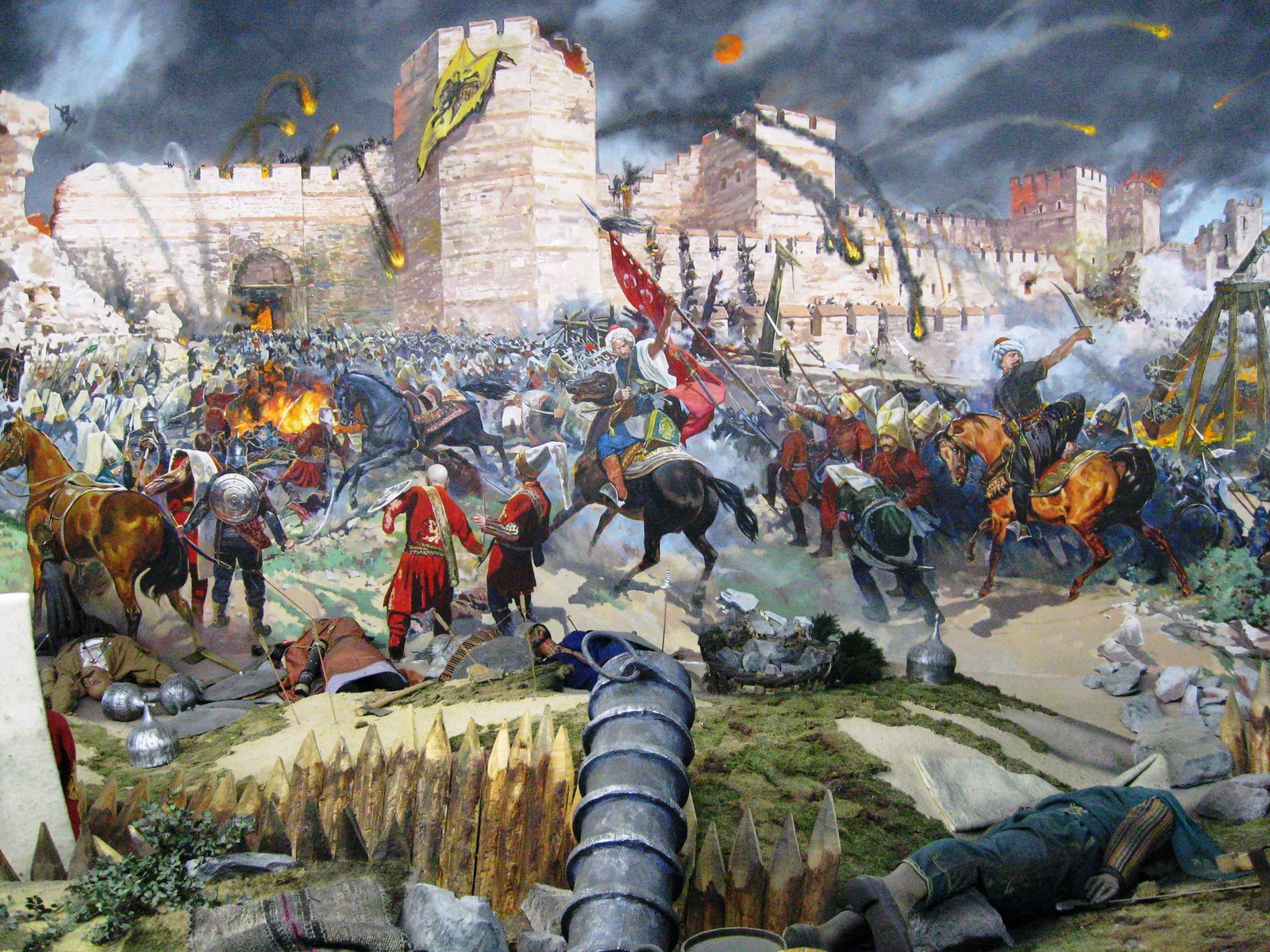
The fall of the last bastion of the Romans.

Constantine Paleologus the last Byzantine(Roman for many historians) emperor

Or otherwise called the fall of Constantinople(modern day Instambul) to the army of the Ottoman sultan Mehmet fatih.

The chronicle of the inevitable end


Ottoman army marches from Edirne to Constantinople.
At the beginning of 1453 the Sultan's army began massing on the plain of Adrianople. Troops came from every region of the Empire. Possibly well over 150.000 men, including thousands of irregulars, from many nationalities, who were attracted by the prospect of looting, were ready to assault the city. The regular troops were well equipped and well trained. The elite corps of the Janissaries composed of abducted Christian children, forcibly converted to Islam, and subsequently trained as professional soldiers, constituted the spear-head of the Ottoman army. The besieging army included a number of artillery pieces, of which one, facing the Military Gate of St Romanus, was particularly huge and was expected to cause heavy damage to the walls in that area. The army, accompanied by crowds of fanatic Dervishes, started moving slowly towards Constantinople. A few small towns, still in Greek hands, near the capital were soon occupied by the Sultan's army. Of those towns Selymvria resisted longer.
During the first week of April the Ottoman troops began taking their assigned positions in front of the city walls. The Sultan had his tent installed north of the civil Gate of St Romanus, near the river Lycus, facing the 5th Military Gate, also known as Military Gate of St Romanus. He ordered the big canon to be installed in the same area. To protect the troops, a protective trench was opened in front of the Ottoman units, the earth from it was accumulated on the city side and on top of it was erected a palissade. On the 12th arrived from Gallipoli the Ottoman fleet. Composed of approximately 200 ships of various sizes and displacements, it sealed the Byzantine capital from the sea. Mehmed's admiral was the Bulgarian renegade Suleiman Baltoghlu. On his side the Emperor distributed his troops as best as he could. It was impossible, with the available garrison, to cover the entire walled circumference of the capital, about fourteen miles long. However, it was clear to all that the main attack would be delivered by the enemy along the land-walls, about four miles long. With the exception of the Blachernae section of the walls, at the north-eastern end of the land side, the city was protected, on the land side, by a triple wall, with a deep foss in front of it. On the sea side, including the Golden Horn port area, the city was protected by a single wall.
Given the availability of troops and the critical sections of the walls, Giustiniani, with most of his men, as well as the Emperor and his best troops, took position in the Military St Romanus's Gate sector, where heavy damage was expected to be inflicted by the canon and the main Ottoman assault to be launched. The Venetian Bailo (the Head of the Venetian Community at Constantinople) Girolamo Minotto and his countrymen were charged with the defence of the region of Blachernae, where the Imperial Palace was located. Minotto and his men faced the European troops of Karadja Pasha. Across the Golden Horn, to the left of Pera, ready to intervene, stood the troops of Zaganos Pasha. Along the southern section of the land-walls the defenders faced the Anatolian troops under the command of Ishak Pasha. The Grand Duke Luke Notaras, with a reserve unit took position near the walls, at the Petra neighborhood, in the north-eastern section of the city. Another reserve unit was stationed near the church of the Holy Apostles, near the center of the city. Most units were positioned on and behind the land-walls. The sea-walls were thinly manned. To protect the entrance to the port the Venetian commander of the small fleet of the defenders, Alviso Diedo, ordered ten ships to take position behind the chain.
According to Islamic tradition the Sultan, before the beginning of hostilities, demanded the surrender of the city, promising to spare the lives of its inhabitants and respect their property. In a proud and dignified reply the Emperor rejected Mehmed's demand. Almost immediately the Ottoman guns began firing. The continuous bombardment soon brought down a section of the walls near the Gate of Charisius, north of the Emperor's position. When night fell, everyone, who was available, rushed to repair the damage. Meanwhile Ottoman troops were trying to fill the foss, particularly in areas in front of the weak sections of the walls which were now constantly bombarded. Other units began attempts to mine weak sections of the wall. On the port area a first attempt by the Ottoman fleet to test the defenders' reaction failed.
Western depiction of the siege
Until the end of the siege the Ottoman guns did not stop pounding the walls. Heavy damage was inflicted. The defenders did their best to limit it. They hanged bales of wool, sheets of leather. Nothing could help. The section of the walls in the Lycus valley, near the Emperor's position, was heavily damaged. The foss in front of it was almost filled by the besiegers. Behind it, the defenders erected a stockade, Night after night men and women came from the city to repair the damaged sections.
The first assault was launched during the night of April 18. Thousands of men attacked the stockade and attempted to burn it down. Giustiniani, his men, and their Greek comrades fought valiantly. Well armed, protected by armor, fighting in a restricted area, they succeeded after four hours of bloody struggle to repulse the enemy.
On Friday, 20 April, in the morning, appeared in the sea of Marmora, near Constantinople, four large vessels loaded with provisions for the city. Three were Genoese and one, a big transport, was Greek. The Greek captain's name was Flantanellas. Baltoghlu dispatched immediately his fleet to attack and capture the ships. The operation seemed easy and soon the ships were surrounded by the smaller Ottoman vessels. Everyone in the city, who was not busy with the defence, rushed to the sea-walls to watch the spectacle. The Sultan on horseback, his officers and a multitude of soldiers, rushed to the shore to watch the battle. Excited and unable to restrain himself, screaming orders at Baltoghlu, the young Sultan rode into the shallow water. Fighting, the big ships continued pushing the smaller ones, and helped by the wind they were now close to the south-eastern corner of the city. Then the wind dropped and the current began pushing them towards the coast on which stood the Sultan and his troops. Fighting continued, with the Christian sailors hurling on the enemy crews stones, javelins and all sorts of projectiles, including Greek Fire. Eventually the four vessels came so close to each other that they became bound together, forming a floating castle. Around sunset the wind rose and the big ships, pushing their way through the mass, and the wrecks, of the enemy vessels, hailed by thousands of people who were standing on the walls, entered the Golden Horn. Next morning Baltoghlu was dismissed by the Sultan, who was so furious that he ordered the beheading of his admiral. The unlucky admiral was replaced by a favorite of Mehmed, Hamza Bey.
This event convinced the Sultan and his commanders that the city had to be more tightly besieged and that the naval arm of the besieged had to be neutralized. Mehmed's ingenious plan, formulated before the events of April 20, consisted in bringing part of his fleet into the Golden Horn. Indeed, thousands of laborers had been building, for some time, a road overland from the Bosphorus, alongside the walls of Pera, to a place called Valley of the Springs, on the shore of the Golden Horn, above Pera. On April 22 to the horror of the
besieged a long procession of ships, sitting on wooden platforms were pulled by teams of oxen and men, over the road, into the port area. About seventy boats entered the Golden Horn. The leaders of the defence held immediately an emergency meeting. Various plans were discussed and it was finally decided to attempt to burn the enemy boats, which were in the Golden Horn. After a succession of postponments the attempt was carried out during the night of April 28. Betrayed by someone from Pera, it failed miserably. Hit by Ottoman guns the Christian ships suffered heavy damage. About forty sailors captured by the enemy were executed.
greek fire
Despite this failure the situation in the Golden Horn became, more or less, stable. Superior naval training, and better naval construction, eventually prevented Hamza's ships from inflicting serious damage on the allied units. However, the Sultan's idea was a military success. Indeed, in 1204 the Crusaders had assaulted the city from the sea-walls and the Greeks had not forgotten it. They feared a repetition of that assault.
On the land side the bombardment continued, more walls collapsed, and when night fell everyone rushed to close the gap, reinforce the stockades, build here and there. Moreover, food was wanting and the authorities did their best to distribute it equally. Worse, help was not coming. Everyone was watching and waiting for the sails of the Western ships to appear coming out of the Dardanelles. In early May a fast boat was sent out, to seek the allied fleet in the Aegean and tell its commanders to hurry.
During the night of May 7 a new assault was launched against the damaged section, where Giustiniani stood. It failed again and then in the night of May 12 another came and failed. It was launched at the junction of the Blachernae wall and of the old Theodosian one. During that time mining and countermining continued. Sometimes fighting went on underground. Sometimes the tunnels collapsed and suffocated the miners.
On May 23 the boat that had been sent out to locate the Christian fleet returned to the city. Its crew brought bad news. Nothing was in sight. The defenders were alone, no help was coming. The men of the crew, obeying their duty, decided to return to the doomed city. Realizing that everything was lost Constantine's chief advisors begged him to leave the city. He could still get out and seek help. His father Manuel II had done the same in 1399, at the time of the blockade of the city by Sultan Bayazid. The Emperor refused to discuss the issue. He had already decided to stay in his capital, fight for it and perish.
Meanwhile, rumors were circulating in the Ottoman camp about the Venetians finally mobilizing their fleet, or about the Hungarians preparing to cross the Danube. The siege was going on without end in sight. The Sultan's Vizier Halil Chandarli, had strong reservations about the siege from the beginning. He was worried about western intervention and he looked upon the whole operation with anxiety. During a meeting of the Sultan's advisors, held on May 25, the Vizir told Mehmed to raise the siege. Pursuing it might bring unknown consequences to Ottoman interests. The Sultan, also depressed because of the prolongation of the operation, finally decided to launch a grand scale final assault on the city. He was supported by younger commanders like Zaganos Pasha, a Christian converted to Islam. Halil was overruled and all present decided to continue the siege.
While the artillery continued pounding the walls without interruption, preparations for the big assault, which was to take place on Tuesday 29 May, were accelerated. Material was thrown into the foss which faced the collapsed ramparts, scaling-ladders were distributed. The Magistrates of Pera were warned not to give any assistance to the besieged. The Sultan swore to distribute fairly the treasures found in the city. According to tradition the troops were free to loot and sack the city for three days. He assured his troops that success was imminent, the defenders were exhausted, some sections of the walls had collapsed. It would be a general assault, throughout the line of the land-walls, as well as in the port area. Then the troops were ordered to rest and recover their strength.
In the city everyone realized that the great moment had come. During Monday, May 28, some last repairs were done on the walls and the stockades, in the collapsed sections, were reinforced. In the city, while the bells of the churches rang mournfully, citizens and soldiers joined a long procession behind the holy relics brought out of the churches. Singing hymns in Greek, Italian or Catalan, Orthodox and Catholic, men, women, children, soldiers, civilians, clergy, monks and nuns, knowing that they were going to die shortly, made peace with themselves, with God and with eternity.
When the procession ended the Emperor met with his commanders and the notables of the city. In a philosophical speech he told his subjects that the end of their time had come. In essence he told them that Man had to be ready to face death when he had to fight for his faith, for his country, for his family or for his sovereign. All four reasons were now present. Furthermore, his subjects, who were the descendants of Greeks and Romans, had to emulate their great ancestors. They had to fight and sacrifice themselves without fear. They had lived in a great city and they were now going to die defending it. As for himself, he was going to die fighting for his faith, for his city and for his people. He also thanked the Italian soldiers, who had not abandoned the great city in its final moments. He still believed that the garrison could repulse the enemy. They all had to be brave, proud warriors and do their duty. He thanked all present for their contribution to the defence of the city and asked them to forgive him, if he had ever treated them without kindness. Meanwhile the great church of Saint Sophia was crowded. Thousands of people were moving towards the church. Inside, Orthodox and Catholic priests were holding mass. People were singing hymns, others were openly crying, others were asking each other for forgiveness. Those who were not serving on the ramparts also went to the church, among them was seen, for a brief moment, the Emperor. People confessed and took communion. Then those who were going to fight rode or walked back to the ramparts.
From the great church the Emperor rode to the Palace at Blachernae. There he asked his household to forgive him. He bade the emotionally shattered men and women farewell, left his Palace and rode away, into the night, for a last inspection of the defence positions. Then he took his battle position.
The assault began after midnight, into the 29th of May 1453. Wave after wave the attackers charged. Battle cries, accompanied by the sound of drums, trumpets and fifes, filled the air. The bells of the city churches began ringing frantically. Orders, screams and the sound of trumpets shattered the night. First came the irregulars, an unreliable, multinational crowd of Christians and Moslems, who were attracted by the opportunity of enriching themselves by looting the great city, the last capital of the Roman Empire. They attacked throughout the line of fortifications and they were massacred by the tough professionals, who were fighting under the orders of Giustiniani. The battle lasted two hours and the irregulars withdrew in disorder, leaving behind an unknown number of dead and wounded.
Next came the Anatolian troops of Ishak Pasha. They tried to storm the stockades. They fought tenaciously, even desperately trying to break through the compact ranks of the defenders. The narrow area in which fighting went on helped the defenders. The could hack left and right with their maces and swords and shoot missiles onto the mass of attackers without having to aim. A group of attackers crashed through a gap and for a moment it seemed that they could enter the city. The were assaulted by the Emperor and his men and were soon slain. This second attack also failed.


The Ottoman army constituted also from Christians charges to the walls
But now came the Janissaries, disciplined, professional, ruthless warriors, superbly trained, ready to die for their master, the Sultan. They assaulted the now exhausted defenders, they were pushing their way over bodies of dead and dying Moslem and Christian soldiers. With tremendous effort the Greek and Italian fighters were hitting back and continued repulsing the enemy. Then a group of enemy soldiers unexpectedly entered the city from a small sally-port called Kerkoporta, on the wall of Blachernae, where this wall joined the triple wall. Fighting broke near the small gate with the defenders trying to eliminate the intruders.
It was almost day now, the first light, before sunrise, when a shot fired from a calverin hit Giustiniani. The shot pierced his breastplate and he fell on the ground. Shaken by his wound and physically exhausted, his fighting spirit collapsed. Despite the pleas of the Emperor, who was fighting nearby, not to leave his post, the Genoese commander ordered his men to take him out of the battle-field. A Gate in the inner wall was opened for the group of Genoese soldiers, who were carrying their wounded commander, to come into the city. The soldiers who were fighting near the area saw the Gate open, their comrades carrying their leader crossing into the city, and they though that the defence line had been broken. They all rushed through the Gate leaving the Emperor and the Greek fighters alone between the two walls. This sudden movement did not escape the attention of the Ottoman commanders. Frantic orders were issued to the troops to concentrate their attack on the weakened position. Thousands rushed to the area. The stockade was broken. The Greeks were now squeezed by crowds of Janissaries between the stockade and the wall. More Janissaries came in and many reached the inner wall.
fictional representation of the emperor's last charge
Meanwhile more were pouring in through the Kerkoporta, where the defenders had not been able to eliminate the first intruders. Soon the first enemy flags were seen on the walls. The Emperor and his commanders were trying frantically to rally their troops and push back the enemy. It was too late. Waves of Janissaries, followed by other regular units of the Ottoman army, were crashing throught the open Gates, mixed with fleeing and slaughtered Christian soldiers. Then the Emperor, realizing that everything was lost, removed his Imperial insignia, and followed by his cousin Theophilus Palaeologus, the Castilian Don Francisco of Toledo, and John Dalmatus, all four holding their swords, charged into the sea of the enemy soldiers, hitting left and right in a final act of defiance. They were never seen again.
Now thousands of Ottoman soldiers were pouring into the city. One after the other the city Gates were opened. The Ottoman flags began appearing on the walls, on the towers, on the Palace at Blachernae. Civilians in panic were rushing to the churches. Others locked themselves in their homes, some continued fighting in the streets, crowds of Greeks and foreigners were rushing towards the port area. The allied ships were still there and began collecting refugees. The Cretan soldiers and sailors, manning three towers near the entrance of the Golden Horn, were still fighting and had no intention of surrendering. At the end, the Ottoman commanders had to agree to a truce and let them sail away, carrying their arms.
The excesses which followed, druing the early hours of the Ottoman victory, are described in detail by eyewitnesses. They were, and unfortunately still are, a common practice, almost a ritual, among all armies capturing enemy strongholds and territory after a prolonged and violent struggle. Thus, bands of soldiers began now looting. Doors were broken, private homes were looted, their tenants were massacred. Shops in the city markets were looted. Monasteries and Convents were broken in. Their tenants were killed, nuns were raped, many, to avoid dishonor, killed themselves. Killing, raping, looting, burning, enslaving, went on and on according to tradition. The troops had to satisfy themselves. The great doors of Saint Sophia were forced open, and crowds of angry soldiers came in and fell upon the unfortunate worshippers. Pillaging and killing in the holy place went on for hours. Similar was the fate of worshippers in most churches in the city. Everything that could be taken from the splendid buildings was taken by the new masters of the Imperial capital. Icons were destroyed, precious manuscripts were lost forever. Thousands of civilians were enslaved, soldiers fought over young boys and young women. Death and enslavement did not distinguish among social classes. Nobles and peasants were treated with equal ruthlessness.
Mehmet enters in Constantinople
In some distant neighborhoods, especially near the sea walls in the sea of Marmora, such as Psamathia, but also in the Golden Horn at Phanar and Petrion, where local fishermen opened the Gates, while the enemy soldiers were pouring into the city from the land Gates, local magistrates negotiated successfully their surrender to Hamza Bey's officers. Their act saved the lives of their fellow citizens. Furthermore their churches were not= desecrated. Meanwhile, the crews of the Ottoman fleet abandoned their ships to rush into the city. They were worried that the land army was going to take everything. The collapse of discipline gave the Christian ships time to sail out of the Golden Horn. Venetian, Genoese and Greek ships, loaded with refugees, some of them having reached the ships swimming from the city, sailed away to freedom. On one of the Genoese vessels was Giustiniani. He was taken from the boat at Chios where he died, from his wound, a few days later.
The Sultan, with his top commanders and his guard of Janissaries, entered the city in the afternoon of the first day of occupation. Constantinople was finally his and he intended to make it the capital of his mighty Empire. He toured the ruined city. He visited Saint Sophia which he ordered to be turned into a mosque. He also ordered an end to the killing. What he saw was desolation, destruction, death in the streets, ruins, desecrated churches. It was too much. It is said that, as he rode through the streets of the former capital of the Christian Roman Empire, the city of Constantine, moved to tears he murmured: "What a city we have given over to plunder and destruction".


Selected Bibliography The present narrative describing the siege and fall of Constantinople, in 1453, is based entirely on accounts written by eyewitnesses (people who were in the city during the events) as well as on modern international scholarship. In particular see:
(1)Nicolo Barbaro, "Diary of the Siege of Constantinople, 1453", translated from the Italian by J.R. Jones, an Exposition-University Book, Exposition Press, New York, 1969. The Venetian surgeon Nicolo Barbaro was present in the city throughout the siege and witnessed the events described by him in his diary.
(2) Among recent studies, the basic reference on the subject is Sir Steven Runciman's, "The Fall Constantinople, 1453", Cambridge University Press, 1969. This work, by the British Historian, a Byzantine studies scholar, is based on an exhaustive study and analysis of existing sourse material.
Additional Referecnes:
(1) Babinger, F., "Mahomet II le Conquerant et son Temps, 1432-1481", translated from the German by H.E. del Medico, Paris, 1954.
(2) Pears ,E., "The Destruction of the Greek Empire and the story of the Capture of Constantinople" by the Turks", London, 1903.
(3) Schlumberger, G., Le siege, la prise et la sac de Constantionple en 1453", Paris, 1926.
(4) Walter, G., La ruine de Byzance", Paris, 1958.

put your country on top

free counters