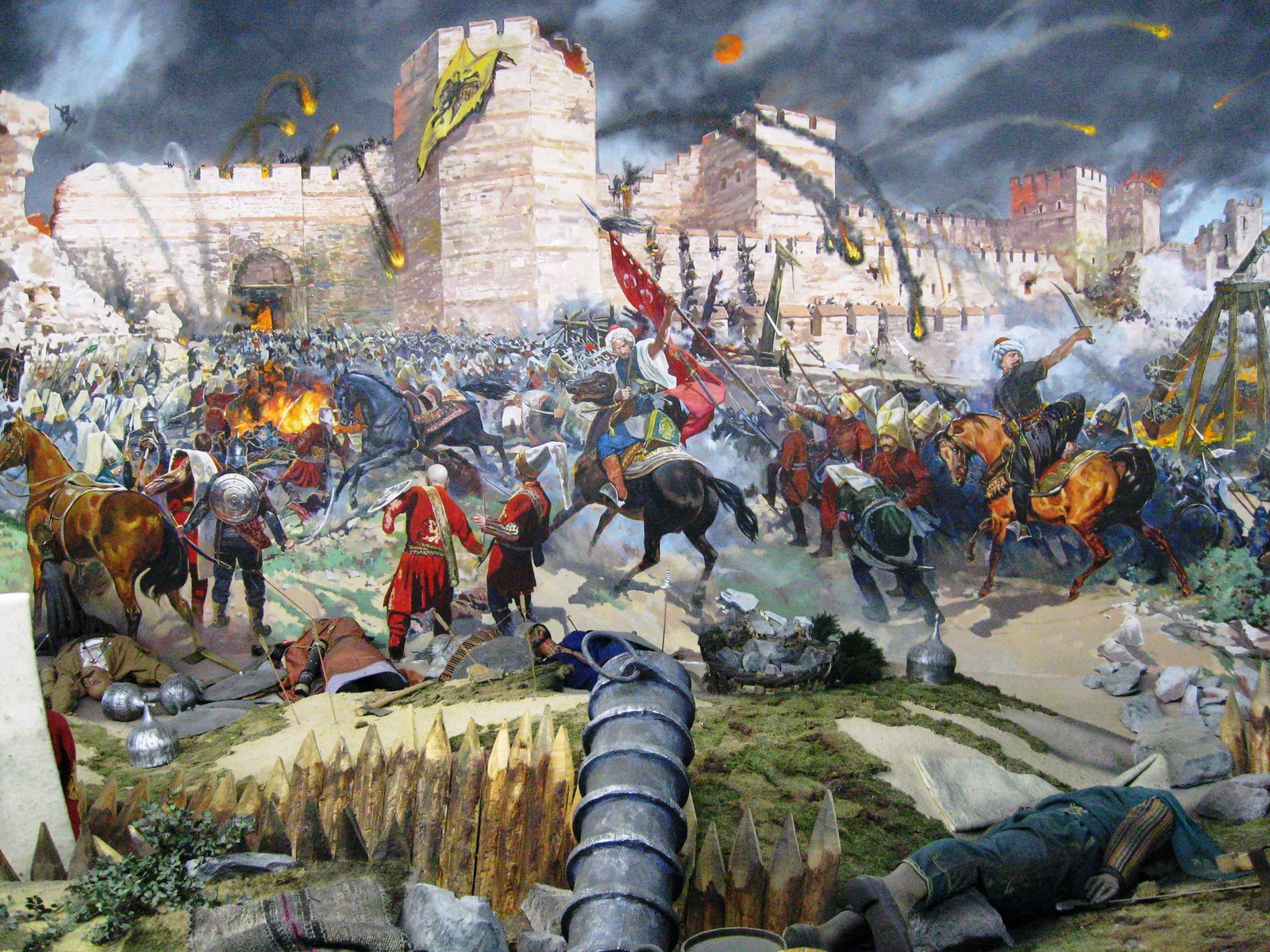
Or otherwise called the fall of Constantinople(modern day Instambul) to the army of the Ottoman sultan Mehmet fatih.
The chronicle of the inevitable end
 |
| Ottoman army marches from Edirne to Constantinople. |
At the beginning of 1453 the Sultan's army began massing on the plain of Adrianople. Troops came from every region of the Empire. Possibly well over 150.000 men, including thousands of irregulars, from many nationalities, who were attracted by the prospect of looting, were ready to assault the city. The regular troops were well equipped and well trained. The elite corps of the Janissaries composed of abducted Christian children, forcibly converted to Islam, and subsequently trained as professional soldiers, constituted the spear-head of the Ottoman army. The besieging army included a number of artillery pieces, of which one, facing the Military Gate of St Romanus, was particularly huge and was expected to cause heavy damage to the walls in that area. The army, accompanied by crowds of fanatic Dervishes, started moving slowly towards Constantinople. A few small towns, still in Greek hands, near the capital were soon occupied by the Sultan's army. Of those towns Selymvria resisted longer.
During the first week of April the Ottoman troops began taking their assigned positions in front of the city walls. The Sultan had his tent installed north of the civil Gate of St Romanus, near the river Lycus, facing the 5th Military Gate, also known as Military Gate of St Romanus. He ordered the big canon to be installed in the same area. To protect the troops, a protective trench was opened in front of the Ottoman units, the earth from it was accumulated on the city side and on top of it was erected a palissade. On the 12th arrived from Gallipoli the Ottoman fleet. Composed of approximately 200 ships of various sizes and displacements, it sealed the Byzantine capital from the sea. Mehmed's admiral was the Bulgarian renegade Suleiman Baltoghlu. On his side the Emperor distributed his troops as best as he could. It was impossible, with the available garrison, to cover the entire walled circumference of the capital, about fourteen miles long. However, it was clear to all that the main attack would be delivered by the enemy along the land-walls, about four miles long. With the exception of the Blachernae section of the walls, at the north-eastern end of the land side, the city was protected, on the land side, by a triple wall, with a deep foss in front of it. On the sea side, including the Golden Horn port area, the city was protected by a single wall.
Given the availability of troops and the critical sections of the walls, Giustiniani, with most of his men, as well as the Emperor and his best troops, took position in the Military St Romanus's Gate sector, where heavy damage was expected to be inflicted by the canon and the main Ottoman assault to be launched. The Venetian Bailo (the Head of the Venetian Community at Constantinople) Girolamo Minotto and his countrymen were charged with the defence of the region of Blachernae, where the Imperial Palace was located. Minotto and his men faced the European troops of Karadja Pasha. Across the Golden Horn, to the left of Pera, ready to intervene, stood the troops of Zaganos Pasha. Along the southern section of the land-walls the defenders faced the Anatolian troops under the command of Ishak Pasha. The Grand Duke Luke Notaras, with a reserve unit took position near the walls, at the Petra neighborhood, in the north-eastern section of the city. Another reserve unit was stationed near the church of the Holy Apostles, near the center of the city. Most units were positioned on and behind the land-walls. The sea-walls were thinly manned. To protect the entrance to the port the Venetian commander of the small fleet of the defenders, Alviso Diedo, ordered ten ships to take position behind the chain.
According to Islamic tradition the Sultan, before the beginning of hostilities, demanded the surrender of the city, promising to spare the lives of its inhabitants and respect their property. In a proud and dignified reply the Emperor rejected Mehmed's demand. Almost immediately the Ottoman guns began firing. The continuous bombardment soon brought down a section of the walls near the Gate of Charisius, north of the Emperor's position. When night fell, everyone, who was available, rushed to repair the damage. Meanwhile Ottoman troops were trying to fill the foss, particularly in areas in front of the weak sections of the walls which were now constantly bombarded. Other units began attempts to mine weak sections of the wall. On the port area a first attempt by the Ottoman fleet to test the defenders' reaction failed.
 |
| Western depiction of the siege |
Until the end of the siege the Ottoman guns did not stop pounding the walls. Heavy damage was inflicted. The defenders did their best to limit it. They hanged bales of wool, sheets of leather. Nothing could help. The section of the walls in the Lycus valley, near the Emperor's position, was heavily damaged. The foss in front of it was almost filled by the besiegers. Behind it, the defenders erected a stockade, Night after night men and women came from the city to repair the damaged sections.
The first assault was launched during the night of April 18. Thousands of men attacked the stockade and attempted to burn it down. Giustiniani, his men, and their Greek comrades fought valiantly. Well armed, protected by armor, fighting in a restricted area, they succeeded after four hours of bloody struggle to repulse the enemy.
On Friday, 20 April, in the morning, appeared in the sea of Marmora, near Constantinople, four large vessels loaded with provisions for the city. Three were Genoese and one, a big transport, was Greek. The Greek captain's name was Flantanellas. Baltoghlu dispatched immediately his fleet to attack and capture the ships. The operation seemed easy and soon the ships were surrounded by the smaller Ottoman vessels. Everyone in the city, who was not busy with the defence, rushed to the sea-walls to watch the spectacle. The Sultan on horseback, his officers and a multitude of soldiers, rushed to the shore to watch the battle. Excited and unable to restrain himself, screaming orders at Baltoghlu, the young Sultan rode into the shallow water. Fighting, the big ships continued pushing the smaller ones, and helped by the wind they were now close to the south-eastern corner of the city. Then the wind dropped and the current began pushing them towards the coast on which stood the Sultan and his troops. Fighting continued, with the Christian sailors hurling on the enemy crews stones, javelins and all sorts of projectiles, including Greek Fire. Eventually the four vessels came so close to each other that they became bound together, forming a floating castle. Around sunset the wind rose and the big ships, pushing their way through the mass, and the wrecks, of the enemy vessels, hailed by thousands of people who were standing on the walls, entered the Golden Horn. Next morning Baltoghlu was dismissed by the Sultan, who was so furious that he ordered the beheading of his admiral. The unlucky admiral was replaced by a favorite of Mehmed, Hamza Bey.
This event convinced the Sultan and his commanders that the city had to be more tightly besieged and that the naval arm of the besieged had to be neutralized. Mehmed's ingenious plan, formulated before the events of April 20, consisted in bringing part of his fleet into the Golden Horn. Indeed, thousands of laborers had been building, for some time, a road overland from the Bosphorus, alongside the walls of Pera, to a place called Valley of the Springs, on the shore of the Golden Horn, above Pera. On April 22 to the horror of the
besieged a long procession of ships, sitting on wooden platforms were pulled by teams of oxen and men, over the road, into the port area. About seventy boats entered the Golden Horn. The leaders of the defence held immediately an emergency meeting. Various plans were discussed and it was finally decided to attempt to burn the enemy boats, which were in the Golden Horn. After a succession of postponments the attempt was carried out during the night of April 28. Betrayed by someone from Pera, it failed miserably. Hit by Ottoman guns the Christian ships suffered heavy damage. About forty sailors captured by the enemy were executed.
 |
| greek fire |
Despite this failure the situation in the Golden Horn became, more or less, stable. Superior naval training, and better naval construction, eventually prevented Hamza's ships from inflicting serious damage on the allied units. However, the Sultan's idea was a military success. Indeed, in 1204 the Crusaders had assaulted the city from the sea-walls and the Greeks had not forgotten it. They feared a repetition of that assault.
On the land side the bombardment continued, more walls collapsed, and when night fell everyone rushed to close the gap, reinforce the stockades, build here and there. Moreover, food was wanting and the authorities did their best to distribute it equally. Worse, help was not coming. Everyone was watching and waiting for the sails of the Western ships to appear coming out of the Dardanelles. In early May a fast boat was sent out, to seek the allied fleet in the Aegean and tell its commanders to hurry.
During the night of May 7 a new assault was launched against the damaged section, where Giustiniani stood. It failed again and then in the night of May 12 another came and failed. It was launched at the junction of the Blachernae wall and of the old Theodosian one. During that time mining and countermining continued. Sometimes fighting went on underground. Sometimes the tunnels collapsed and suffocated the miners.
On May 23 the boat that had been sent out to locate the Christian fleet returned to the city. Its crew brought bad news. Nothing was in sight. The defenders were alone, no help was coming. The men of the crew, obeying their duty, decided to return to the doomed city. Realizing that everything was lost Constantine's chief advisors begged him to leave the city. He could still get out and seek help. His father Manuel II had done the same in 1399, at the time of the blockade of the city by Sultan Bayazid. The Emperor refused to discuss the issue. He had already decided to stay in his capital, fight for it and perish.
Meanwhile, rumors were circulating in the Ottoman camp about the Venetians finally mobilizing their fleet, or about the Hungarians preparing to cross the Danube. The siege was going on without end in sight. The Sultan's Vizier Halil Chandarli, had strong reservations about the siege from the beginning. He was worried about western intervention and he looked upon the whole operation with anxiety. During a meeting of the Sultan's advisors, held on May 25, the Vizir told Mehmed to raise the siege. Pursuing it might bring unknown consequences to Ottoman interests. The Sultan, also depressed because of the prolongation of the operation, finally decided to launch a grand scale final assault on the city. He was supported by younger commanders like Zaganos Pasha, a Christian converted to Islam. Halil was overruled and all present decided to continue the siege.
While the artillery continued pounding the walls without interruption, preparations for the big assault, which was to take place on Tuesday 29 May, were accelerated. Material was thrown into the foss which faced the collapsed ramparts, scaling-ladders were distributed. The Magistrates of Pera were warned not to give any assistance to the besieged. The Sultan swore to distribute fairly the treasures found in the city. According to tradition the troops were free to loot and sack the city for three days. He assured his troops that success was imminent, the defenders were exhausted, some sections of the walls had collapsed. It would be a general assault, throughout the line of the land-walls, as well as in the port area. Then the troops were ordered to rest and recover their strength.
In the city everyone realized that the great moment had come. During Monday, May 28, some last repairs were done on the walls and the stockades, in the collapsed sections, were reinforced. In the city, while the bells of the churches rang mournfully, citizens and soldiers joined a long procession behind the holy relics brought out of the churches. Singing hymns in Greek, Italian or Catalan, Orthodox and Catholic, men, women, children, soldiers, civilians, clergy, monks and nuns, knowing that they were going to die shortly, made peace with themselves, with God and with eternity.
When the procession ended the Emperor met with his commanders and the notables of the city. In a philosophical speech he told his subjects that the end of their time had come. In essence he told them that Man had to be ready to face death when he had to fight for his faith, for his country, for his family or for his sovereign. All four reasons were now present. Furthermore, his subjects, who were the descendants of Greeks and Romans, had to emulate their great ancestors. They had to fight and sacrifice themselves without fear. They had lived in a great city and they were now going to die defending it. As for himself, he was going to die fighting for his faith, for his city and for his people. He also thanked the Italian soldiers, who had not abandoned the great city in its final moments. He still believed that the garrison could repulse the enemy. They all had to be brave, proud warriors and do their duty. He thanked all present for their contribution to the defence of the city and asked them to forgive him, if he had ever treated them without kindness. Meanwhile the great church of Saint Sophia was crowded. Thousands of people were moving towards the church. Inside, Orthodox and Catholic priests were holding mass. People were singing hymns, others were openly crying, others were asking each other for forgiveness. Those who were not serving on the ramparts also went to the church, among them was seen, for a brief moment, the Emperor. People confessed and took communion. Then those who were going to fight rode or walked back to the ramparts.
From the great church the Emperor rode to the Palace at Blachernae. There he asked his household to forgive him. He bade the emotionally shattered men and women farewell, left his Palace and rode away, into the night, for a last inspection of the defence positions. Then he took his battle position.
The assault began after midnight, into the 29th of May 1453. Wave after wave the attackers charged. Battle cries, accompanied by the sound of drums, trumpets and fifes, filled the air. The bells of the city churches began ringing frantically. Orders, screams and the sound of trumpets shattered the night. First came the irregulars, an unreliable, multinational crowd of Christians and Moslems, who were attracted by the opportunity of enriching themselves by looting the great city, the last capital of the Roman Empire. They attacked throughout the line of fortifications and they were massacred by the tough professionals, who were fighting under the orders of Giustiniani. The battle lasted two hours and the irregulars withdrew in disorder, leaving behind an unknown number of dead and wounded.
Next came the Anatolian troops of Ishak Pasha. They tried to storm the stockades. They fought tenaciously, even desperately trying to break through the compact ranks of the defenders. The narrow area in which fighting went on helped the defenders. The could hack left and right with their maces and swords and shoot missiles onto the mass of attackers without having to aim. A group of attackers crashed through a gap and for a moment it seemed that they could enter the city. The were assaulted by the Emperor and his men and were soon slain. This second attack also failed.
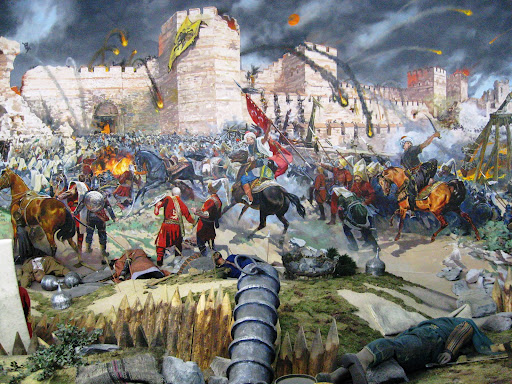 |
| The Ottoman army constituted also from Christians charges to the walls |
But now came the Janissaries, disciplined, professional, ruthless warriors, superbly trained, ready to die for their master, the Sultan. They assaulted the now exhausted defenders, they were pushing their way over bodies of dead and dying Moslem and Christian soldiers. With tremendous effort the Greek and Italian fighters were hitting back and continued repulsing the enemy. Then a group of enemy soldiers unexpectedly entered the city from a small sally-port called Kerkoporta, on the wall of Blachernae, where this wall joined the triple wall. Fighting broke near the small gate with the defenders trying to eliminate the intruders.
It was almost day now, the first light, before sunrise, when a shot fired from a calverin hit Giustiniani. The shot pierced his breastplate and he fell on the ground. Shaken by his wound and physically exhausted, his fighting spirit collapsed. Despite the pleas of the Emperor, who was fighting nearby, not to leave his post, the Genoese commander ordered his men to take him out of the battle-field. A Gate in the inner wall was opened for the group of Genoese soldiers, who were carrying their wounded commander, to come into the city. The soldiers who were fighting near the area saw the Gate open, their comrades carrying their leader crossing into the city, and they though that the defence line had been broken. They all rushed through the Gate leaving the Emperor and the Greek fighters alone between the two walls. This sudden movement did not escape the attention of the Ottoman commanders. Frantic orders were issued to the troops to concentrate their attack on the weakened position. Thousands rushed to the area. The stockade was broken. The Greeks were now squeezed by crowds of Janissaries between the stockade and the wall. More Janissaries came in and many reached the inner wall.
 |
| fictional representation of the emperor's last charge |
Meanwhile more were pouring in through the Kerkoporta, where the defenders had not been able to eliminate the first intruders. Soon the first enemy flags were seen on the walls. The Emperor and his commanders were trying frantically to rally their troops and push back the enemy. It was too late. Waves of Janissaries, followed by other regular units of the Ottoman army, were crashing throught the open Gates, mixed with fleeing and slaughtered Christian soldiers. Then the Emperor, realizing that everything was lost, removed his Imperial insignia, and followed by his cousin Theophilus Palaeologus, the Castilian Don Francisco of Toledo, and John Dalmatus, all four holding their swords, charged into the sea of the enemy soldiers, hitting left and right in a final act of defiance. They were never seen again.
Now thousands of Ottoman soldiers were pouring into the city. One after the other the city Gates were opened. The Ottoman flags began appearing on the walls, on the towers, on the Palace at Blachernae. Civilians in panic were rushing to the churches. Others locked themselves in their homes, some continued fighting in the streets, crowds of Greeks and foreigners were rushing towards the port area. The allied ships were still there and began collecting refugees. The Cretan soldiers and sailors, manning three towers near the entrance of the Golden Horn, were still fighting and had no intention of surrendering. At the end, the Ottoman commanders had to agree to a truce and let them sail away, carrying their arms.
The excesses which followed, druing the early hours of the Ottoman victory, are described in detail by eyewitnesses. They were, and unfortunately still are, a common practice, almost a ritual, among all armies capturing enemy strongholds and territory after a prolonged and violent struggle. Thus, bands of soldiers began now looting. Doors were broken, private homes were looted, their tenants were massacred. Shops in the city markets were looted. Monasteries and Convents were broken in. Their tenants were killed, nuns were raped, many, to avoid dishonor, killed themselves. Killing, raping, looting, burning, enslaving, went on and on according to tradition. The troops had to satisfy themselves. The great doors of Saint Sophia were forced open, and crowds of angry soldiers came in and fell upon the unfortunate worshippers. Pillaging and killing in the holy place went on for hours. Similar was the fate of worshippers in most churches in the city. Everything that could be taken from the splendid buildings was taken by the new masters of the Imperial capital. Icons were destroyed, precious manuscripts were lost forever. Thousands of civilians were enslaved, soldiers fought over young boys and young women. Death and enslavement did not distinguish among social classes. Nobles and peasants were treated with equal ruthlessness.
 |
| Mehmet enters in Constantinople |
In some distant neighborhoods, especially near the sea walls in the sea of Marmora, such as Psamathia, but also in the Golden Horn at Phanar and Petrion, where local fishermen opened the Gates, while the enemy soldiers were pouring into the city from the land Gates, local magistrates negotiated successfully their surrender to Hamza Bey's officers. Their act saved the lives of their fellow citizens. Furthermore their churches were not= desecrated. Meanwhile, the crews of the Ottoman fleet abandoned their ships to rush into the city. They were worried that the land army was going to take everything. The collapse of discipline gave the Christian ships time to sail out of the Golden Horn. Venetian, Genoese and Greek ships, loaded with refugees, some of them having reached the ships swimming from the city, sailed away to freedom. On one of the Genoese vessels was Giustiniani. He was taken from the boat at Chios where he died, from his wound, a few days later.
The Sultan, with his top commanders and his guard of Janissaries, entered the city in the afternoon of the first day of occupation. Constantinople was finally his and he intended to make it the capital of his mighty Empire. He toured the ruined city. He visited Saint Sophia which he ordered to be turned into a mosque. He also ordered an end to the killing. What he saw was desolation, destruction, death in the streets, ruins, desecrated churches. It was too much. It is said that, as he rode through the streets of the former capital of the Christian Roman Empire, the city of Constantine, moved to tears he murmured: "What a city we have given over to plunder and destruction".
Selected Bibliography The present narrative describing the siege and fall of Constantinople, in 1453, is based entirely on accounts written by eyewitnesses (people who were in the city during the events) as well as on modern international scholarship. In particular see:
(1)Nicolo Barbaro, "Diary of the Siege of Constantinople, 1453", translated from the Italian by J.R. Jones, an Exposition-University Book, Exposition Press, New York, 1969. The Venetian surgeon Nicolo Barbaro was present in the city throughout the siege and witnessed the events described by him in his diary.
(2) Among recent studies, the basic reference on the subject is Sir Steven Runciman's, "The Fall Constantinople, 1453", Cambridge University Press, 1969. This work, by the British Historian, a Byzantine studies scholar, is based on an exhaustive study and analysis of existing sourse material.
Additional Referecnes:
(1) Babinger, F., "Mahomet II le Conquerant et son Temps, 1432-1481", translated from the German by H.E. del Medico, Paris, 1954.
(2) Pears ,E., "The Destruction of the Greek Empire and the story of the Capture of Constantinople" by the Turks", London, 1903.
(3) Schlumberger, G., Le siege, la prise et la sac de Constantionple en 1453", Paris, 1926.
(4) Walter, G., La ruine de Byzance", Paris, 1958.